
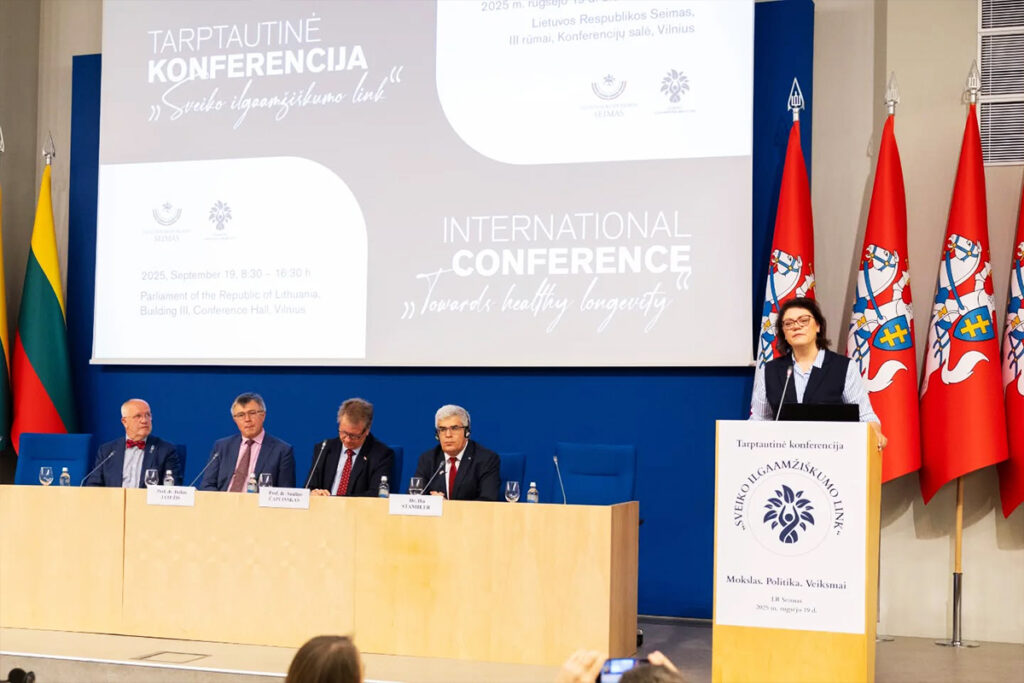
Lithuania is preparing to host what may prove to be one of the more politically ambitious longevity gatherings of the year; not because of celebrity speakers or investment fanfare, but because the country appears intent on treating healthy aging as a matter of national strategy rather than specialist interest.
Running from 8–14 June across Vilnius, Kaunas, Klaipėda, Druskininkai and Birštonas, Healthy Ageing and Longevity Assembly 2026 will bring together researchers, physicians, policymakers, diplomats and public-health advocates for a week of conferences, public events and parliamentary discussion focused on extending healthy lifespan and embedding prevention more deeply into healthcare systems. The program ranges from molecular mechanisms of aging to urban policy, from biomarkers to balneology; broad in scope, certainly, but deliberately so.
What distinguishes the Assembly from the increasingly crowded calendar of longevity events is its attempt to operate simultaneously at several levels – scientific, civic and governmental. Alongside academic conferences and clinical meetings, the Lithuanian Parliament, the Seimas, will host a high-level policy forum dedicated entirely to healthy aging and prevention policy, while public-facing events in city squares and universities seek to pull the conversation beyond clinics and conference halls.

Longevity.Technology: There is no shortage of longevity conferences on the calendar – the sector is, if anything, becoming impressively well-catered – but Lithuania’s Healthy Ageing and Longevity Assembly is interesting because it appears to be attempting something more structural than another round of panels, networking and polite applause. By placing healthy longevity inside the Seimas, across ministries and within a country-wide week of public, academic, clinical and diplomatic activity, Lithuania is positioning aging not simply as a biomedical challenge but as a matter of statecraft; a question of national resilience, economic continuity and whether governments are prepared to treat longer, healthier lives as infrastructure rather than aspiration. The proposed International Parliamentary Cooperation Initiative for Healthy Aging and Longevity will, of course, need to prove it can move beyond symbolism – parliamentary initiatives can be rather good at launching and rather less good at landing. But the signal is nonetheless important. For a field long driven by laboratories, investors and specialist clinics, the emergence of a national testbed that seeks to connect geroscience, prevention and policy is worth watching; if longevity is to become a serious public priority, it will need exactly this kind of translation from promising science into political machinery.
Demographics in the driver’s seat
The urgency behind the Assembly is not difficult to identify. Lithuania faces one of the sharper demographic transitions in Europe; by 2050, the country’s population is projected to decline by 20%, while the proportion of citizens aged over 65 is expected to exceed 30%. Healthy life expectancy also remains comparatively low – around 64 years – despite overall life expectancy approaching 76.
These are not abstract numbers buried in OECD spreadsheets. Aging populations place pressure on labor markets, healthcare expenditure and social-care systems simultaneously; governments across Europe are increasingly aware that prevention policy and healthy longevity are becoming entwined with economic resilience. Quietly, almost reluctantly, longevity has entered the policy briefcase.
The Assembly’s stated objectives reflect this broader framing. Organizers describe ambitions not merely to discuss aging biology, but to encourage “Health in All Policies” approaches, strengthen scientific and educational capacity and develop a regional healthy longevity ecosystem linking medicine, research, technology and public engagement.
From senescence to systems policy
Scientific programming across the week spans both core geroscience and clinical application. An 11 June conference at the Lithuanian Academy of Sciences in Vilnius will focus on the basic biological mechanisms of aging, featuring sessions on senescent cells, epigenetics, immunosenescence and microbiome research alongside discussions of biomarkers and clinical translation.
Speakers at this scientific anchor include Valery Krizhanovsky, Artūras Petronis, Sonata Jarmalaitė, Aurelija Žvirblienė and Michal Jazwinski, reflecting the Assembly’s unusually international composition for a Baltic state gathering. Researchers and clinicians from more than ten countries are expected to participate across the week’s events.
Elsewhere, the emphasis shifts toward implementation. A 9 June conference at the Lithuanian University of Health Sciences in Kaunas – one of the first universities globally to establish an academic course in longevity medicine – will focus on evidence-based longevity medicine and preventive healthcare practice, featuring insights on proactive healthcare from figures like Dr Tamara Pheiffer and biomarker tracking from Dr Jesper Eugen-Olsen.
Then comes the political centerpiece. On June 12, the Seimas will host the high-level policy forum Healthy Ageing and Health in All Policies – A Strategic Choice for the State, bringing together the Speaker of the Seimas alongside Lithuania’s ministers responsible for finance, education, social security, culture and health. They will be joined by international policy voices, including Sir Michael Hirst and Dr Malina Müller, to map out a shift toward treating health as a national investment.
That breadth matters. Aging policy rarely sits neatly inside one ministry; it spills into pensions, housing, workforce participation, urban planning, education and fiscal planning with alarming efficiency. Biology, alas, is interdisciplinary.
Beyond the conference hall
Not all of the week’s activity will unfold beneath chandeliers and PowerPoint decks. Public-facing events and regional gatherings branded Longevity Science in the City are planned across Vilnius, Kaunas, Druskininkai and Klaipėda to popularize healthy aging concepts and encourage community initiative. Notably, Klaipėda University will host a dedicated dialogue between science and civic practice, focusing on the “Silver Economy” and the role aging citizens play in maintaining their own independent vitality.
In Birštonas, the closing Innovation and Partnership Weekend at Eglės Sanatorija concludes the week with a specific symposium: Resort Medicine as a Prevention System: More Healthy Life Years. Featuring experts like Janka Zalešakova, Vice-President of the European Balneological Association, the weekend will examine the structural role of medical spas and rehabilitation infrastructure in long-term healthspan extension.
There is something quietly interesting in that too; longevity medicine often speaks the language of frontier biotech, yet many healthspan gains may ultimately depend on infrastructure, adherence and systems of preventive care that already exist in partial form.
For now, Lithuania’s experiment remains exactly that – an experiment. Still, in a field often preoccupied with the next molecule, the next platform or the next financing round, there is something refreshing about a country asking a rather older question: what would it actually look like to organize society around longer, healthier lives?
The Healthy Ageing and Longevity Assembly 2026, will take place on 8–14 June 2026 in Lithuania – CLICK HERE for more information and to register.