
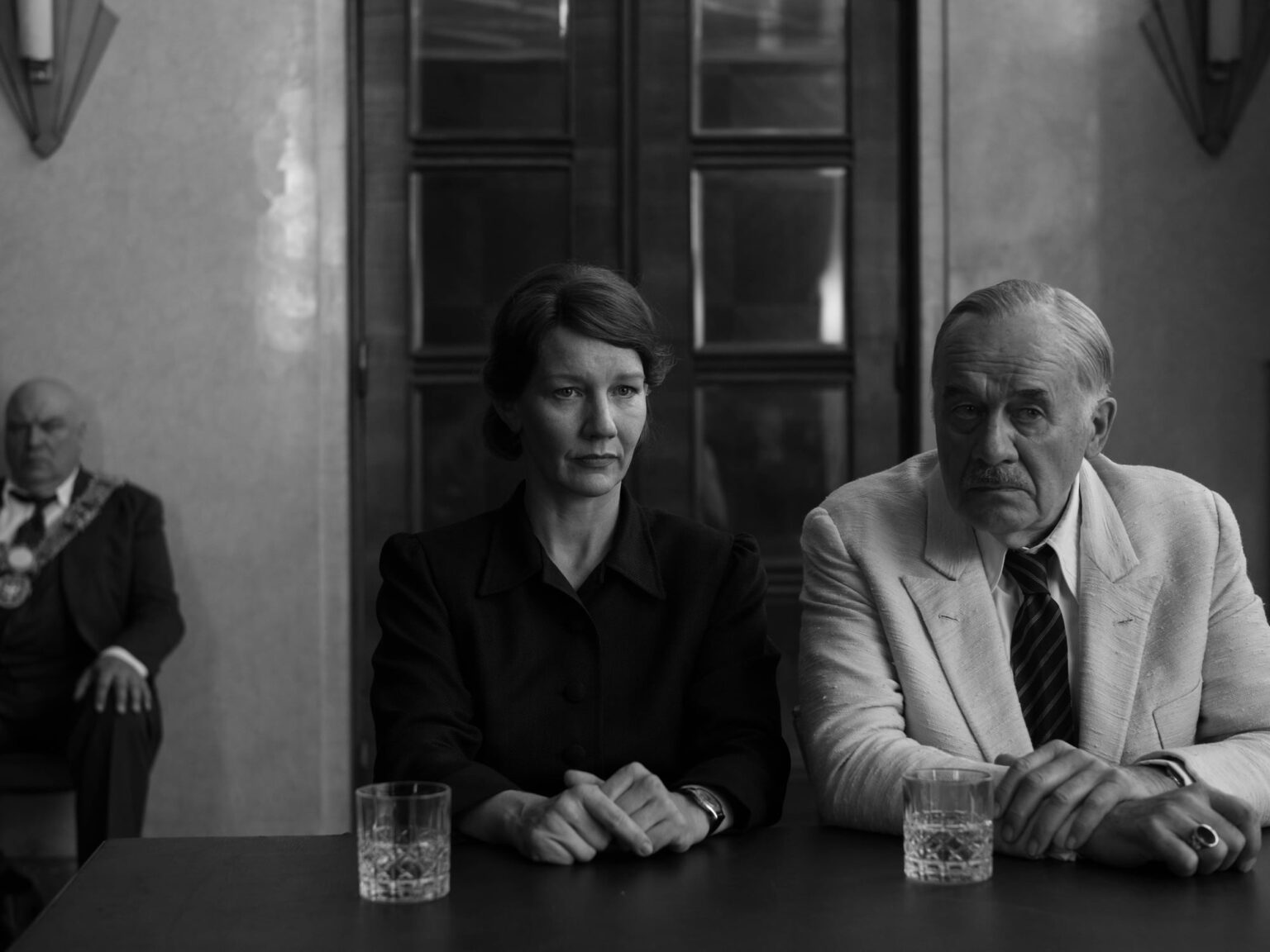
“Fatherland” seized the attention of Cannes Film Festival the moment it premiered, becoming a Palme d’Or favorite early on. Set in Germany during the Cold War, “Fatherland” follows the true story of Nobel Laureate and novelist Thomas Mann (Hanns Zischler) who goes on a road trip from West to East Germany with his daughter, Erika (Sandra Hüller). In each city, Thomas gives an inspiring speech condemning Old Germany’s faults and building hope of a better future.
The film ambitiously tackles numerous themes. Most prominently, it questions how far postwar Germany has truly moved beyond its wartime ideologies. “Fatherland” depicts several wealthy Germans who were evidently affiliated with the Nazi Party during the war and received no consequence. Mann himself is worshipped by the Germans in both East and West Germany, somewhat unanimously and forcefully. For instance, after one of Mann’s speeches, the crowd moves from applause to a united clap, as though the support is required over voluntary. Writer and director Pawel Pawlikowski’s choice here directly demonstrates Germany’s lack of progression from authoritarianism.
As may be expected from a film centered on the tragedy of postwar Germany, “Fatherland” is greatly existential. It opens with Mann’s son Klaus (August Diehl) admitting that it is impossible to care for anything after the war — not even art and literature. This absence is illustrated in the film through the decay of institutions that offer higher meaning; Pawlikowski will pair shots of broken churches with loud organ music in the background. Similarly, lively jazz plays through scenes that feature corrupt interactions. The contrast of the joyful music with the dark conversations renders any perceived joy in this period artificial.
Pawlikowski tackles these themes in a sophisticated way. “Fatherland” is undoubtedly a quintessential arthouse film — it is shot in black-and-white, the camera films in odd angles, the editing lingers on frames for a beat longer than expected — but the film never chooses style over substance. Every initially unconventional quality reveals itself to be completely founded. For example, the black-and-white filmmaking matches the nihilistic themes, and the higher contrast colors evoke the postwar geopolitical conflicts.
The film’s dialogue is dense yet economical. In this way, “Fatherland” avoids being overly expository, but perhaps swings too far in the opposite direction, marking the film’s greatest weakness: inaccessibility. Completely understanding the film requires a strong knowledge of German history, which in turn mutes much of its emotional impact. The audience will learn of a character’s death through dialogue despite the character having been introduced only once beforehand, making their death feel emotionally insignificant. The saving grace is Hüller’s performance, which carries the emotional weight of the film.
“Fatherland” reflects the irony of a Germany who unanimously venerates a progressive writer: Even though Mann’s ideas are liberal, the praise is nonetheless forced. While lacking in emotional resonance and accessibility, “Fatherland” manages to address a plethora of themes in its brief 82-minute runtime. For that ambition alone, the film is deserving of its immense acclaim.
—Staff writer Anat Goldstein can be reached at [email protected].