
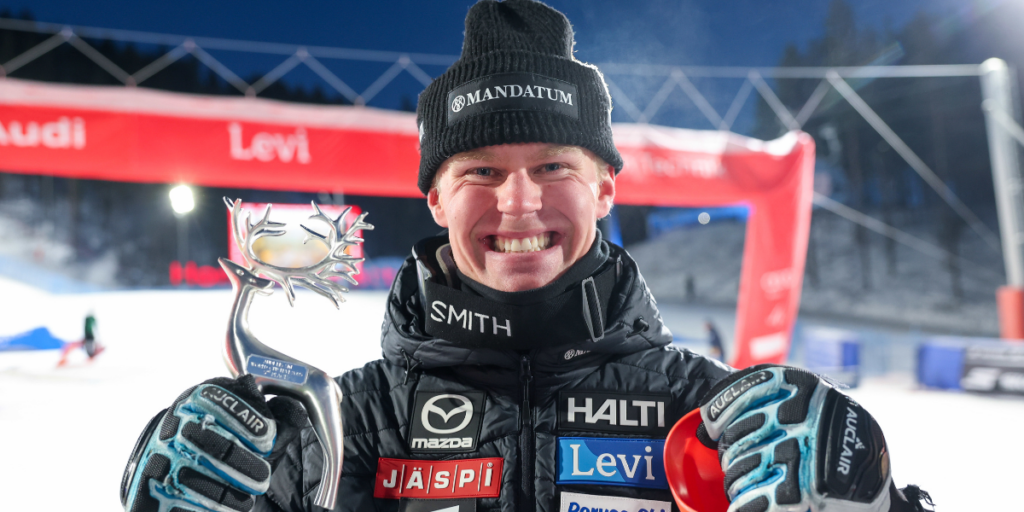
Eduard “Eddite” Hallberg / GEPA pictures
An exclusive with Eduard Hallberg after his rise into the World Cup slalom elite.
At the start of the 2025/26 World Cup season, Eduard Hallberg was viewed as one of slalom’s promising young talents.
Six months later, the 22-year-old Finn had climbed to eighth in the final World Cup slalom standings, established himself among the sport’s elite and moved closer to becoming Finland’s first men’s World Cup race winner since Kalle Palander in 2007.
Few skiers made a bigger impact on the men’s slalom season.
The skier from Sipoo, south of Helsinki opened the winter with the first World Cup podium of his career on home snow in Finland, becoming the first Finnish man ever to stand on a World Cup podium in Levi. Before Hallberg, only the 2004 women’s Levi winner Tanja Poutiainen had achieved the feat.
The results kept coming.
Hallberg led the first run of the prestigious Madonna di Campiglio night slalom in January before finishing second behind 2022 Olympic champion Clément Noël. He later closed the season with another podium at the World Cup Finals in Hafjell, Norway.
Three podiums, six finishes of eighth or better, another national title, a second World Cup Rising Star award and an Olympic Team Combined top-10 finish alongside compatriot Elian Lehto transformed Hallberg from promising prospect into a legitimate contender on the World Cup circuit.
Now, after a career-defining season, Hallberg is taking a brief pause from skiing before returning to snow in the Southern Hemisphere in August to begin preparation for another winter carrying even greater expectations.
What fueled the rise?
When asked what went well this season, Hallberg said, “I think there was improvement in every area and a lot of physical work during the summer, a lot of mental work during the summer, just preparing myself for the season, for good results, staying cool, calm and collected. I can stay calm and go with my own plan.”
Calm off the hill, aggressive on it
Hallberg is one of the calmest athletes on the World Cup tour. Inside the race course, however, he is among the most aggressive.
Discussing that balance, Hallberg said, “I always try to be as active as possible but keep relaxed and stay calm in my head to maintain a clear vision. I’m always trying to find a balance between enough space and stability. I think this is the key for slalom when it’s so tight.”
That aggressive style comes with risk.
“If you overdo it, there’s a high risk of mistakes and skiing out, and if you’re one gear off, then you’re seconds behind right away. It’s all very small margins,” Hallberg said.
A formative move to Norway
During his teenage years, Hallberg attended school in Oppdal, Norway, training within the same system that helped develop Norwegian World Cup slalom star Timon Haugan.
Looking back on his decision to move to Norway at 14, Hallberg believes it changed the direction of his career.
“It was a really important step and an important choice for me to move there. I learned so much. The culture, the people, the team and the team-building spirit — they were working smartly. The coaches are so passionate and the cooperation with the school, the ski team and everything worked well,” he said.
Before leaving Finland to pursue skiing more seriously, Hallberg remembers his father questioning whether the dream could truly become a career.
“I said, ‘I’m going to make a career by skiing,’ and he would say, ‘Take it easy, Eddie, just go to school and do your homework.’”
Chasing the top of the sport
Hallberg now believes he belongs among the world’s top slalom skiers, but he also understands how difficult the final step can be.
“I feel much more confident in my own level, so I don’t have to overdo anything,” Hallberg said. “But of course, if you want to take the next step and win races, you need to ski really fast.”
Hallberg has been viewed as a major talent for several years. He won giant slalom silver at the 2023 World Junior Championships in St. Anton, and his technical ability has long been recognized within the European circuit.
Now, after his career-defining season, the Finn is increasingly viewed as one of the strongest young slalom skiers in the sport.
New leadership for the Fearless Finns
The Finnish men’s team enters the next Olympic cycle under returning head coach Janez Slivnik, who previously led the Finnish men’s program from 2006-14.
Ski Racing Media spoke with Slivnik before his first camp back with the team in Levi in April.
“I was very impressed with Eddie’s season and it’s a big motivation to work with an athlete with this capacity, knowing that his time is really coming,” Slivnik said.
During Slivnik’s previous stint with Finland, Kalle Palander secured the nation’s most recent men’s World Cup victory.
For the past two years, Slivnik served as head coach of the Austrian men’s Europa Cup speed team before returning to Finland’s rebuilt technical program.
“Three podiums already tell you he’s somewhere close to the very top of the sport,” Slivnik said. “Results are results; they have to come by themselves. We can’t really think that Eddie has to win now. He wants to win, but the victories have to come from good skiing, hard work and taking the opportunity.”
Slivnik added that his first eight-day camp with Hallberg in Levi in April went “to plan.”
A growing Finnish generation
Throughout the World Cup season and spring camp, Hallberg trained alongside fellow Finn Jesper Pohjolainen, who scored his first World Cup points in Alta Badia in December.
Pohjolainen’s rise from the Europa Cup level into the World Cup has added further momentum to Finland’s next generation.
On the women’s side, Erika Pykäläinen scored World Cup giant slalom points and Rosa Pohjolainen — Jesper’s sister — also earned World Cup slalom points during the past season.
How close is the first World Cup win?
When asked about the possibility of a maiden World Cup victory, Hallberg did not sound far from believing it could happen soon.
“I feel like it’s pretty close,” Hallberg said. “It’s the last thing. I just have to put two runs together without any mistakes and find the exact balance between enough throttle and control. I haven’t really found that 100% yet, but I feel like it’s coming.”
He came closest in Madonna di Campiglio in January when he led the first run for the first time in his World Cup career before ultimately finishing second behind Noël.
Finnish history within reach
With a career-defining season behind him, Hallberg now has a chance to chase more Finnish history.
Next winter, the skier from Levi will attempt to become the first Finn to win a World Cup race since Poutiainen in January 2011 and the first Finnish man to win since Palander in December 2007.
Hallberg was only four years old at the time.
“I at least heard stories of when I was cheering for Poutiainen,” Hallberg said. “I was very young, so I don’t have a clear memory of watching them. After that it was Marcus Sandell and Samu Torsti and those guys that I also got inspired by, but then it didn’t have to be only Finnish racers that we could take inspiration from.”
Building consistency
Following his second full World Cup season, Hallberg believes consistency became the biggest area of improvement.
“It’s nice to see the improvement in my consistency,” he said. “Last year I really struggled with visualization and seeing myself finish the race, but this season I feel much more confident and much better mentally. I can really trust myself in races and the stability and consistency is maybe the number one thing that I wanted to improve this past season.”
Determined to succeed in two disciplines
Hallberg’s ambitions extend beyond slalom.
Although he has not yet scored World Cup giant slalom points, he qualified for his first second run in the discipline at Schladming in January.
“The goal is to get the GS up there and to have two strong disciplines. That’s something I’ve always wanted,” Hallberg said.
“I’ve never really wanted to be only a slalom specialist or a GS specialist. I want to race both slalom and GS on a high level. I’m trying not to rush anything, but step by step get the GS up there.”
Hallberg’s first three World Cup starts actually came in giant slalom.
He won World Junior Championship giant slalom silver in 2023, captured a Europa Cup giant slalom victory in Zinal, Switzerland, this past December and later added another Europa Cup podium.
Hallberg also finished inside the top 10 in the Europa Cup giant slalom standings, reinforcing the belief that he can eventually compete at the highest level in both technical disciplines.
Final thoughts
Finland clearly has a skier capable of leading the nation’s next generation in technical skiing.
Expectations around Hallberg are now significantly higher after his career-defining season, but the 22-year-old appears comfortable with that reality.
The next challenge is no longer proving he belongs on the World Cup tour.
Now, it is proving he can win on it.