
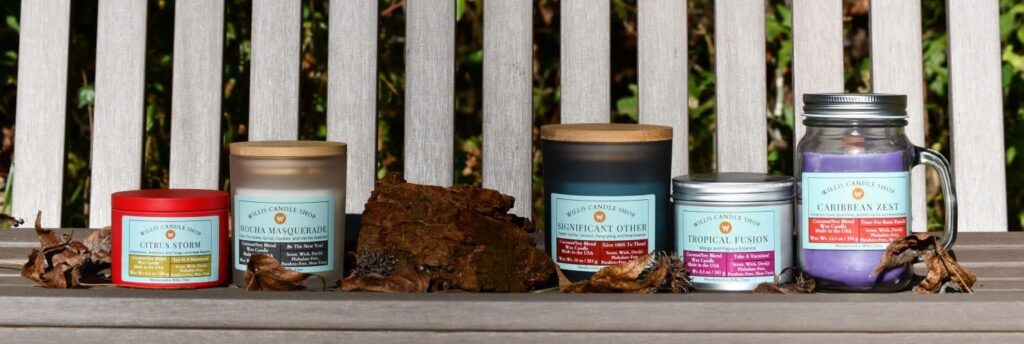
When we think about keeping our homes healthy, we focus on the obvious things, wiping down surfaces, running the vacuum, cracking a window. But one contributor to indoor air quality tends to fly completely under the radar: the candle burning on your coffee table.
Every time a flame meets a wick, a small but real chemical process begins. Depending on what that candle is made of, the byproducts entering your breathing space can range from harmless to genuinely concerning. For Rob Woloszyn, founder of Willis Candle Shop, this realization came after 30 years of public service as a U.S. Marine and retired FBI Special Agent.
Accustomed to evaluating risk with clear eyes, he found the lack of honesty in the candle industry hard to ignore, and set out to change it. This article breaks down what that honestly looks like, starting with the industry standard most brands don’t want to talk about.
Paraffin Wax: What It Is and Where It Comes From
The vast majority of candles sold today are made from paraffin wax, and most buyers have no idea what that actually means. Paraffin isn’t an agricultural product. It’s a byproduct of crude oil refining, essentially what’s left over after manufacturers have extracted gasoline, diesel, and industrial lubricants. It’s the bottom of the barrel, literally.
When paraffin burns, the combustion is often incomplete, releasing fine black soot and volatile organic compounds (VOCs), including benzene and toluene, into the air. These aren’t trace amounts you’d need a lab to detect; in enclosed rooms, they’re visible as the black film that builds up on walls and jar lids over time. For anyone spending significant time at home, that’s worth taking seriously.
Why Big Brands Still Use It
The reason paraffin dominates the market has less to do with quality and more to do with manufacturing convenience. Petroleum-based waxes behave with extreme consistency under high-speed production lines, letting large factories produce thousands of identical candles per hour.
To make these cheap bases look and feel premium on shelves, manufacturers routinely add chemical hardeners, synthetic plasticizers, and anti-shrink agents like stearic acid or microcrystalline wax. These additives smooth over the cosmetic flaws of petroleum as it cools, but they’re still synthetic compounds designed to be vaporized inside your home.
The Wick Makes a Bigger Difference Than Most People Think
Beyond the wax itself, the wick plays a meaningful role in how cleanly a candle burns. Traditional cotton wicks can curl or shift as they burn, creating an uneven flame that accelerates wax breakdown and increases soot output. Switching to a wood wick candle collection addresses this in a practical way. Wooden wicks produce a wide, horizontal flame that distributes heat more evenly across the wax surface.
This prevents the tunneling effect, where a narrow channel burns straight down the center, leaving wax clinging to the sides, and keeps combustion steady and efficient. The result is less soot, more complete wax use, and the subtle crackling sound that many people find genuinely relaxing.
The “All-Natural” Problem
On the other end of the spectrum, candles marketed as “100% essential oil scented” come with their own complications. Essential oils are concentrated plant extracts that work beautifully in cold applications, lotions, diffusers, skincare. But they aren’t built to withstand direct, sustained heat.
When essential oils burn without a stable wax carrier to help anchor the fragrance molecules, they volatilize rapidly. This “flash off” can release secondary vapors and free radicals into the air that are more irritating to the respiratory system than the original oil would suggest. The natural origin of a material doesn’t guarantee it behaves safely under heat stress, that’s a chemistry question, not a marketing one.
A Balanced Wax Formula That Actually Works
Getting around both of these problems requires deliberate formulation rather than defaulting to whatever is cheapest or most marketable. The 79/19/2 botanical blend, 79% American soy wax, 19% coconut wax, and 2% natural beeswax, is built around what each component actually does.
Soy wax provides a slow, long-burning foundation. Coconut wax lowers the melting point slightly, encouraging a full, even melt pool and a clean scent release. The 2% beeswax acts as a natural structural hardener, eliminating the need for the synthetic fillers and chemical acids that paraffin manufacturers rely on to stabilize their pours. Together, the three waxes create a stable, plant-derived base that burns cool and consistently.
Fragrance Loading: Why More Isn’t Better
Scent strength is often used as a selling point, but more fragrance oil doesn’t mean a better candle, it can mean the opposite. At an 8% fragrance load (with a controlled variance of ±0.5% based on container and wick testing), fragrance oils form a permanent bond within the wax matrix.
This prevents “oil bleeding,” where excess unbonded fragrance pools on the wax surface and burns at irregular temperatures, releasing chemical vapor spikes into the air. Precision here isn’t about being conservative with scent, it’s about ensuring the scent that is present burns cleanly and evenly from the first hour to the last.
Curing: The Step Mass Production Skips
In high-volume facilities, candles are often poured, cooled, boxed, and shipped within the same day. Time is treated as waste. But for plant-based wax blends, a 10-day curing period before distribution is genuinely functional.
It gives the fragrance molecules and the wax time to bond completely, which directly affects how the candle performs, both in cold throw (the scent you detect before lighting) and hot throw (the scent during the burn). Skipping this step results in candles that smell strong before lighting but burn weak and uneven once lit.
Transparency as a Standard
One straightforward way to evaluate any candle brand is to look at what they’re willing to put on the label. Vague terms like “fragrance” or “wax blend” aren’t accidents, they’re deliberate.
A label that lists exactly what’s in a candle, and explicitly states what isn’t (lead, parabens, phthalates, paraffin), gives buyers real information. That kind of disclosure shouldn’t be exceptional in this industry, but it largely is.
The Bottom Line
Candles are meant to make your home more comfortable, not less. Understanding what they’re made of, and what those ingredients do under heat, is a reasonable thing to ask of any product you burn indoors around your family.
The science isn’t complicated: cleaner ingredients, stable formulation, and honest labeling produce a better and safer experience. That standard should be the floor, not a premium differentiator.