
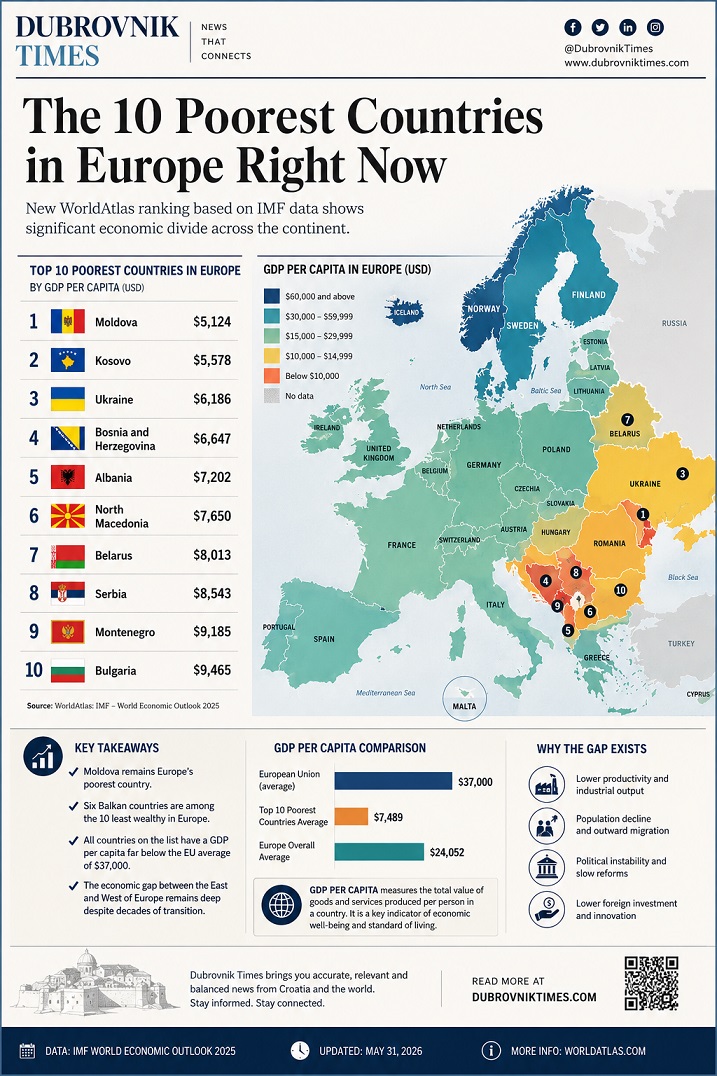
Several Balkan countries have been ranked among the poorest nations in Europe, according to a new analysis published by WorldAtlas based on International Monetary Fund (IMF) economic data.
The ranking, which uses GDP per capita figures from the IMF’s 2025 World Economic Outlook, highlights the persistent economic divide between Western and Eastern Europe despite decades of development, investment and economic transition.
According to the report, Moldova remains Europe’s poorest country, followed by Kosovo and Ukraine. Bosnia and Herzegovina ranks fourth on the list, while Albania occupies fifth place.
The remainder of the top ten is made up of North Macedonia, Belarus, Serbia, Montenegro and Bulgaria.
Economic Gap Remains Significant
The rankings are based on gross domestic product (GDP) per capita, a commonly used indicator that measures the average economic output per person. The figures show that these countries continue to lag significantly behind the European Union average in terms of economic performance and living standards.
While many countries in Central and Eastern Europe have experienced steady growth since joining the European Union or pursuing economic reforms, the data suggests that considerable disparities remain across the continent.
Balkans Highly Represented
The report underlines the challenges still facing parts of Southeast Europe, with six Balkan nations appearing in the top ten.
Kosovo was ranked as Europe’s second poorest country, while Bosnia and Herzegovina, Albania and North Macedonia all placed within the top six. Serbia and Montenegro also featured on the list.
Economists often point to factors such as lower productivity, population decline, outward migration, political instability and slower investment growth as contributing factors behind lower GDP per capita levels in the region.
Signs of Progress Despite Challenges
Although the rankings paint a challenging picture, many of the countries listed have recorded economic growth in recent years and continue to attract foreign investment, particularly in sectors such as tourism, manufacturing, information technology and renewable energy.
Analysts note that GDP per capita figures do not always reflect broader measures of quality of life, infrastructure improvements or social development, but they remain an important benchmark when comparing economic performance between countries.
As Europe continues to face economic uncertainty, inflationary pressures and geopolitical tensions, narrowing the development gap between regions remains a key challenge for policymakers across the continent.
@dubrovnik_times One of those true summer days in Dubrovnik #adriatic #dubrovnik #traveltiktok ♬ FEEL THE GROOVE – Queens Road, Fabian Graetz