
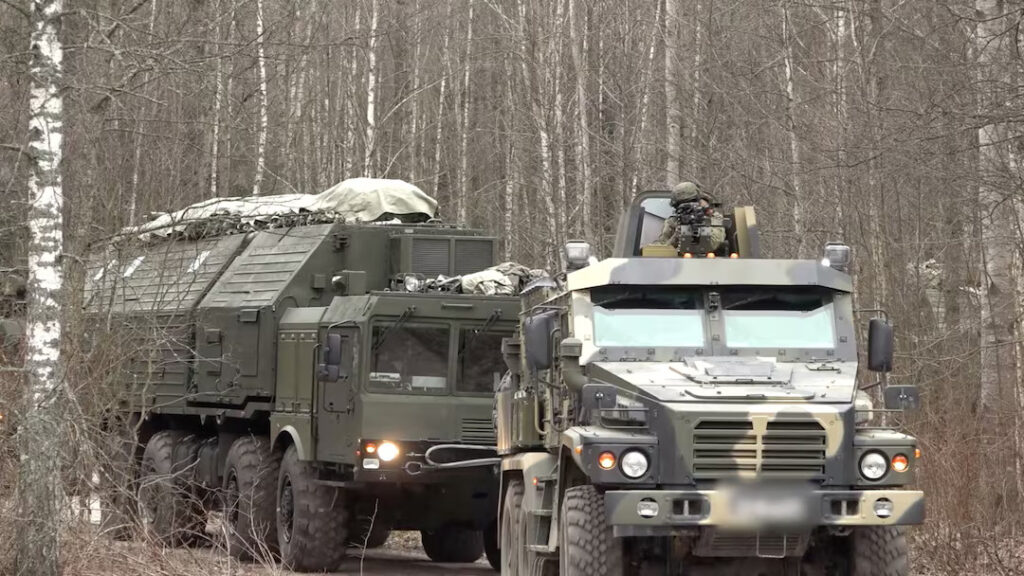
On the night of May 23-24, Russian forces launched a devastating coordinated strike against military targets in Ukraine, deploying a formidable combination of Oreshnik, Iskander, Kinzhal, and Zircon hypersonic cruise missiles alongside a swarm of assault drones.
In Kyiv, authorities reported that the barrage killed four people, injured a hundred others, and caused extensive damage to civilian infrastructure in Bila Tserkva—historically known during the Soviet era as Belaya Tserkov.
The massive aerial assault was an apparent retaliation for a Ukrainian strike on a college dormitory in Russia-occupied Luhansk province. According to Moscow authorities, that earlier attack killed 21 students and injured 42. Russian President Vladimir Putin had vowed retribution and called for “proposals” from his armed forces to avenge the attack.
Moscow flatly denied targeting civilians, maintaining that the operation was aimed strictly at military infrastructure. However, Russian outrage over the dormitory strike was evident in their choice of weaponry. While the deployment of Iskander, Kinzhal, and Zircon missiles has become a routine feature of the conflict, it was the introduction of the Oreshnik missile that sparked deep concern and dominated discussions across Ukraine and among its NATO allies.
Oreshnik: Equal to a meteorite
The Oreshnik remains unique within its weapon class, commanding global military interest and stoking deep apprehension among Western policymakers. In what was only its third operational deployment by Russia, the missile demonstrated why it is frequently compared to a nuclear weapon in terms of raw destructive power.
Capable of evading conventional radar detection, the hypersonic missile offers air defence networks a negligible response window, leaving Western and Ukrainian forces with virtually no time to execute an interception.
The first time the world became aware of the missile was in late 2024, almost 17 months before it struck Belaya Tserkov.
By deploying a missile equipped with multiple independently targetable reentry vehicles (MIRVs) for the first time in military history, the operation marked a significant technological threshold in modern warfare, drawing comparisons to the mid-20th century arrival of strategic ballistic missile systems.
Extensive damage inflicted
A series of thunderous bolts from the sky hit the Yuzhmash military production complex at Dnipro, resulting in massive explosions. The extent of the damage caused was not revealed by Ukraine for obvious reasons, but was estimated to have been extensive. Analysts calculated that a complex—spanning roughly one square mile, with facilities built deep underground during Soviet times—was rendered largely non-functional.
Such was the impact that the usually vocal Kyiv authorities remained silent for many days even as Russia preened over what it saw as the new missile’s fearsome destructive potential.
Coming days after a fearsome strike on the energy grid of Ukraine, which crippled the war-torn country, the strike by the new missile, christened Oreshnik by Putin, had what he described as the equivalent force of a meteorite.
Rewriting war doctrine
Russia, which unleashed the attack by its its latest, and until then unknown Oreshnik missile, understandably touted its achievement.
Oreshnik (meaning ‘hazel’ in Russian, a tree that produces nuts packed with vitamin A) may force many militaries to rewrite their war doctrine. It is a system that consists of a rocket vehicle, or ‘bus’, that carries separating warheads to the higher levels of the atmosphere, much like an intercontinental ballistic missile (ICBM).
Each of the MIRVs carries six submunitions consisting of solid metal rods. Analysts speculate they are made of dense, ultra-hard material such as tungsten, or alloys such as tungsten-titanium, or perhaps even more dense metals like osmium or rhenium, that bear down on their target, and at impact, reduce the object of their wrath to nothing.
This is because, at the time of impact, they unleash energy equivalent to close to 80 American Mark 84 (MK-84) bombs used in Vietnam. This means roughly four-fifths of a kiloton. For comparison, the ‘Little Boy’ atomic bomb that destroyed Hiroshima was 15 kilotons.
The missile is an intermediate-range ballistic missile (IRBM) whose range would have been restricted under the Intermediate-Range Nuclear Forces (INF) Treaty between the US and Russia, signed during the Soviet days, which the US withdrew from during the first Trump term. In fact, Moscow informed Washington of its intention to use the missile in advance, confirming that the missile was not carrying a nuclear warhead to prevent accidental escalation.
Mixed reactions
Western defence analysts responded with mixed reactions. Some scoffed at the scientific feasibility of a missile maintaining terminal speeds of Mach 10–11. They said any object entering the dense lower atmosphere would encounter extreme atmospheric resistance and thermal friction, causing it to lose velocity or disintegrate before impact.
Others doubted if the missile’s MIRVs had been accurate since, at the speed claimed, the projectiles would be covered in a plasma cloud that could prevent guidance signals from reaching them, to aim them at their intended targets. The ‘before’ images of the Yuzhmash complex are available freely on the internet, but Ukraine, which claimed that there was no critical damage to the complex, has not released the ‘after’ photographs, so it is not easy to assess the devastation wrought.
But that reluctance raises the speculation that the impact the 36 projectiles wrought could have put the facility out of service for a prolonged period.
The Russian avenger
Taking that into account, the Oreshnik, although it is nuclear-capable, is meant to penetrate and destroy strong, multi-layered concrete defence structures, including those underground, housing critical military production facilities, missile silos, or military headquarters.
The Russians have been using the Oreshnik sparingly, mostly as an avenger, to pay back for strikes on their civilian facilities, or as a warning signal to Kyiv’s Western backers whenever there is a move in Western capitals to send long-range strike missiles, like the German Taurus KEPD 350, or equip the Ukrainian army with the latest Western tanks.
In January 2026, after EU leaders pledged increased military assistance to Ukraine, Russia used the Oreshnik for a second time, near Lviv in western Ukraine, striking an aviation repair plant and an underground gas storage facility at Bilche-Volytsko-Uherske.