
Germany has long been recognized as Europe’s engineering powerhouse. From automobiles and manufacturing equipment to advanced industrial systems, the country has built a reputation for technological excellence and innovation.
Now, a new wave of transformation is taking shape across the German economy—one driven by service robotics.
Unlike industrial robots that operate behind safety barriers in manufacturing plants, service robots are designed to assist people directly in everyday environments. They clean offices, support surgeries, deliver packages, assist elderly patients, and perform countless other tasks that improve productivity and quality of life.
As artificial intelligence becomes more sophisticated and labor shortages continue to challenge industries, service robots are rapidly moving from futuristic concepts to practical business solutions.
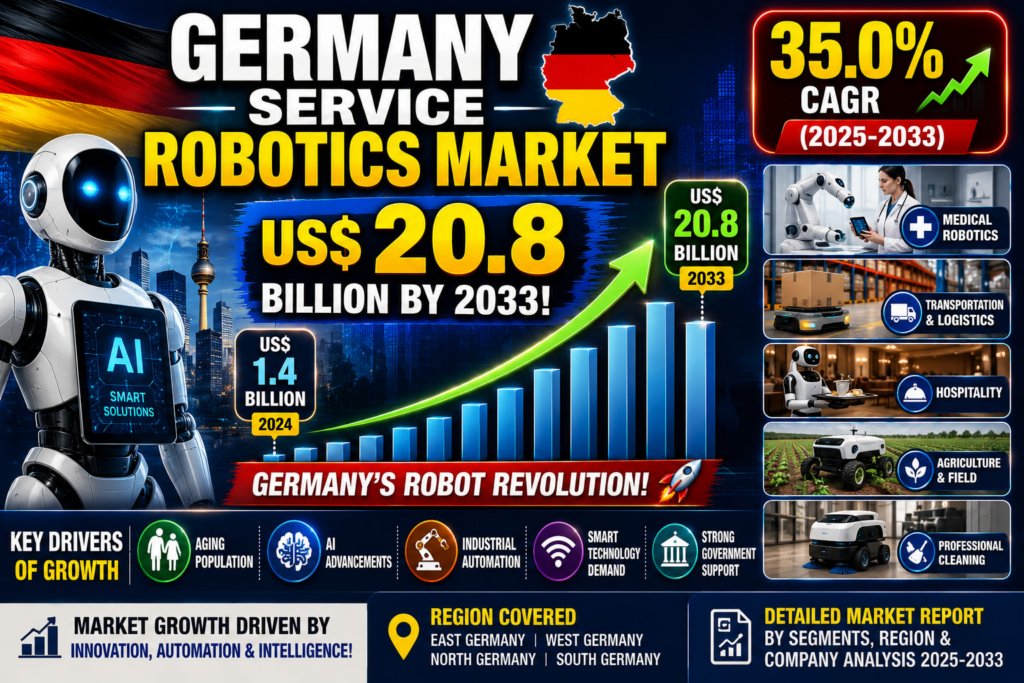
According to Renub Research, the Germany Service Robotics Market is expected to expand from US$ 1.4 billion in 2024 to US$ 20.8 billion by 2033, representing an extraordinary compound annual growth rate (CAGR) of 35.00% between 2025 and 2033. This remarkable growth highlights Germany’s position as one of the most promising service robotics markets in Europe.
As businesses, healthcare providers, and consumers increasingly embrace intelligent automation, service robotics is becoming a key pillar of Germany’s digital future.
 What Are Service Robots?
Service robots are autonomous or semi-autonomous machines designed to perform useful tasks for humans outside traditional industrial manufacturing environments.
Unlike factory robots that primarily focus on repetitive production tasks, service robots operate in dynamic settings where they often interact directly with people.
Common applications include:
- Healthcare assistance
- Elderly care support
- Hospital logistics
- Professional cleaning
- Hospitality services
- Agriculture
- Delivery and transportation
- Smart home assistance
- Security and surveillance
These robots rely heavily on advanced technologies such as artificial intelligence, machine learning, sensors, computer vision, and cloud connectivity to function effectively. Their ability to adapt to changing environments makes them highly valuable across multiple sectors.
As technology continues to evolve, service robots are becoming smarter, more reliable, and increasingly capable of handling complex real-world tasks.
Why Germany Is Emerging as a Robotics Leader
Several factors have combined to create ideal conditions for service robotics growth in Germany.
The country possesses:
- A strong engineering tradition
- Advanced manufacturing capabilities
- World-class research institutions
- Robust digital infrastructure
- Government support for innovation
- A rapidly aging population
These advantages have enabled Germany to become one of Europe’s most attractive markets for robotics development and deployment.
Unlike many countries where robotics adoption remains concentrated in manufacturing, Germany is witnessing increasing implementation across healthcare, logistics, hospitality, agriculture, and residential environments.
This diversification is helping accelerate market growth and expand the industry’s long-term potential.
An Aging Population Is Creating Urgent Demand
One of the strongest drivers behind Germany’s service robotics market is demographic change.
Germany has one of Europe’s oldest populations, and the number of elderly citizens continues to grow. While increased life expectancy represents a positive achievement, it also creates significant challenges for healthcare systems and caregiving services.
Healthcare providers are already facing staffing shortages, rising patient volumes, and increasing pressure to deliver high-quality care efficiently.
Service robots offer practical solutions.
In healthcare settings, robots can assist with:
- Patient monitoring
- Medication delivery
- Mobility support
- Hospital logistics
- Rehabilitation programs
- Administrative tasks
These technologies help healthcare professionals focus on patient care while reducing workload pressures.
Elderly care applications are particularly important because many seniors wish to maintain independence while remaining in their homes for as long as possible.
Robotic assistance systems can help make that goal more achievable.
Artificial Intelligence Is Unlocking New Possibilities
Artificial intelligence is one of the most transformative forces shaping the service robotics industry.
Earlier generations of robots were often limited to predefined actions and controlled environments. Modern service robots, however, are increasingly capable of learning, adapting, and making decisions in real time.
AI-powered robots can:
- Analyze large amounts of data
- Recognize objects and people
- Navigate unfamiliar environments
- Understand voice commands
- Respond to changing situations
- Improve performance through machine learning
These capabilities dramatically expand the range of tasks robots can perform effectively.
In Germany, where precision, efficiency, and technological sophistication are highly valued, AI integration is accelerating adoption across multiple sectors.
The combination of robotics and artificial intelligence is creating systems that are not only automated but genuinely intelligent.
Industrial Automation Is Supporting Market Expansion
Germany’s globally renowned manufacturing sector is also contributing significantly to service robotics growth.
As companies embrace Industry 4.0 principles, they increasingly seek technologies that improve flexibility, efficiency, and operational performance.
Collaborative robots, often called cobots, are becoming particularly important.
Unlike traditional industrial robots, cobots are designed to work alongside human employees, assisting with repetitive or physically demanding tasks while enhancing workplace safety and productivity.
Service robotics solutions are increasingly integrated into:
- Automotive manufacturing
- Electronics production
- Warehousing operations
- Logistics centers
- Distribution facilities
The result is a more connected and intelligent industrial ecosystem where humans and robots work together to achieve better outcomes.
Government Support Is Accelerating Innovation
One of Germany’s greatest competitive advantages is its strong government commitment to technological innovation.
Public investment has become a major catalyst for service robotics development.
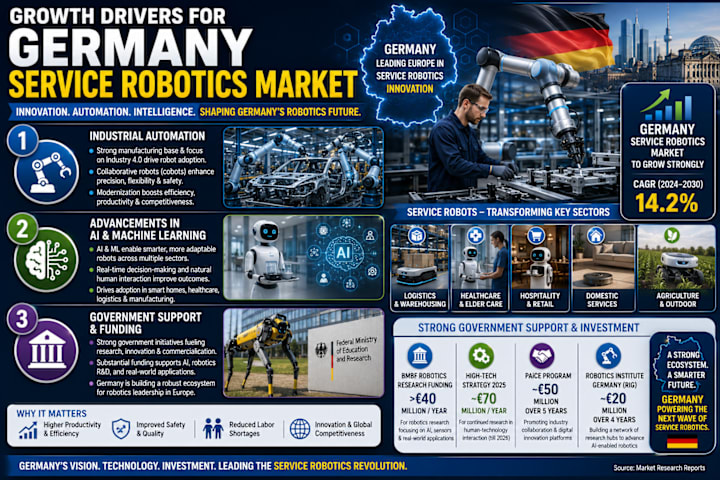
According to the report, Germany’s Federal Ministry of Education and Research invests more than €40 million annually in robotics research focused on advanced sensors, AI-controlled systems, healthcare applications, and rescue operations.
Additional initiatives include:
High-Tech Strategy 2025
This program allocates approximately €70 million annually to support human-technology interaction research and innovation.
PAiCE Program
With funding totaling approximately €50 million over five years, PAiCE promotes digital industry platforms and collaboration between technology companies.
Robotics Institute Germany (RIG)
The RIG initiative provides up to €20 million over four years to strengthen robotics research networks and accelerate AI integration into robotic systems.
These investments are helping Germany establish itself as a leading European hub for robotics innovation.
Logistics and Transportation Are Becoming Major Growth Areas
The rapid expansion of e-commerce and supply chain modernization is creating strong demand for logistics-focused service robots.
Warehouses and fulfillment centers increasingly rely on robotic systems to:
- Move inventory
- Sort products
- Manage storage
- Support order fulfillment
- Improve delivery efficiency
These technologies help businesses address labor shortages while improving speed and accuracy.
As consumer expectations for faster deliveries continue to rise, logistics operators are investing heavily in automation solutions that can enhance operational performance.
This trend is expected to remain one of the market’s strongest growth drivers throughout the forecast period.
Medical Robotics Is Revolutionizing Healthcare
Among all service robotics segments, medical robotics stands out as one of the most promising.
Germany’s healthcare sector is increasingly adopting robotic technologies to improve patient outcomes and operational efficiency.
Medical robots are now used for:
- Minimally invasive surgery
- Diagnostic support
- Rehabilitation therapy
- Hospital logistics
- Patient assistance
Robotic surgery systems, in particular, offer greater precision and control during complex procedures.
As healthcare providers seek ways to improve care quality while managing costs, medical robotics adoption is expected to continue accelerating.
Recent Industry Developments Highlight Momentum
The German service robotics market continues attracting significant investment and strategic partnerships.
Several noteworthy developments include:
ABB Expansion
In September 2023, ABB strengthened its presence in Germany by acquiring a controlling stake in a robotics company specializing in automation solutions for small and medium-sized businesses.
Yaskawa and SoftBank Robotics Collaboration
In August 2023, Yaskawa and SoftBank Robotics announced a partnership focused on developing advanced humanoid robots for service-sector applications.
These initiatives demonstrate growing confidence in the long-term potential of Germany’s robotics ecosystem.
Challenges Still Facing the Industry
Despite impressive growth prospects, several challenges remain.
High Initial Costs
The development, deployment, and customization of advanced service robots often require substantial investment.
Many small and medium-sized enterprises may struggle to justify these upfront costs, particularly when return-on-investment timelines remain uncertain.
Additional expenses related to maintenance, employee training, and infrastructure upgrades can further increase financial barriers.
Cybersecurity Risks
As robots become increasingly connected through cloud systems and Internet of Things (IoT) platforms, cybersecurity concerns are growing.
Potential risks include:
- Data breaches
- Privacy violations
- Operational disruptions
- Unauthorized system access
These concerns are particularly important in sectors such as healthcare and logistics, where robots often process sensitive information.
Ensuring robust cybersecurity protections will be critical for maintaining public trust and encouraging wider adoption.
The Future of Service Robotics in Germany
The next decade is likely to be transformative for Germany’s service robotics industry.
Future growth will be fueled by:
- Continued AI advancements
- Expanding healthcare applications
- Smart home adoption
- Autonomous logistics systems
- Aging population needs
Increased public and private investment
As robots become more intelligent, affordable, and user-friendly, their role in everyday life is expected to expand significantly.
Industries that once viewed robotics as an experimental technology are increasingly recognizing it as a practical business necessity.
Final Thoughts
Germany’s service robotics industry is entering a period of extraordinary growth.
Driven by demographic shifts, technological innovation, industrial modernization, and strong government support, the market is rapidly evolving from an emerging sector into a major pillar of the country’s digital economy.
With the market projected to expand from US$ 1.4 billion in 2024 to US$ 20.8 billion by 2033, Germany is positioning itself at the forefront of Europe’s service robotics revolution.
While challenges related to costs and cybersecurity remain, continued investment in artificial intelligence, automation, and robotics research is creating a strong foundation for long-term success.
For businesses, healthcare providers, investors, and consumers alike, service robotics is no longer a glimpse into the future—it is becoming an increasingly important part of daily life in Germany.