It is becoming increasingly clear that the approach to monetisation differs significantly between companies, depending on four key pillars: monetisation, control of the technology chain, visibility into demand, and quality of spending.
By Raphael Thüin
Although they are usually grouped under the same investment theme linked to artificial intelligence, the hyperscalers are developing very different business models. Beyond the aggregate CAPEX figures, companies such as Microsoft, Alphabet, Amazon and Meta are not allocating capital to the same objectives, nor are they monetising AI at the same pace, nor are they building the same competitive advantages.
Currently, what matters is not so much the absolute magnitude of spending as the quality of that spending: whether it translates into greater visibility on demand, greater control over the technology chain and, ultimately, a clearer path to transforming infrastructure investments into revenue generation. In this context, it is worth reviewing the business models and investment theses of the major hyperscalers.
It is becoming increasingly clear that the path to monetisation differs significantly between companies. Microsoft is integrating AI into enterprise software; Google monetises a vertically integrated chain; Amazon positions Amazon Web Services as a neutral infrastructure layer for external developers; and Meta uses AI primarily to strengthen its own platforms and advertising business, rather than to market cloud infrastructure directly.
The sector can be approached through four key pillars: monetisation, control of the technology chain, visibility into demand and quality of spend.
Google appears well-positioned in artificial intelligence thanks to a high degree of vertical integration across chips, models and distribution, in both consumer and enterprise products. Its infrastructure advantage is also beginning to become more visible from a commercial perspective, as it increasingly monetises parts of its stack beyond internal use.
The main risk does not lie in an abrupt disruption of the Search business, but in a gradual shift in the way information is accessed. As AI Overviews and AI Mode reduce reliance on traditional “blue links”, the economics of the search business could become less attractive over time due to lower click-through rates and weaker monetisation of traffic.
Even so, there is currently no clear evidence of a loss of market share and Search revenue continues to grow, suggesting that the risk stems more from a long-term economic transition than from immediate disruption.
Microsoft
Microsoft’s AI investment thesis rests primarily on its distribution capabilities through Copilot, Azure and its software ecosystem, enabling it to integrate artificial intelligence directly into large-scale enterprise workflows. Its partnership with OpenAI gave it an early advantage, whilst Azure Foundry and a more open, multi-model approach help reduce reliance on a single vendor.
At the same time, the market remains uncertain on several fronts, including the durability of the relationship with OpenAI, the actual impact on Azure and the software business, the lack of leading LLM models and chips developed in-house, and the still mixed reception of Copilot.
The main risk is software disintermediation. If enterprise workflows evolve from tools such as Excel or Microsoft 365 towards autonomous agents powered by third-party models, software could become more of a backend utility and part of the value chain could shift outside the Microsoft ecosystem.
Microsoft maintains a strong commercial position, although it also faces one of the most significant strategic dilemmas within artificial intelligence.
Amazon
Amazon’s strategy in artificial intelligence is based on flexibility, scale and cost efficiency. Through AWS, the group provides the infrastructure, models and tools necessary to develop AI and non-AI applications, whilst its proprietary chips, such as Graviton and Trainium, improve the price-performance ratio.
This sets Amazon apart from other competitors more focused on capturing user attention or defending software flows, as its value proposition relies primarily on a broad offering, competitive pricing and operational efficiency.
The main risk lies in the e-commerce business. In the long term, AI agents could reduce the relevance of Amazon’s retail interface, weakening the direct relationship with the customer and putting pressure on the advertising business. For the time being, this is a more structural than immediate risk.
Meta
Meta stands out for an AI strategy focused primarily on strengthening its own platforms, increasing engagement and improving advertising efficiency, rather than on selling infrastructure to third parties. Its monetisation route is therefore less direct, although the strategic relevance remains significant.
The main risk lies in the high level of investment in infrastructure and the increase in capital intensity, particularly in the absence of a significant public cloud business to absorb some of these costs.
The strategy is coherent, though particularly demanding from a capital allocation perspective.
Overall, hyperscalers remain one of the most relevant ways to gain exposure to the artificial intelligence investment theme, given their visibility on demand, pricing power and ability to generate sufficient cash flows to finance their investments.
However, they should no longer be considered interchangeable exposures within the same sector. As business models diverge, artificial intelligence is increasingly becoming a story of stock-picking, determined by each company’s monetisation capacity and risk profile.
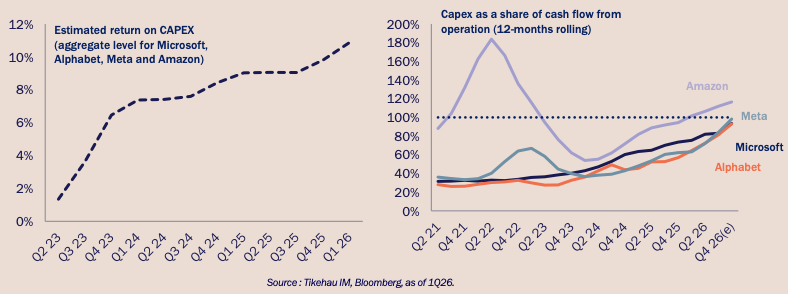
The monetisation prospects for hyperscalers appear to be developing positively
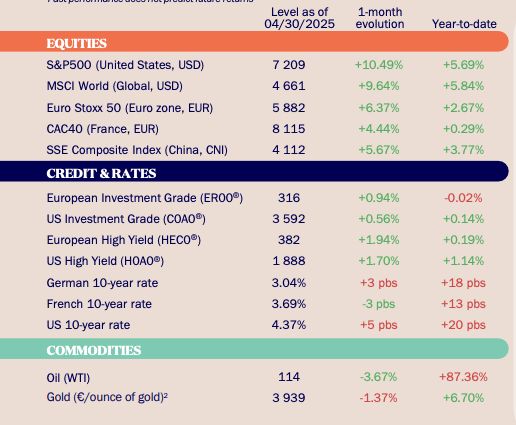
Equities performed strongly throughout April, supported by favourable macroeconomic data that particularly boosted the main US and European indices. The S&P 500 recorded its best month since November 2020, whilst the Euro Stoxx 50 also posted significant gains.
However, the market remained closely focused on inflation trends and the geopolitical context. Rising oil prices and growing expectations of a prolonged international conflict triggered a fresh spike in sovereign bond yields, particularly in the US and Germany.
At the same time, credit markets continued to show resilience despite the environment of geopolitical uncertainty, whilstoil prices remained at high levels due to tensions surrounding Iran and the Strait of Hormuz, which continue to fuel supply concerns.
Against this backdrop, CAPEX spending by hyperscalers remains robust and the returns on these investments continue to perform well.