
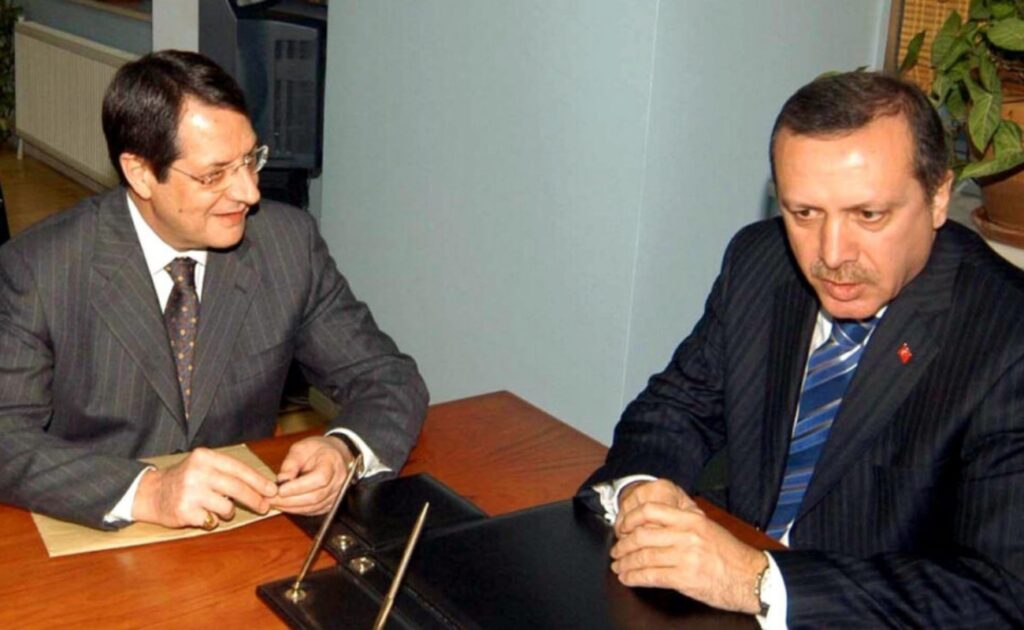
NICOSIA – Prospects for a Cyprus solution have never been dimmer than they are today, with the stance of Turkish President Recep Tayyip Erdoğan continuing to harden, accompanied by actions seemingly intended to secure permanent partition, not reunification .
It was not always that way with Erdogan, as is illustrated by a recent interview by former President of the Republic of Cyprus Nicos Anastasiades.
“In 2004, Turkey had a clear European orientation. In fact, in 2005, after the referendum [on the UN’s Annan Plan], I received as President of DISY an invitation from Erdogan for a meeting,” recalls Anastasiades in an interview on the ‘Legalisms’ podcast of the Cyprus Times with Marinos Nomikos.
Anastasiades then went to Ankara and discussed with Erdogan, who at that time was Prime Minister of Turkey, the results of research conducted regarding the reasons for the Greek Cypriot electorate’s rejection of the Annan Plan. Among them were the issues of security and guarantees, the functionality of the state, and the risk of collapse.
After presenting the information to Erdogan, the latter asked him to go back to Cyprus and tell Tassos Papadopoulos to start the dialogue with [Turkish Cypriot leader Mehmet Ali] Talat. Erdogan and Prime Minister of Greece Kostas Karamanlis would come to drink the “coffee of peace,” as Anastasiades said, citing the words of Erdogan.
“At that time, Erdogan was determined and oriented towards Europe. In fact, one of the AKP vice-chairmen had told me “please when you meet, convince him to join the European People’s Party,” because he had an invitation and had applied. When I saw him I told him “you know, in order for the European orientation to succeed or to accelerate Turkey’s accession to the European Union, it would be good to join one of the major political powers of the European Union.” Instead of observer status, he wanted an upgraded role that at the time the statute of the European People’s Party did not allow for states that were not members of the Union. He would come five or six times to the European People’s Party meetings, we had the opportunity to talk, we had the opportunity to see how ‘the negatives’ were finally improving. The conditions were completely different then.”
The former President then explained that he revised the stance he had taken in the referendum when he saw Turkey hardening its stance. When Erdogan started to distance himself from the European Union, he started to express revisionist policies, when the peace between Turkey and Greece began to be threatened and when Turkish Cypriot leader Mustafa Akinci started to backtrack on essential issues.
He attributed Akinci’s stance to blackmail and threats. For example, he said that “before our move to Crans Montana, in January [2017] in Geneva, territorial maps were submitted for the first time. For the first time in the history of the Cyprus problem, the Turkish side submitted specific maps, which gave us hope. Our difference was just 0.5% of the territorial area. After the time he (Akinci) submitted them, he had not been received by Erdogan again. Only on June 4, that is, after six months, when we were going to go to New York to meet with the Secretary General to plan the Crans Montana summit” did they meet again. The summit held in July 2017 collapsed.