
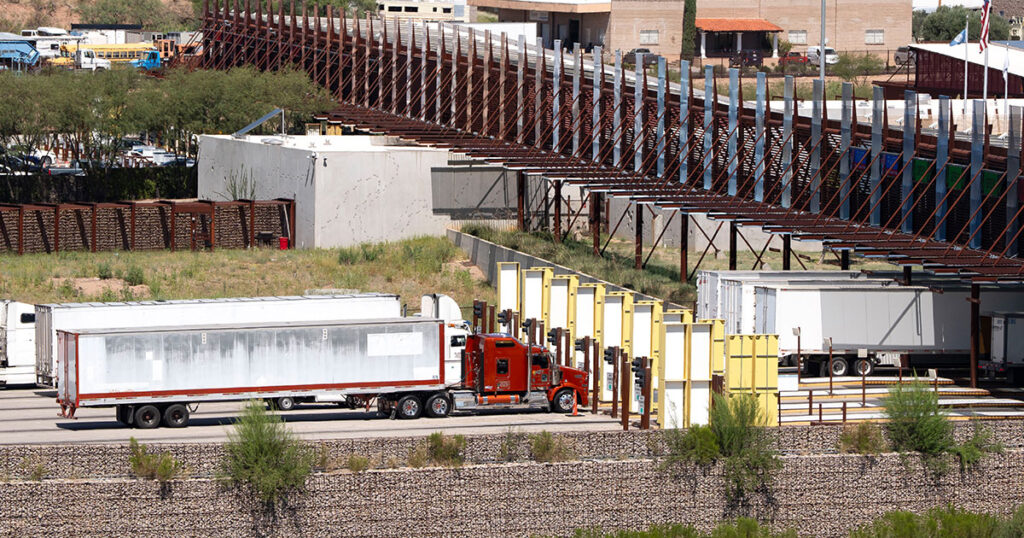
Trucks enter the U.S. from Mexico at the Nogales-Mariposa port of entry in Nogales, Ariz., on July 30, 2025. (Rebecca Noble/Bloomberg)
June 1, 2026 5:00 PM, EDT

- Nearshoring is continuing to reshape U.S. supply chains in 2026 even though tariffs and geopolitical risks complicate cross-border moves, executives said.
- Mexico — the United States’ top trading partner as of 2023 — holds 16.3% of U.S. trade in 2026, and experts said the shift from ocean to truck lanes is straining border hubs.
- Shippers are adapting with border transloading, consolidated exports and more compliance-focused capacity.
Nearshoring has further evolved supply chains this year even as tariffs and geopolitical risks have complicated the process.
The practice involves companies moving offshore operations closer to end consumers. The U.S. has seen increased interest in nearshoring since the COVID pandemic, evidenced by Mexico displacing China as the country’s top overall trading partner in early 2023. Census Bureau data continues to hold the southern neighbor in the top spot with 16.3% of all trade so far in 2026.
“Nearshoring continues to be a long-term structural shift, but the operating environment around it has become significantly more complex over the last year,” said Zeid Houssami, senior vice president overseeing cross-border business at Uber Freight. “We’re seeing strong demand across major cross-border hubs like Laredo [in Texas].”
Houssami added that this demand is happening even as shippers navigate rising fuel costs, evolving tariff policies, tighter driver availability and new enforcement dynamics around cross-border freight movements. They are also becoming more committed to regionalizing supply chains and rethinking day-to-day operations.
“More shippers are exploring transloading strategies at the border, consolidating shipments inside Mexico before export and looking for ways to create more flexibility,” Houssami said. “At the same time, we’re seeing capacity become more concentrated in high-compliance, operationally disciplined networks.”
He added that this has increased the importance of visibility, local expertise and strong carrier relationships in a way that wasn’t as critical a few years ago. The companies that will navigate this environment best, he noted, are the ones treating cross-border transportation as a strategic part of supply chain planning rather than just a transactional move.
“U.S. imports from China are declining, while those from Mexico are rising,” said John Lash, group vice president of product strategy at E2open. “You find it’s mainly tactical sourcing of goods from alternative manufacturers already set up in Mexico.”
Lash added there is strategic nearshoring through initiatives to move manufacturing from Asia to Mexico. The byproduct is a major shift in global commerce from ocean to land lanes, he noted, that are mostly operated by trucks.
“This puts pressure on infrastructure at border-crossing hubs, such as Laredo, and on major Mexico-U.S. corridors,” Lash said. “As someone living in Austin, I can attest to the visible increase in truck volume on [Interstate 35].”
Infios warned May 19 that tariffs are no longer a predictable cost-line item for businesses in its report analyzing U.S. customs entries in 2025. The supply chain software company found that shipment values increased about 78% from the prior year, while entry counts fell about 7%. The report noted that this indicates consolidated and smarter shipping instead of a retreat from trade.
“The clearest takeaway is that transportation strategy has become inseparable from tariff strategy,” said Don Mabry, senior vice president of global trade at Infios. “What stands out in the data is that transportation decisions are no longer being made primarily around freight cost or transit time in isolation.”
Mabry added that these decisions are being increasingly tied to tariff exposure, policy risk and preserving flexibility. The report also noted that a rise in truck freight reflected sustained nearshoring and demand for more stable and shorter supply chains.
“Trucking has been one of the clearest beneficiaries of nearshoring and tariff-driven network redesign,” Mabry said. “Trucking increasingly functions as a strategic resilience lever by enabling faster inventory repositioning, shorter supply chains and greater response flexibility.”
Mabry added that shorter supply chains offer trucking several advantages in a tariff-heavy environment, including reduced exposure to long ocean transit during policy uncertainty, more predictable transit windows and the ability to move inventory faster as conditions shift.
“Brands are increasingly shipping inventory into regional fulfillment hubs and moving warehouses closer to the end customer, especially in Europe and Canada,” said Fabrizio Alvear, co-president at ePost Global. “The goal is to reduce tariff exposure and avoid unnecessary duties, taxes and transportation costs tied to cross-border movement.”
Alvear noted that many global brands have historically shipped products into the United States to fulfill orders and distribute internationally from warehouses. But ongoing tariff volatility, increased duties and other new costs have made that model more expensive, which he has seen push companies to favor cheaper business-to-business clearance models at the border.

TT Top 100 Logistics Companies
The largest 3PLs in North America continued to face volatile business conditions last year, from compressed margins to tariff-driven supply chain upheaval. Read more
“As more companies move inventory directly into regional markets instead of routing everything through the United States, there’s less freight moving through traditional U.S. transportation networks,” Alvear said. “That means fewer container pickups at ports, fewer trucking movements to domestic fulfillment centers and fewer export shipments.”
Alvear added that rising fuel prices are accelerating this trend as well. He sees companies eliminating unnecessary transportation legs where possible, resulting in a shift in how trucking freight volume is concentrated and how goods move.
“When we think about shifts in freight volumes to Mexico, this hasn’t just been since tariffs of 2018,” said Matt Muenster, chief economist at Breakthrough. “It goes back much further than that.”
Muenster views nearshoring as a longer-term trend primarily driven by the financial crisis of 2008. He has seen this lead to growth in the North American manufacturing base that has promoted freight moves along cross-border corridors. Muenster doesn’t expect the tariffs or geopolitical disruptions of the past year to stop that trend.
“There could be some reservation of significant investment until clear line of sight to what a reworked USMCA agreement looks like,” Muenster said. “But in terms of the longer-term trend for nearshoring, we still see that happening.”
Muenster added that the underlying economic motivation for companies is still there, including longer-term uncertainty around trade with China and East Asian nations.
“It’s had a profound impact in certain corridors,” Muenster said. “You basically pick any of the top five border crossings with our southern border in Mexico, and freight volumes have changed tremendously over the last decade but continue to grow as of late.”
Source Logistics in its Supply Chain Outlook Report on May 20 identified nearshoring and trade growth-driven geographic restructuring as the defining shifts reshaping warehousing, transportation and fulfillment. It found supply chains are becoming more regionalized and resilience-driven, resulting in infrastructure near key trade corridors becoming strategically more important.
“The biggest takeaway is that North American supply chains are undergoing a long-term restructuring, not just a temporary reaction to tariffs or short-term economic conditions,” Source Logistics CEO Raul Villarreal said. “Companies are increasingly redesigning their logistics networks around resiliency, proximity and cross-border flexibility.”
Mexico was shown in the report to be playing a much larger role in manufacturing and distribution strategies. It highlighted that companies are prioritizing service reliability and operational continuity over simply chasing the lowest cost.
“Over the last several years, disruptions ranging from tariffs to port congestion and geopolitical instability exposed the risks of overly optimized, low-cost global supply chains,” Villarreal said. “As a result, businesses are now placing greater value on predictable transit times, inventory visibility, regional redundancy and dependable capacity.”
Villarreal noted that there has been growing demand for capacity positioned near key cross-border and regional distribution corridors as companies shift manufacturing and sourcing closer to the U.S. market.
“This has increased the importance of facilities that can support transloading, overflow storage, inventory buffering and faster replenishment cycles tied to Mexico-U.S. trade flows,” Villarreal said. “It has also elevated demand for warehouse operators that can manage complexity.”