
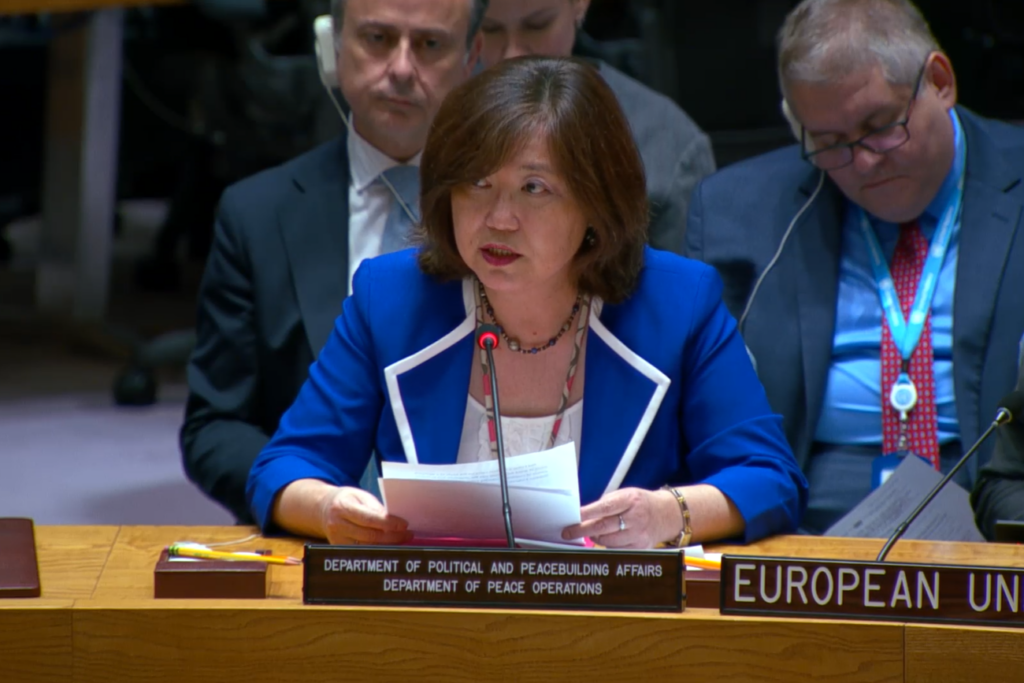
Madam President,
Excellencies,
Only last week, the Secretary-General alerted this Council to the serious risk of further escalation of the war in Ukraine, including to the broader region.
Last Friday, a dangerous incident crystallized our oft-stated warnings about potential spillover of the war.
On the night of 28 to 29 May, an armed drone exploded on the top floor of a ten-story residential building in the eastern Romanian city of Galaţi, injuring two residents, a woman and a child.
This was not the first reported breach of Romanian airspace by an armed drone since Russia’s full-scale invasion of Ukraine.
However, it was the first time such an incident resulted in casualties.
The United Nations does not have any additional information on the strike in Galaţi.
But Friday’s incident came on the heels of a worrying trend of drone incursions into the airspaces and territorial waters of countries bordering either Ukraine or the Russian Federation.
Over the past 12 months, such incidents have been reported by the authorities in Moldova, Latvia, Lithuania, Estonia, Finland, Poland, Kazakhstan, and Belarus, as well as in countries in the wider region – Bulgaria, Greece and Türkiye.
Madam President,
The United Nations strongly condemns all attacks on civilians and civilian infrastructure.
Such attacks, wherever they occur, violate international humanitarian law and must cease immediately. Civilians must be protected at all times.
Madam President,
The Galaţi incident comes amidst a sharp escalation of large-scale missile and drone attacks by the armed forces of the Russian Federation on Ukrainian towns and cities, resulting in ever worsening toll of civilian casualties and destruction of civilian infrastructure.
There has also been a marked increase in Ukrainian attacks on military, energy and industrial infrastructure in the Russian Federation, which have reportedly resulted in a growing number of civilian casualties and damage to civilian infrastructure.
As the Secretary-General stressed last week, the dangerous trajectory of escalation and intensification that we are witnessing today, risks getting out of control.
The current course must change.
Madam President,
The risk of miscalculation is particularly dangerous for the safety of nuclear facilities.
Such risk has only increased in recent days.
On 30 May, the International Atomic Energy Agency (IAEA) was informed by the Zaporizhzhia Nuclear Power Plant that a drone struck a turbine building at the site, reportedly causing a hole in its wall. This was the first such attack within the Plant’s perimeter since April 2024.
Yesterday, the IAEA team at the site observed damage to the exterior of a turbine building, noting that it appeared consistent with the impact of a drone.
We echo the deep concern expressed by the IAEA Director-General over this serious incident that endangered key nuclear safety principles.
Attacks on nuclear sites are reckless and unacceptable. They must stop immediately to prevent any risk of a nuclear accident.
Madam President,
Amidst heightened tensions, it is incumbent on all concerned to act responsibly and to refrain from any action that could destabilize the situation further.
As the Secretary-General emphasized last week, we urgently need immediate steps towards de-escalation, leading to a full and unconditional ceasefire.
To that end, we urge dialogue and negotiations to resume at once.
Diplomacy needs to be given a meaningful chance to create conditions for achieving peace in Ukraine.
A peace that is just, lasting and comprehensive – in line with the Charter of the United Nations, international law, and relevant UN resolutions.
A peace that contributes to a more stable regional and international environment.
The United Nations will continue to fully support all meaningful efforts to that end.
Thank you.