

As part of our Language of Soccer World Cup series, The Athletic is speaking to supporters of all 48 nations competing at the 2026 edition to capture their unique football culture, distilled into a single phrase. You can read the articles in one place here.
Nad nama nebo ima da gori – Above us the sky will burn
Bosnia and Herzegovina have qualified for their second World Cup. For a nation of little more than three million people which gained independence just three decades ago, it is an impressive achievement. They are, however, just as notable for their presence off the pitch as on it.
“Most people in the U.S. don’t know Bosnia,” explains national team fan Amila Sirco, who works in a travel agency which previously helped with logistics for the Bosnia and Herzegovina team, including planning for this World Cup.
“We are so emotional because of our history, our identity, trying to define ourselves. You don’t support Bosnia because it is easy or successful. You support it because it is yours.”
Bosnia is about passion, intensity, commitment, and belonging. This manifests itself through fandom for the national team. ‘Above us the sky will burn’: if you are in Bosnia, you know the national team are playing because of the noise and colour from above the stadium.
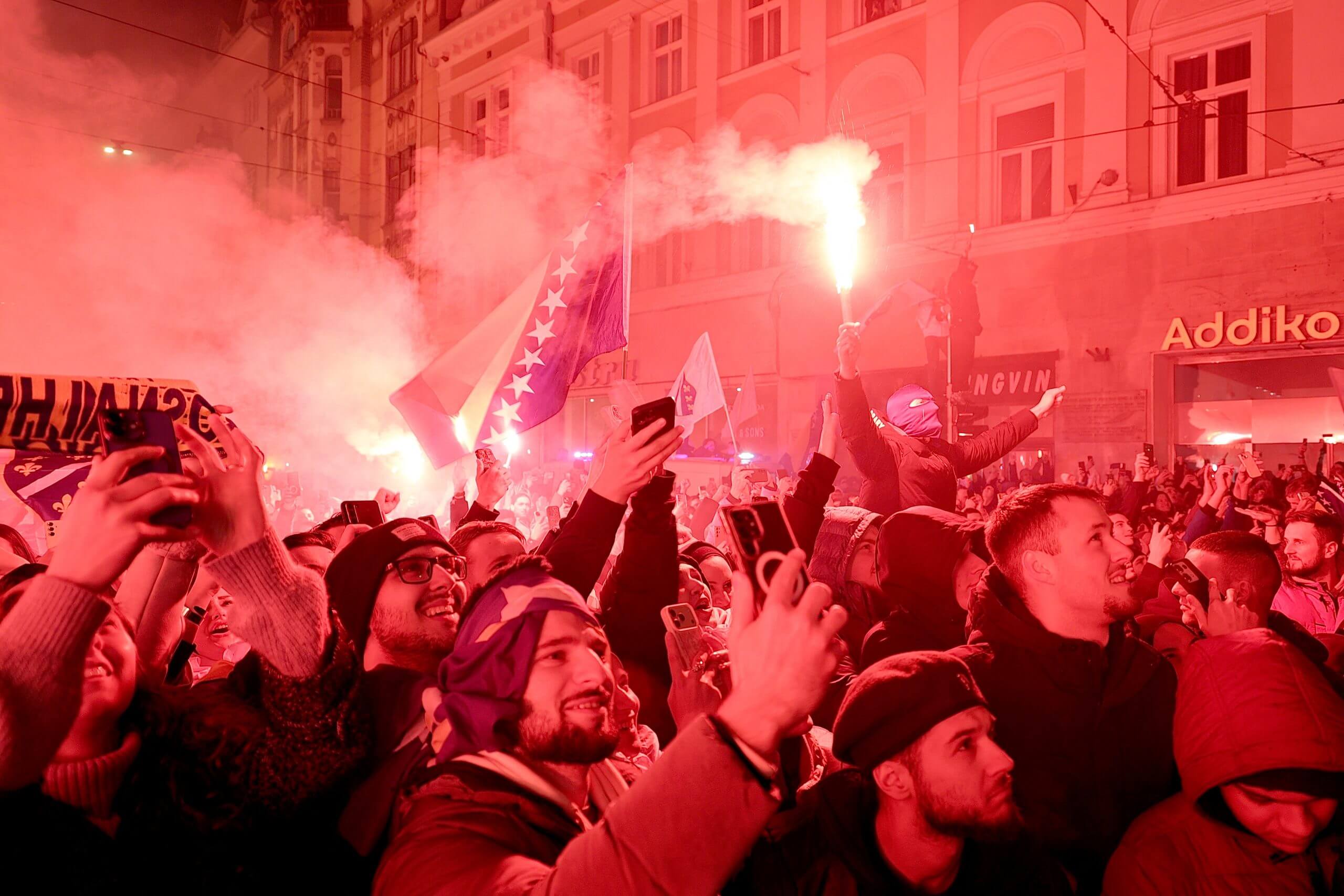
Bosnia and Herzegovina fans celebrate their team beating Italy to reach the World Cup (AFP via Getty Images)
The Bosnian War — an ethnically-rooted conflict between Bosniaks, ethnic Serbs and ethnic Croats, lasted from 1992 to 1995, with an estimated 100,000 deaths — led to a global Bosnian diaspora, numbering in the millions. “The diaspora is a huge part of our identity,” Sirco explains. “You will find Bosnia fans everywhere — sometimes in bigger numbers abroad than at home.”
Around 350,000 of them are in the U.S.. This includes Esmir Bajraktarevic: born in Wisconsin, he made one senior appearance for the USMNT, before declaring for Bosnia in 2024. Bajraktarevic’s family were originally from the Bosnian town of Srebrenica, and the PSV winger is now one of the nation’s star players. Bosnia’s squad, and fanbase, reflects this diversity.
“You can’t cut our ties to our homeland,” says Ika Ferrer Gotic, a broadcast news journalist in Bosnia. “We have survived war, division and hardship. Our national team became our proof that Bosnia still breathes, dreams, and fights. Football is like therapy here, it gives us hope and it is our national glue.”
Semir Mustafic, who works for Bosnia’s TV N1, said World Cup qualification “helps erase everyday problems” for people across the nation. “Bosnia celebrated together. Supporting the team is about defiance, pride, and the fight to exist and be recognised.”
Bosnia’s largest fan group is the BHFanaticos, which since 2000 has followed the national team around the world in football, basketball and handball. “We are about bringing intense passion, flares, noise, and the electric atmosphere when Bosnian fans come together,” explains group member Kemal.

Bosnia and Herzegovina fans light flares during a World Cup qualifier (Raigo Pajula/AFP via Getty Images)
Reflecting the diaspora, the BHFanaticos have multiple members based in North America. Erva, a U.S.-based member of the fan group, says Bosnia’s unexpected qualification for the tournament has generated excitement in the community. “We will see an invasion of Bosnians for every match,” he explains. “Between Canada and the U.S., there are around 400,000 people of Bosnian descent.”
Despite the geographical distance to their homeland, Erva adds that the fanaticism among the diaspora is second to none. “Supporting our country is a way of defending our values and highlighting the pride of being Bosnian. It is loving your country regardless of ethnic or religious background.”
Another member of the group, Benjo, agrees that the Bosnian presence at the tournament will be significant. “Many people underestimate Bosnia due to its size, but fans consistently show up in huge numbers abroad,” he explains. “We are known for our intense pyro atmosphere, non-stop chanting, and strong loyalty.”
“This World Cup is going to be filled with blue and yellow shirts,” adds Mustafic, highlighting the passion for the sport across the community. Gotic says fandom for Bosnia goes beyond a sporting attachment. “Supporting the country is carrying the nation’s sole in your chest, like a heartbeat.”
Bosnia remains a nation in which identity can be complex. A 2013 census recorded 50 per cent of the population as Bosniak — a South Slavic ethnic group native to the Bosnian region, who are predominantly of Sunni Islam faith — with 30 per cent Bosnian Serbs, primarily of Orthodox religion using the Cyrillic script, and 15 per cent Bosnian Croats, predominantly Catholic.
The country comprises two autonomous entities — the Federation of Bosnia and Herzegovina and Republika Srpska (Serb Republic) — and the Brcko District, which is ruled by its own local government. These come under a federal government and rotating presidency. The Republika Srpska, with a 1.2million population, has its own government and institutions but is not sovereign and is subject to the overall authority of the Bosnian state.
The difference in religion, language, culture and scripts highlights the diversity of a nation which has a complex power-sharing agreement among three constituent peoples. Bosnia has a distinctive collective presidency arrangement, where the state-level head of state is a three-member presidency (one Bosniak, one Croat, one Serb), with the chairing of it rotating every eight months.
“Part of our population does not support Bosnia, and instead identifies either with neighbouring Serbia or Croatia,” explains Mustafic. BHFanaticos member Erva adds: “There are people of Serbian or Croatian descent that do support our national team, but many do not. They do not care for the recent success we have had. It is an unfortunate reality.”
These divisions are not insignificant, but football in Bosnia both internationally and at club level functions within this context. Bosnia’s head coach Sergej Barbarez, who previously captained the team, is from a family background of different cultures, languages and religions. “My mother is from a marriage between a Croat and a Bosniak, and my father was a Serb,” Barbarez explained to telegraf.rs earlier this year. “Religion and nationality never played a major role in my family.”
Mustafic adds: “Bosnia’s national team is multi-ethnic. It has shown that unity brings more success than division.”
Croatia are also at this year’s World Cup. “They are definitely our biggest rival,” Gotic explains. “But honestly, I wish Serbia were at this World Cup too. We could be there for each other; our nations are brothers and sisters. This is our time now, war is over.
“We are passionate because football is one of the few things that can truly unite us,” Gotic concludes. “This passion was born from survival. Our fire is love, not anger.”
Whatever Bosnia achieve on the pitch this summer, its fanbase will bring the colour, noise and atmosphere off it. Above us the sky will burn.
The Language of Soccer series is sponsored by Google.
The Athletic maintains full editorial independence. Sponsors have no control over or input into the reporting or editing process and do not review stories before publication.