
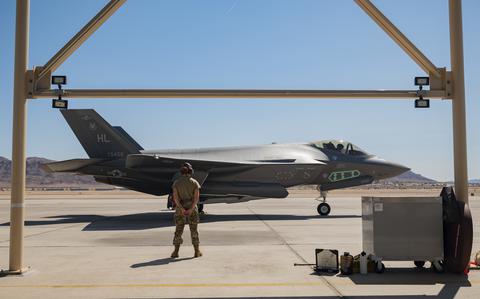
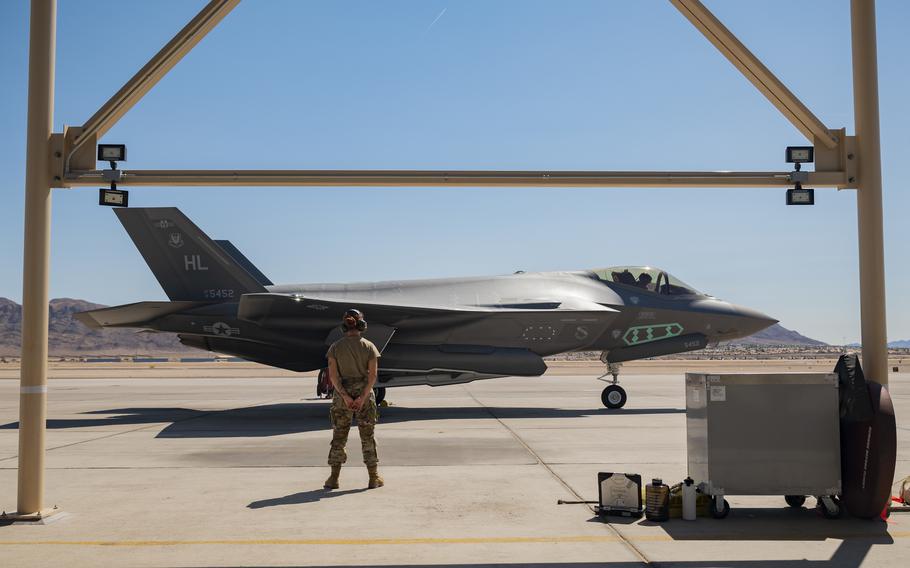
An Air Force crew chief watches a pilot do preflight checks on an F-35A Lightning II at Nellis Air Force Base, Nev., on Sept. 21, 2021, during a nuclear design certification test for the refurbished B61-12 gravity bomb. The U.S. is reportedly in talks to expand the number of European countries that host American nuclear bombs, a posture shift that relies on dual-capable aircraft like the F-35A, now certified to carry the upgraded B61-12. (Zachary Rufus/U.S. Air Force)
The United States is reviewing whether to deploy nuclear weapons to more European countries, according to a news report Tuesday.
Citing three people briefed on the discussions, the Financial Times said U.S. officials have indicated interest in expanding deployments beyond the six locations that are currently part of NATO’s nuclear-sharing initiative.
It’s unclear how far the reported conversations have progressed. The talks are “highly confidential and may not lead to any changes in nuclear-sharing arrangements,” the report said.
Two of the people quoted by the newspaper said the discussions were meant to demonstrate continued U.S. commitment to providing Europe a nuclear umbrella, even as Washington pushes allies to take on a greater share of the burden for the Continent’s conventional defense.
The discussions included NATO channels — with allies closest to Russia’s border, including Poland and some Baltic states — showing particular interest in hosting U.S. nuclear weapons, the report said.
If the U.S. were to shift some nuclear weapons to Poland, it could alleviate some concerns along NATO’s eastern flank about U.S. security guarantees.
Those concerns have intensified, given plans to reduce the amount of conventional support the Pentagon intends to make available to Europe in the event of a future crisis.
Since the early days of the Cold War, the United States has kept nuclear weapons at various locations in Europe. Under NATO’s nuclear-sharing program, allied fighter pilots would deliver tactical nuclear bombs if a conventional conflict turned into an atomic one.
The arrangement is designed to deter Russia while ensuring that responsibility for NATO’s strike mission is shared across the alliance.
The U.S. does not publicly discuss where its tactical bombs are stored in Europe, but watchdog groups have reported that roughly 100 of those weapons are stored at six bases in five NATO member countries: Belgium, Germany, Italy, the Netherlands and Turkey.
A NATO document inadvertently released and then deleted in 2019 listed the same locations.
In recent years, there have been calls in the alliance to add other countries to the nuclear mix. Poland has publicly stated that it would welcome being incorporated into the nuclear program.
The conservative Heritage Foundation, in a 2023 report, also called for shifting some nuclear bombs to Poland from current positions in western Europe.
NATO’s eastward enlargement following the collapse of the Soviet Union means that allied fighter planes carrying nuclear gravity bombs would have farther to travel to reach enemy targets, the think tank said.
“If such distances require a fighter bomber to conduct an aerial refueling before reaching a target, both the fighter bomber and the refueler could be vulnerable to enemy long-range air defenses,” the report said.
Any push to extend NATO’s nuclear range eastward would likely cause consternation in Russia, which has lashed out at such proposals in the past.