
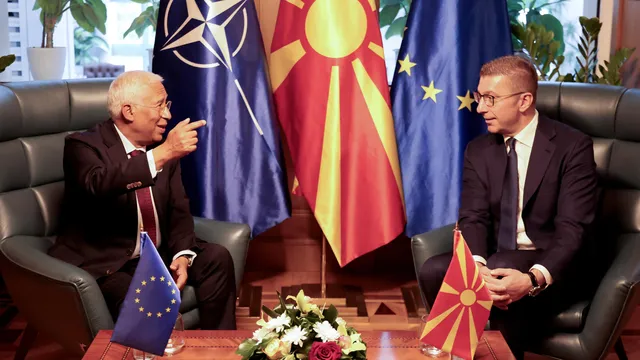
You must fulfil everything that has been agreed, Costa said.
European Council President António Costa repeatedly stressed, in the presence of North Macedonian Prime Minister Hristijan Mickoski, that the Republic of North Macedonia must implement everything agreed in 2022 in order to start EU membership negotiations.
You must fulfil everything that has been agreed, Costa said at least three times, making it clear that the start of the negotiation process depends entirely on the authorities in Skopje.
“Implementing the agreed constitutional changes is the only path towards the opening of negotiations between North Macedonia and the European Union. This is the only way for the citizens of North Macedonia to benefit fully from EU membership,” the European Council President said.
“The EU is the most reliable partner of the Western Balkans and North Macedonia, and remains the largest investor and trading partner. We will continue to support you politically and financially, but ultimately your future is in your own hands,” Costa said.
He added that progress can be achieved only through constructive dialogue with neighbours, pragmatic decisions aimed at building trust, and the implementation of the necessary reforms.
Asked about the Skopje government’s demand for guarantees regarding the country’s further European integration, Costa said:
“What I told you last year, I am telling you again now: what has been agreed has been agreed. I truly ask that we implement what has been agreed, and nothing more than that. This means that what was agreed in 2022 must be implemented, and nothing more than that. Beyond this, we are talking about the normal enlargement process: opening and closing different chapters and clusters. Negotiations proceed step by step, and this is a merit-based process,” the European Council President said, adding that all candidate countries go through the same procedure.
BGNES recalls that on August 1, 2025, Costa said the following regarding Skopje’s European integration:
“EU enlargement is based on each country’s own merits. The authorities in North Macedonia know what they have to do. We hope for real progress in 2026.”
North Macedonia accepted the so-called “French proposal”, a compromise backed by all EU member states in 2022 to unblock the country’s EU accession process. Under the Negotiating Framework, Bulgarians must be included in the Macedonian Constitution before negotiations between Skopje and the EU can begin. North Macedonia must also comply with the 2017 Treaty of Friendship, Good-Neighbourliness and Cooperation with Bulgaria, as well as the two protocols to it.
The protocol from the second meeting of the Joint Intergovernmental Conference, signed three years ago by ministers Teodora Genchovska and Bujar Osmani, states that Skopje agrees for the next intergovernmental conference with the EU to take place after Bulgarians are included among the state-forming peoples in the preamble and in two articles of its Constitution.
In the same protocol, the Government of the Republic of North Macedonia confirms its commitment that nothing in its Constitution can or should be interpreted as a basis for interference in Bulgaria’s internal affairs for the purpose of protecting the status and rights of persons who are not citizens of North Macedonia. De facto and de jure, this clause means that Skopje will not seek recognition of a “Macedonian minority” in Bulgaria.
The protocol also provides for countering hate speech against Bulgarians and Bulgaria, the rehabilitation of victims of the communist regime in Macedonia, and the opening of the archives of the Yugoslav-era security services. | BGNES