
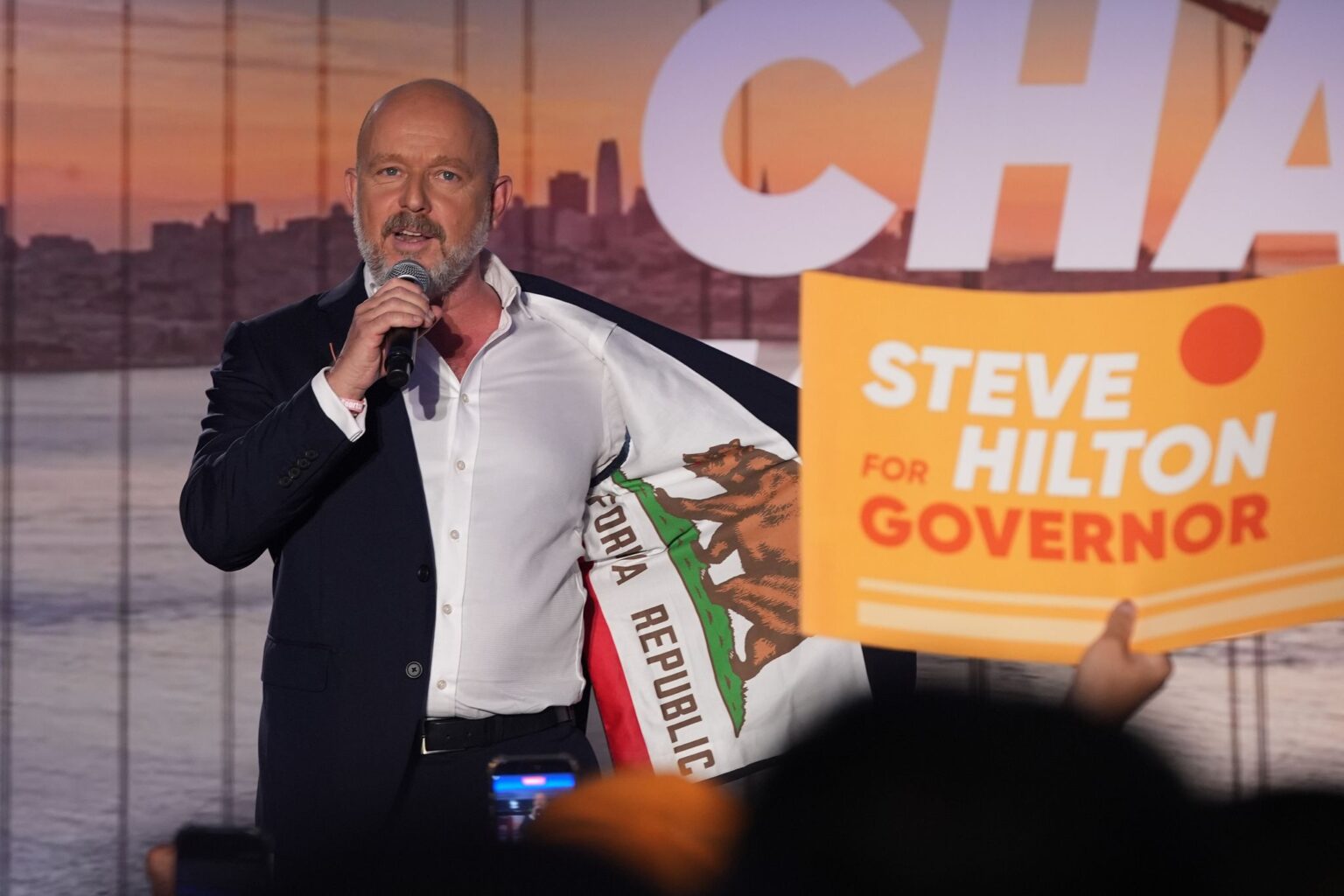
Steve Hilton speaks during an election night event Tuesday.
Gregory Bull/Associated Press
Xavier Becerra spoke during an election night event Tuesday.
Jae C. Hong/Associated Press
Dolores Huerta, center, attends gubernatorial candidate Xavier Becerra’s election night watch party in downtown Los Angeles.
Jen Osborne for the S.F. Chronicle
Scott Wiener’s election party at his campaign headquarters on election night in San Francisco.
Gabrielle Lurie/S.F. Chronicle
Saikat Chakrabarti at his election night gathering in San Francisco.
Carlos Avila Gonzalez/S.F. Chronicle
Workers prepare for gubernatorial candidate Xavier Becerra’s election night watch party in downtown Los Angeles.
Jen Osborne for the S.F. Chronicle
A polling place at Alisal Elementary School in Pleasanton, Calif.
Lea Suzuki/S.F. Chronicle
A voter enters a polling place at El Mansour restaurant on Primary Election Day in San Francisco, Tuesday, June 2, 2026.
Stephen Lam/S.F. Chronicle
It’s election night in California. Eyes across the nation will be on the race to replace term-limited Gov. Gavin Newsom, a tumultuous gubernatorial primary unlike any California has seen in decades. Polls closed at 8 p.m. across California, and early results are now being reported.
Tom Steyer during his election night watch party at the Regency Ballroom in San Francisco.
Santiago Mejia/S.F. Chronicle
In recent years, election observers have been able to rely on a new source of prognostications beyond just the polls: betting markets like Kalshi and Polymarket. Those markets show a clear result: Former Health and Human Services Secretary Xavier Becerra and Steve Hilton are likely to advance, based on the limited results already out.
They’re not completely counting financier and climate activist Tom Steyer out yet, but his odds on Kalshi have already fallen from about 33% to 16%, as of 9:15pm on Tuesday.
Article continues below this ad
The markets also suggest that political operative Saikat Chakrabarti has less than a 7% chance to advance to face State Sen. Scott Wiener in the general election for California’s 11th congressional district race. Instead, they give supervisor Connie Chan a 98% of moving on to November.
Though these platforms aren’t perfect — they’re vulnerable to manipulation by interested actors — they’ve nonetheless proved strikingly accurate in the minutes and hours after recent tight election contests.
Consider the Democratic Senate primary in Texas back in March. Like this governor’s primary (and the contest between Chan and Chakrabarti), that election was a nail-biter: polls showed state representative James Talarico with a slight edge over U.S. Rep. Jasmine Crockett, and the final results saw Talarico beat Crockett by just six points.
But within a couple hours of polls closing in that race — and before it had been called — betting markets assigned Talarico a greater than 90% chance of winning, up from 80% earlier in the day.
Why might these markets converge faster than authorities like the Associated Press can call them? In part, it’s because election nerds (or even election insiders) watching the results are well-attuned to how to extrapolate based on the results already out and are looking to capitalize on that information.
Still, in the recent few years that prediction markets have been popular, there haven’t been many close California elections. Our Byzantine vote-counting pace may yet confound Steyer’s naysayers.
Supervisor Stephen Sherrill’s supporters were packed into Lobalita, a bar on Chestnut street in the Marina, celebrating his decisive victory over Lori Brooke, a community activist.
Mayor Daniel Lurie, who endorsed Sherrill, addressed the ebullient crowd from a little after 9:30 p.m. and praised the supervisor as “a great partner at City Hall, focused on getting housing built, focused on public safety, focused on D2.” The results in the district leave “no doubt” that voters approve of Sherrill’s job in office so far, Lurie said.
Article continues below this ad
Sherrill thanked his supporters, staff, wife and the mayor for their support.
“One of the reasons that we saw the results we saw tonight is because people are happy with the direction of the city, and that starts at the top,” Sherrill said, standing next to Lurie atop a bench in the bar’s backyard.
He also praised several of his moderate colleagues on the Board of Supervisors, some of whom had been in attendance earlier in the evening. Throughout his campaign, Sherrill stressed his willingness to work with the mayor and with other supervisors to cut red tape and pass legislation.
“It’s incredible what a team that gets together that’s willing to collaborate can do,” Sherrill said.
Tomorrow, Sherrill joked, he might take a nap. But on Thursday, he said he would get back to work on the policies that have defined his 18-month tenure in City Hall, like supporting the construction of new housing, bolstering public safety and making childcare affordable.
Article continues below this ad
“We got a lot of work ahead of us,” he said.
Former Orange County Rep. Katie Porter conceded Thursday evening.
Porter, an early frontrunner in the race to become California’s next governor, became mired in controversy after video surfaced of her being testy with a reporter and a years-old clip of her yelling at a staffer, even as some of her male rivals avoided similar scrutiny of their temperaments. She began to call out the disparity, but the damage was done, and her support declined significantly. As of 10 p.m., she was winning just 5% of the vote.
Article continues below this ad
“We know tonight that we will not advance to the general election in November,” Porter wrote in a statement. “Running a race like this isn’t easy, and coming up short is hard, but democracy is worth doing hard things for.”
Less than 30 minutes after the polls closed Tuesday night, former Los Angeles Mayor Antonio Villaraigosa, 73, conceded, ending his second failed run for governor.
In early results, he only had won 1.6% of the vote, leading only Superintendent of Public Instruction Tony Thurmond among the major candidates.
“Tonight didn’t turn out the way we hoped, and I offer my congratulations to the winners and offer my best wishes for the road ahead,” Villaraigosa said in a statement his campaign email time-stamped at 8:29 p.m. Tuesday.
Article continues below this ad
“I’m grateful beyond words to my family, my friends, organized labor, and community organizations who stood with us, our staff, and our volunteers,” he said.
Later Tuesday night, and with about half of the estimated vote counted, San Jose Matt Mahan admitted defeat in his bid for governor.
Mahan entered the race relatively late after previously saying he would not launch a campaign. His moderate, business-friendly platform won him the support of some of the country’s most powerful billionaires, who poured tens of millions of dollars into efforts to elect him. But he failed to catch fire with voters. As of 9:45 p.m., he was winning 4.5% of the vote.
“While this campaign for governor ends tonight, our mission has only begun,” Mahan wrote in a statement. “This is not the last time I will ask Californians to come together to fight for a better state.”
Willie Brown attended Tom Steyer’s election night watch party at the Regency Ballroom in San Francisco.
Santiago Mejia/S.F. Chronicle
Tom Steyer projected optimism to a room of supporters at the Regency Ballroom in San Francisco Tuesday night, even as early results showed him trailing in third place.
“It’s going to take some time to figure out where this is going,” Steyer said. “We’re going to wait until every ballot is counted. We’re going to give democracy time to work, and we know we finished really strong.”
The billionaire activist also stressed the fierce opposition his campaign had faced from “some of the wealthiest people and corporations in the history of the world.”
“Together, we put the corporations on notice,” Steyer concluded, over Tom Petty’s “I Won’t Back Down.” “Now, we just have to be patient.”
Supporters cheered, many wearing “Tom Steyer for governor” shirts and “class traitor” baseball hats. But the mood in the room was mixed as televisions around the room showed a widening gap between Steyer and the other two frontrunners.
Jaria Jaug, who also serves as a trustee on the Berryessa Union School Board, said she felt positive about the results, stressing that they would continue to change as more votes were tallied.
Tom Steyer leaves the stage at his election night watch party in downtown San Francisco.
Santiago Mejia
“A lot of people in my day-to-day life who aren’t really politically involved voted for Tom,” she said. “That’s something I’m motivated by. People just naturally want to vote for him. He’s talking about a lot of issues that everyday people talk about.”
Other supporters, like Ryan Callahan, were less optimistic. Callahan said he felt “not good” as he watched the results coming in on a television in the corner of the watch party.
But Callahan said he was hopeful about the impact Steyer’s campaign would leave on state politics even if he does not advance to the general election.
“He’s laid out these salient things that Californians can want and ask for and care about,” said Callahan. “Even if it isn’t enough at the end of the night, I hope his articulation of those things can make Californians ask for them and demand them of their candidates.”
Alameda County District 2 Supervisor Elisa Marquez won her race, beating out challengers Liz Ames, director of BART, and Rhan Marfatia. Separately, District 3 Supervisor Lena Tam also won her primary. She ran unopposed.
In the East Bay city of El Cerrito, a controversial measure to raise taxes to pay for a new library was trailing by a large margin in early returns.
The measure proposes implementing a parcel tax of up to 17 cents a square foot to build a library that would replace the city’s current literary archive, an old, cramped structure built in 1948. Proponents argue that a larger, more modern venue could serve as a hub for film screenings and author events, a “third space” for kids to go after school and a cooling station in the worst summer heat waves.
Critics opposed the proposed cost of the building, and said they were worried it would get mired in the city’s planning process and never get built. Because Measure C is a citizen’s initiative, it needs a majority vote to pass. In early results, 3,412 voters had cast ballots against the measure, and 1,273 people had voted in favor of the measure.
A conservative soccer mom from Chino took an early lead in the race for state Superintendent of Public Instruction as the first votes were counted Tuesday evening.
Sonja Shaw, who is backed by the Republican party and ran on a platform of parental rights, pulled in more than 25% of votes counted, followed by Richard Barrera, president of the San Diego school board and the pick of the California teachers union, who had 19% of voter support.
Shaw is the president of the Chino Valley board of education and campaigned against transgender access to sports, locker rooms while advocating for a back-to-basics approach to education.
Wendy Castañeda Leal, superintendent of the Semitropic Elementary School District in Kern County, followed well behind in third place, with 10% of the vote.
The top two candidates will advance to the November election.
The San Francisco election results were welcome news for Mayor Daniel Lurie, with early returns showing voters siding with him in local races in which he made an endorsement.
Voters elected two Lurie allies on the Board of Supervisors, Stephen Sherrill and Alan Wong, the latter of whom Lurie appointed to the board late last year. Lurie’s endorsed candidate in the board of education race, Phil Kim, was also reelected.
Proposition A, an earthquake safety bond backed by Lurie, passed as well. Proposition C, a business tax measure Lurie opposed, was defeated. And Proposition D, the union-backed Overpaid CEO Act Lurie also urged voters to reject, was trailing, though the race was too close to call.
Speaking to reporters outside Original Joe’s restaurant in North Beach, Lurie said the early results showed that “San Franciscans like the direction that we’re heading in” since he became mayor in January 2025.
“We are just getting started,” Lurie said. “We are going to continue to put our foot on the accelerator to continue this momentum that this city has seen over the last 16, 17 months. And I think voters are sending a message that they want to continue that.”
Despite an unusual campaign by powerful opponents of the North Bay’s only commuter rail service, voters in Sonoma and Marin counties have so far voted overwhelmingly to support a crucial lifeline for the SMART train.
Measure B proposed to extend a quarter cent sales tax in place since 2008 for another 30 years. The tax, which was scheduled to expire in 2029, generates about $51 million annually and provides the core of SMART’s budget.
According to early returns, 70% of voters in Sonoma and Napa counties voted in support of Measure B. A simple majority of 50% plus one vote is required for the measure to pass.
However, elections offices reported that only 22% of voters in Sonoma County, and 17% of registered voters in Marin County, have so far cast ballots.
In the East Bay city of Richmond, Councilmember Claudia Jimenez was leading in early returns in the mayoral race. The election is the city’s first-ever mayoral primary. Jimenez is facing four opponents: incumbent Eduardo Martinez, Mark Wassberg, former councilmember Demnlus Johnson and Ahmad Anderson. After the first vote drop at 8:12 p.m., Jimenez had captured 3,048 of 8,966 votes cast, followed most closely by Anderson, who had 2,633.
Tuesday’s primary is the first since voters created a new system in 2024 in which a candidate who wins more than half of votes cast wins the election outright. If none of the candidates obtains 50%, the two with the most votes run head-to-head in the general election.
See all Contra Costa election results.
There won’t be a comeback for Pamela Price this year.
Current Alameda County District Attorney Ursula Jones Dickson won the race to keep her seat, despite a challenge from Pamela Price, the former DA who was recalled in 2024 after serving less than two years in office. Early returns indicate that Jones Dickson got 66% of the vote, and Price got 23%. Gopal Krishan, a lawyer, got 11% of the vote.
The Board of Supervisors appointed Jones Dickson, a former judge, last year as the successor to Price. She previously served as a Superior Court judge and also worked as a deputy prosecutor for the county.
Price’s jump into the race earlier this year was a surprise to many, especially after she was recalled by 63% of voters in 2024 amid criticism over her attempts at criminal justice reform and her management of the office.
Democrat Rob Bonta led handily in early returns Tuesday, with 54.3% of 2.9 million votes cast. Republican Michael Gates had earned about 41.3% of votes cast, far outstripping the third candidate in the race, Green candidate Marjorie Mikels.
Elected attorney general in 2022 after eight years as an Assembly member, Bonta has launched dozens of lawsuits against President Trump, but came under scrutiny over his ties to a father-son duo at the center of an FBI probe that brought down Oakland mayor Sheng Thao.
Gates, a former deputy assistant attorney general in the Trump administration, repeatedly sued California and lost while serving as Huntington Beach’s city attorney. He unsuccessfully challenged state housing laws in a case that a Yale Law School professor described to the Chronicle as “batshit bananas” and also championed a local voter ID law struck down by a state appeals court.
Incumbent Phil Kim soundly defeated two challengers for his seat on the San Francisco school board, giving him a few months before he is forced to run again.
The result was clear from the first returns, with Kim pulling in more than 64% of the votes, while the challengers, Virginia Cheung and Brandee Marckmann, both district parents, split the leftovers.
Kim, who is currently board president, has served on the seven-member board since 2024, when former Mayor London Breed appointed him to fill a vacancy, with the requirement to run for the seat in the next election.
He will now serve out the remainder of the original member’s term, which runs through this year, meaning he will need to win again in November to remain on the board for a full four-year term.
A San Francisco ballot measure designed to boost funding for city services by hiking taxes on large companies with highly paid CEOs was trailing in early returns Tuesday despite a big push from local public-sector unions.
Proposition D, which its supporters called the Overpaid CEO Act, was behind with only 43.1% of the vote, though more ballots were left to count.
The measure would increase a local tax on big businesses with top executives who make more than 100 times the median pay of their employees. Prop D would also change the way the tax is calculated so that it’s based on the compensation of all workers at the affected companies, not just those in San Francisco.
The measure was advanced by labor groups, which said it would provide San Francisco with a vital revenue source after the city’s long-running budget woes were exacerbated by funding cuts from the Trump Administration. An estimated $250 million to $300 million in annual revenue could be generated by the tax, providing an influx of cash at a time when San Francisco faces massive recurring budget deficits.
But critics, including the Chamber of Commerce, warned that Prop D could imperil San Francisco’s fragile economic recovery by prompting businesses to reduce their presence in the city or raise prices for consumers. A recent report from the city’s chief economist found that over the next 20 years, Prop D could leave San Francisco with 944 fewer jobs on average and reduce gross domestic product by $206 million.
Hoping to defeat Prop D, the chamber backed a competing measure, Proposition C, that would extend tax relief to more small businesses and accelerate a previously scheduled increase in the same “overpaid executive” tax that Prop D would raise. But Prop C failed after voters rejected it with 63.6% of the vote.
If both Prop C and Prop D had gotten more than 50% support in the final tally, only the measure with the most votes will go into effect.
With 37.6% of the vote reported just before 9 p.m. Tuesday, two Democrats were leading the field of 11 candidates vying to be California’s next insurance commissioner. Former San Francisco city supervisor Jane Kim led with 23.8% of the vote followed by state Sen. Ben Allen, D-Santa Monica, with 20.8%.
If both candidates advance to the November general election, it would be the first Democratic lockout in the history of the position.
Within San Francisco, votes cast before Election Day were split between the two city residents running for the position: Kim and fellow Democrat Patrick Wolff, a financial analyst and chess Grandmaster. Kim received 37.3% of the city’s early votes, Wolff captured 22.4%.
State Sen. Scott Wiener was leading Tuesday in the race to replace Rep. Nancy Pelosi in Congress, with votes left to be counted. Wiener had 43.4% of the vote in the first batch of results posted after polls closed at 8 p.m.
San Francisco Supervisor Connie Chan had 28% of the vote, and former tech executive and House staffer Saikat Chakrabarti trailed with 13.5%. All three of the top candidates are Democrats. The top two vote-getters, regardless of party, will advance to the November general election.
The person who wins in November not only has to replace an icon in Pelosi, the first female speaker of the House and the architect of the Affordable Care Act’s passage, but will hold outsize power in representing one of the bluest districts in the country — and the home of many deep-pocketed Democratic donors. Pelosi has raised more than $1 billion for Democrats over the past two decades.
With about a third of expected votes reporting, Fiona Ma, Josh Fryday, Michael Tubbs and Gloria Romero led California’s race for lieutenant governor amid a field of 16 candidates. Early returns showed Ma, a Democrat, with 20.6% of the 2.5 million votes cast. Republican Gloria Romero — a former Democrat who switched parties — had captured about 19% of the vote, followed by Josh Fryday and Michael Tubbs.
The post of lieutenant governor is largely ceremonial, stepping in for the state’s top politician when they travel out of state. But past office-holders have gone on to the governorship and other more powerful political posts.
The top candidates this year included Ma, the state treasurer, Fryday, a Newsom appointee responsible for the state’s volunteer programs, Romero, and Michael Tubbs, former mayor of Stockton.
Crowds celebrated S.F. Supervisor Stephen Sherrill as he won the District 2 seat in San Francisco.
Lizzy Myers/For the S.F. Chronicle
Supervisor Stephen Sherrill won election Tuesday to his District 2 seat in San Francisco. He had 71% of the vote in early results, with ballots left to be counted in ranked-choice voting.
Sherrill, a moderate ally of Mayor Daniel Lurie, was appointed to represent District 2 at the end of 2024 by former Mayor London Breed after Catherine Stefani was elected to the State Assembly. Challenging Sherrill for the seat was Lori Brooke, a neighborhood activist and organizer with deep ties to the district, which includes affluent neighborhoods such as the Marina, Cow Hollow and Pacific Heights.
Bobak Esfandiari selfies with Alan Wong’s campaign team at the headquarters next to Hole in the Wall Pizza, where his party is, in the Sunset district of San Francisco on election night.
Camille Cohen/For the S.F. Chronicle
Supervisor Alan Wong was elected Tuesday in the supervisor race for San Francisco’s Sunset District with more votes yet to be counted in the ranked-choice election. The result is a promising sign for Mayor Daniel Lurie who appointed Wong to represent the Sunset District at the end of last year and who had endorsed his campaign.
Wong had the most first-choice votes and was leading with 72% of votes after ranked-choice voting was factored in. Gee was second with 28% of the vote.
Wong will fill out the remainder of former Supervisor Joel Engardio’s term, which would have ended in January. Engardio was recalled by voters in September. Another election, in November, will determine who will represent the district for a full four-year term.
Several Sunset residents lined up to challenge Wong, including Natalie Gee, a legislative aide to Supervisor Shamann Walton; Albert Chow, an organizer of the campaign to recall Engardio; David Lee, a political science lecturer; and Jeremy Greco, a campus coordinator.
A victory for Gee, a longtime legislative aide to Supervisor Shamann Walton, would mean a boost for the Board of Supervisors’ progressive minority, which has largely found itself outvoted by moderates aligned with Lurie. Though the moderates are not poised to lose their majority on the board, Gee’s success could come as a blow to Lurie, who had endorsed Wong.
San Francisco voters passed a $535 million earthquake safety bond, with the measure gaining an insurmountable 76.3% of the vote in early returns. The measure needed at least two-thirds of the vote to pass.
Proposition A will let the city borrow money to pay for various seismic upgrades and infrastructure improvements, including to police and fire stations that supporters say are vulnerable to collapsing during a catastrophic earthquake. Money from the bond will also fund enhancements to the city’s emergency firefighting water system, which ensures that firefighters have reliable access to water in the event of an emergency.
The measure will not raise taxes, boosters said, because San Francisco has a policy of issuing new bonds as it pays off old ones.
Prop A was backed by Mayor Daniel Lurie, Speaker Emerita Nancy Pelosi, all 11 San Francisco supervisors and all three of the city’s representatives in the California Legislature. Labor groups and wealthy donors, led by crypto billionaire Chris Larsen, raised $2 million to ensure its success.
As supporters at Tom Steyer’s election night party in San Francisco waited for results, his campaign urged patience.
Senior adviser Anthony York told reporters at the Regency Ballroom not to take Tuesday’s results at face value: it could be “days, or even weeks” before the results of the primary were settled, he said. York recalled the 2022 Los Angeles mayoral election, when now-Mayor Karen Bass gained a lead as votes were counted after Election Day.
“It might take a while,” York said. “We think Tom will either increase the lead he has or close the gap over the next couple of days.”
York cited accelerating rates of ballot return in the last week, predicting that Steyer would continue to gain vote share as late ballots were tallied. Election Day votes have “tended to be more Republican,” he said.
Oakland’s Measure C, which would provide a one-year tax holiday for existing small businesses grossing under $1 million annually, and eliminate up to $1 million in gross receipts taxes for new businesses of any size, passed with 76.4% of voters approving in early returns. The measure requires a simple majority to pass, and it can be renewed for up to three years by the city council.
Voters also signed off on Measure D, an amendment to the city’s charter that will expand eligibility for the board of the Oakland Police and Fire Retirement System, a pension plan that covers sworn police and firefighters hired before 1976. Since the retirement system is part of the City Charter, any changes to its governance must be approved by voters. Early returns showed 73.5% of voters in favor of the amendment.
Democrat Shirley Weber and Republican challenger Don Wagner were leading in early returns in the race for Secretary of State. With 28.4% of votes cast, Weber, the incumbent, had about 57% of the vote, and Wagner had 39%. Two other candidates garnered 4.1% of votes cast.
Weber, a former Assembly member and university professor, was appointed in 2021 by Newsom to replace Alex Padilla. During her tenure, she has overseen the state’s implementation of universal vote-by-mail. Wagner, a supervisor in Orange County, was a former mayor of Irvine and state Assembly member. He has previously argued that voters “don’t have confidence” in the state’s election process and said he wants to overturn a 2021 law requiring a mail-in ballot to be sent to every voter.
State Sen. Aisha Wahab and BART Board President Melissa Hernandez took an early lead Tuesday night in the open House race to represent portions of the East Bay, with many votes left to be counted. Two Republican candidates, Wendy Huang and Dena Maldonado, were trailing close behind Hernandez. The top two vote-getters, regardless of party, will advance to the November general election.
Former Rep. Eric Swalwell’s decision to run instead for California governor opened up this safely Democratic seat for the first time in more than a decade, setting off a melee for what could become a lifetime gig. Swalwell’s predecessor represented the area for 40 years.
Wahab had received 36.2% of the vote in early returns and Hernandez had received 16.4% of the vote.
Oakland voters were rejecting a new tax on residential properties that city leaders had hoped would plug a hole in this year’s budget, early returns indicated Tuesday night.
As of 8:15 p.m., 55% of voters had voted against Measure E, a parcel tax expected to raise $34 million a year for the next nine years. The measure needs a majority in favor to pass.
Republican Steve Hilton and Democrat Xavier Becerra led a crowded governor’s race in early vote totals shortly after polls closed at 8 p.m. With just 1.1 million votes counted, Hilton, a former Fox News host, had 29.8% and Becerra, who served as Health and Human Services Secretary under President Joe Biden, had 24.8%. Democrat Tom Steyer, a billionaire and liberal activist, was trailing in third with 17.3%.
If Becerra and Hilton advance to the general election, Becerra will be the overwhelming favorite to win in liberal California.
Riverside County Sheriff Chad Bianco, former Rep. Katie Porter, San Jose Mayor Mahan, former Los Angeles Mayor Antonio Villaraigosa and state schools chief Tony Thurmond trailed with less than 12% of the vote each.
Read more on the governor race here.
After the retirement of Iowa Sen. Joni Ernst, voters on Tuesday appeared poised to send Democratic State Rep. Josh Turek, 47, and Rep. Ashley Hinson, the 42-year-old Republican candidate endorsed by President Trump, to face off in the general election in November. Multiple media organizations projected the two candidates to have won their respective primaries.
Iowans haven’t elected a Democrat to the Senate since 2008, but the GOP considers the race pivotal to protecting their majority, and Democrats have grown hopeful that it might be one they could flip.
Former Navy helicopter pilot and healthcare executive Rebecca Bennett has won the Democratic primary for New Jersey’s 7th Congressional District, defeating three challengers. She will face Republican Rep. Tom Kean Jr. in one of the most competitive House races in the country and which Trump won by just one percentage point two years ago.
Kean was elected in 2022 and outperformed Trump during the 2024 election, winning the race by more than five points. Over the past few months, however, he has come under scrutiny for his absence from public life due to what his office has called a “personal medical issue.”
Scott Wiener waits to talk to potential voters in the Duboce neighborhood of San Francisco on Tuesday.
Minh Connors/For the S.F. Chronicle
State Sen. Scott Wiener spent Election Day crisscrossing San Francisco as he sought to advance in the race to replace Rep. Nancy Pelosi, starting the morning at Glen Park before appearing later with campaign volunteers in Duboce Park and the Castro.
Wiener’s campaign also leaned into one of his signature issues: public transit.
In a post on X, Wiener said he rode the T-Third line to Chinatown and called for more federal support for transit, including potential extensions to North Beach, Fisherman’s Wharf and the Richmond.
“Huge priority for me in Congress,” Wiener wrote. “I’ll go to the mat for transit as I always have.”
San Francisco Supervisor Connie Chan, who has Pelosi’s endorsement, was also greeting voters Tuesday, including in Chinatown. Chan’s campaign has sought to turn out Chinese-speaking voters, a potentially important bloc in a race that could be decided by narrow margins.
Saikat Chakrabarti, a former tech executive and former chief of staff to Rep. Alexandria Ocasio-Cortez, also touted a large field operation.
His campaign said volunteers and organizers were knocking 5,000 doors an hour Tuesday and had placed more than 20,000 door stickers earlier in the day to remind voters to cast ballots.
“No matter what the result is tonight, I’m so proud of what we’ve built together,” Chakrabarti wrote on X.
The race is one of San Francisco’s most closely watched contests. Pelosi has represented the city in Congress since 1987 and announced last year that she would not seek another term.
Among the crazily crowded list of people who qualified to run for governor, stretching 61 names on overwhelmed voters’ ballots, two candidates who are likely to fall short in Tuesday’s election own some pretty eye-catching names: Barack D. Obama Shaw and LivingForGod AndCountry DeMott.
Shaw, listed as a Democratic business owner, and DeMott, an independent chaplain, have cracked zero polls since paying the $3,900 filing fee and meeting the other requirements to qualify in the state (be an adult citizen with a clean record).
According to Transparency USA, Shaw has raised no money and (logically) spent no money since entering the race, while DeMott gave himself about $11,000 and spent $6,250 of that on his candidate statement, where he confirms that LivingForGod AndCountry DeMott is indeed his legal name.
In his statement, the Redding-based DeMott says he went from running a pest control company to delivering Jesus Christ’s message as a chaplain, has a plan to stop U.S. Immigration and Customs Enforcement and opposes a mileage tax.
Shaw, the son of a Soul Train performer, says on his website that he legally changed his name from Cecil L. Shaw III after President Barack Obama’s hopeful message sparked “an inspired vision” in 2013. Shaw, whose Instagram handle is Barack4California, has otherwise taken a relaxed-fit approach to his candidacy, saying in one video, “You vote for who you want to vote for,” adding that he understood if voters chose President Donald Trump simply because they find Melania Trump attractive. “So whether you vote for someone because it’s deep or… trivial, it’s still your choice… If you want to vote for a fella named Barack D. Obama Shaw, great,” Shaw said, laughing.
Oakland’s staff labor unions have spent over $500,000 supporting Measure E, a parcel tax that would raise $34 million for the city’s budget year, but one group of city employees has been quiet: the city’s police union.
The Oakland Police Officers Association has not offered support for Measure E, even though if it passes, Mayor Barbara Lee has said she aims to use $6.9 million to pay for 22 additional sworn officers and $3.8 million for a 27-week police academy to recruit new officers.
Just two years ago, the police union backed a different parcel tax, Measure NN. But that measure had a provision that made it more favorable to the association: it required about $25 million of the $47 million it brought to be directed to the police department and required the city to adhere to a minimum staffing level of 700 sworn officers.
Measure E was designed to be more flexible — the money raised will go into the general fund, rather than to specific departments.
A person familiar with the police union said that was a sticking point. Some members also feel the city broke its promises related to minimum staffing levels: Lee’s proposed 2026-27 budget includes funding for just 678 sworn officers, an increase from its current level of 604, but still not meeting the 700 required by NN.
Outside of San Francisco’s Parkside Branch Library in the Sunset District, residents shepherded children while dropping off ballots. Reilly Walker, 33, pushed his toddler in a stroller as he dropped his ballot off, which ranked the current supervisor Alan Wong first.
For Walker and many other Sunset District voters, a candidate’s view on Sunset Dunes, a park that has replaced the Great Highway, greatly influenced his vote.
“To start off, I wasn’t super happy about any of the candidates positions on the Great Highway,” Walker said as he fed a seaweed snack to his daughter. “I would love to keep it closed because we use it all the time.”
The 2-mile, 50-acre park stretching from Sloat Boulevard to Lincoln Way has sharply divided the Sunset community for years. The park, which formally opened in April 2025, is largely credited as the reason why voters recalled former District 4 Supervisor Joel Engardio.
After voters recalled Engardio, Mayor Daniel Lurie appointed pet shop owner Beya Alcaraz as supervisor. Alcaraz quickly resigned after media organizations reported on mismanagement of the pet store. Lurie later appointed Wong, a twice-elected member of the Board of Trustees for City College of San Francisco.
“We’ve had too much turmoil, up and down with the last recall,” Walker said. “If I had to say one thing that was just driving (my vote), it was continuity.”
Moira McAlister, 70, said she also wanted Sunset Dunes to remain open, which led her to choose school administrator Jeremy Greco. McAlister, who has lived in the Sunset her entire life, said she was initially against the park because she felt there was a lack of planning but has since changed her mind.
“It’s such a beautiful resource, and it’s clean air,” McAlister said.
Trina De Joya, 52, said she was looking for a candidate that was going to listen to the community and put their needs first. She voted for Natalie Gee, trusting that Gee would listen to the community on the Great Highway, which she wants to go back to be open to traffic on weekdays.
After Lurie endorsed Wong, she soured a bit on the candidate and questioned his priorities.
“I felt that Lurie’s endorsement meant that Alan Wong would be somebody that would support the mayor’s decision as opposed to the neighborhood’s decisions,” De Joya said.
NBC News Chief Data Analyst Steve Kornacki said in a TV broadcast on Tuesday that one of the key things he will be watching after polls close Tuesday is whether Xavier Becerra can run up votes in Southern California — or whether Tom Steyer can counter with strength in the Bay Area and Northern California.
In California’s crowded governor race, the top two vote-getters advance to the November election, regardless of party. That makes regional performance especially important in a race with no clear front-runner.
Becerra represented downtown Los Angeles in Congress and may be positioned to draw more support from Southern California. Steyer, the billionaire environmental activist, is expected to perform more strongly in Northern California.
“Is Becerra getting more out of L.A. County, or is Steyer getting more out of the Bay Area?” Kornacki said. “I think that’s a crucial thing I’m going to be looking for as these numbers come in.”
Kornacki also said he will be watching Los Angeles County’s first results release, expected around 8:30 p.m. The county’s initial batch is expected to include vote-by-mail ballots processed before Election Day.
That first update could quickly reveal a large share of the vote in the Los Angeles mayoral race, Kornacki said.
“Instantly, we’re probably going to see half the results in this mayor’s race,” he said. “Those are going to be crucial here to understand, of course, with vote by mail, those are going to be ballots that were mailed in, processed ahead of time.”
Hilton said Tuesday that he would move aggressively to shrink California’s bureaucracy if elected, using a primary day Newsmax appearance to sharpen his case against Democratic control of the state.
“They’ve had 16 years now to prove that their far-left progressive governance model works,” Hilton told Newsmax. “Where are we? Highest poverty rate in the country. Highest unemployment rate in America. The highest cost of living by far.”
Hilton also pointed to rankings from U.S. News & World Report and Chief Executive magazine to argue that California has become hostile to opportunity and business.
Hilton said he would be “insanely, ferociously aggressive” in attacking a “massive, bloated, bureaucratic nanny state government bossing us around from morning till night, telling us how to live, how to raise our kids, how to run our businesses.”
He added, “The thing I hate most in life is ridiculous, pointless rules and bureaucracy. So you’re going to get a fighter like we’ve never seen before when I get to Sacramento.”
Hilton, a British-born former adviser to U.K. Prime Minister David Cameron, became a naturalized U.S. citizen in 2021 and has cast himself as an outsider who can shake up Sacramento.
Riverside County Sheriff and Republican candidate for governor Chad Bianco pushed back Tuesday against pressure to consolidate GOP support behind Steve Hilton.
Hilton has urged Republicans not to “waste” votes on candidates he says have little chance of reaching the November election, according to Newsmax. Bianco rejected that argument and accused Hilton of trying to force him out of the governor’s race.
“This election has been crazy for a year and a half,” Bianco told the outlet. “For the first year, I was on top of every single poll. And then Steve Hilton started attacking me. And that’s the only thing that has changed.”
Bianco said Hilton should be the one to drop out if he “cares about California.” He pointed to support from conservative activists and said “the grassroots movement in California is completely on my side.”
Trump endorsed Hilton in April, calling him “a truly fine man” and saying he could work with the federal government to improve California. The endorsement elevated Hilton in the Republican field but also sharpened tensions with Bianco.
Bianco told Newsmax that Trump’s support could be a liability in a state where Republicans have struggled for years to win statewide office.
“Unfortunately — I love my president — but there’s no one in California on the no-party preference side or the Democrat side that are ever going to support a candidate that is supported by Donald Trump in California,” Bianco said.
A lot of Californians held onto their ballots until the last minute: Only 21% of voters had turned in their ballots as of Tuesday, compared with 27% four years ago, when Newsom ran for reelection after beating back a recall effort. Nonetheless, Sacramento political data expert Paul Mitchell predicts that the final turnout will be higher than 2022.
He predicted this year it should be 37% to 40% of 23 million registered voters, compared with 33% of 21 million voters in 2022.
Who does the higher turnout help? It helps Becerra if the higher turnout is driven by older Latino voters, Mitchell said. It helps Steyer “if it’s college kids,” Mitchell said.
Tom Steyer used the final hours of California’s primary to confront one of the central tensions of his campaign: He is a billionaire running against corporate power.
“I know a lot of people have reservations about voting for a billionaire,” Steyer wrote Tuesday on X, before criticizing wealthy people who “hoard their wealth and avoid paying taxes.”
“Screw that,” he wrote.
Steyer also said corporations had spent more than $55 million to stop him, calling it the most outside spending in a California primary. He said he was running on “a not-so-radical idea: California should work for working people.”
Xavier Becerra used the opportunity to attack in his primary Democratic rival.
“Money does not buy you leadership in California. Work does. Results do,” Becerra wrote on X.
In another post, Becerra said public office “should not go to the highest bidder” and argued that leadership should be earned through service and experience. The exchange captured one of the defining contrasts in the crowded race to replace Newsom, who is term-limited. Steyer, a billionaire environmental activist and former hedge fund manager, has spent heavily on his campaign while arguing that his wealth makes him independent of corporate influence.
The vast majority of Californians vote with a mail-in ballot — either by dropping it in their own mailbox, at the post office, an election drop box or polling place. Tallying those ballots takes time. It could be days or weeks before results for all races happening across the state are known, depending on how close a race is after election night — and that potentially includes the governor race.
Here are our election live results pages — bookmark them now and come back at 8 p.m. when California polls close:
You can also sign up for our email news alerts or download our app to have us send you the results of races as soon as they’re called.
Julia Baran, the owner of the pet store Animal Connection in the Sunset District, is closely watching the race for the neighborhood’s supervisor, which was unfolding Tuesday. Baran’s revelations led to the resignation of the neighborhood’s former supervisor, Beya Alcaraz, last year. Alcaraz, a 29-year-old with no political experience, was appointed by Lurie to represent the Sunset District after the recall of Supervisor Joel Engardio. The information Baran brought to light about Alcaraz prompted the supervisor’s resignation after a week on the job — deemed an embarrassment for Lurie. Baran asked at the time why Lurie’s administration hadn’t done a better job of vetting Alcaraz.
Baran said Tuesday that she supported City Hall staffer Natalie Gee to represent the Sunset on the Board of Supervisors over Lurie’s pick: Supervisor Alan Wong, who was appointed by the mayor to replace Alcaraz.
“Natalie is an alum of my high school and reminds me of the hardworking and honest kids that I went to school with,” Baran said, referring to Lowell High School. “Alan was appointed by the mayor, his PAC money comes from a MAGA donor and a group that lobbied against worker rights, while Natalie’s backed by labor unions and healthcare workers. Honestly, I’ll always trust a woman over a man when given the choice.”
Jan Koum, a tech billionaire and Trump donor, gave $250,000 to a political action committee called S.F. Believes led by Lurie allies that has spent six figures backing Wong.
The other main candidates in the race are small business owner Albert Chow, who helped run the recall against Engardio, and political science lecturer David Lee.
The race for California insurance commissioner may be one of the least well-known races on the primary ballot. Lindasay Chin, a 30-year-old San Francisco resident, voted for Jane Kim based purely on name recognition.
“That one was obscure,” Chin said. “I know her name.”
Javier Ruiz, 44, who voted largely on “vibes” and based on his friends’ choices, voted for Kim because she used to be his district’s supervisor.Both Chin and Ruiz dropped ballots at San Francisco’s Civic Center Tuesday. Their uncertainty seemed to reflect that of a broader set of voters. In a survey of likely California voters held from May 23 to 26, 34% said they were undecided.
The survey was conducted by Cal State Long Beach, the University of Southern California and Cal Poly Pomona.
Outgoing Insurance Commissioner Ricardo Lara was elected to office just days before the 2018 Camp Fire broke out in Butte County, razing Paradise and becoming the deadliest wildfire in state history.
The disaster also plunged California’s home insurance market into a state of crisis of which it has only just begun to climb out of nearly seven years later. The next insurance commissioner, to be decided in November after the top two finishers are chosen on Tuesday, will step into a high-stakes, high-profile job.
Lara, termed out after eight years, pushed through reforms that sought to stem the tide of insurance companies dropping customers and dramatically raising rates.
California’s next insurance commissioner will take over a market that’s begun to heal but still faces major issues — the financial instability of its market leader, State Farm General; the overexposure of the California FAIR Plan; and the ongoing recovery efforts in Los Angeles County after the Eaton and Palisades wildfires last year.
Many voters were anxious to keep Republican names off the gubernatorial ballot and cast their votes for the most popular Democratic candidates.
At one corner of San Francisco City Hall, a steady stream of voters slipped their ballots into the drop box. Finnrain Whelan, 24, was among those dropping off her ballot. The Berkeley resident and environmental science graduate said she voted for billionaire Democratic activist Tom Steyer partly because she liked his environmental messaging but also to boost one of the Democratic frontrunners for governor.
“All the Democratic choices may dilute the Democratic power,” she said. “So I just voted for someone who seems like the most popular.”
Lindasay Chin, 30, said she debated between Steyer, former Rep. Katie Porter and Xavier Becerra, the former U.S. Health and Human Services Secretary. She ultimately landed on Steyer.
“There were a ton of candidates, so this was kind of a tough decision,” Chin said. “There were so many names.”
A 25-story residential tower slated for development at the site of the Safeway in the Marina has alarmed neighbors and drawn widespread opposition — including from some of San Francisco’s pro-housing lawmakers.
Lori Brooke, a Cow Hollow activist who is challenging Supervisor Stephen Sherrill to represent District 2, has sought to tie her opponent to the plan for 790 units and cast herself as the best candidate to defeat it.
“My opponent is a rubber stamp for the politicians that make this happen. As supervisor, I will not be,” she said.
But how much power does a supervisor have to kill the project? Not much.
Though Brooke has highlighted Sherrill’s support for housing production and the support his campaign has received from YIMBY groups, Sherrill has maintained that the plans for the Safeway project are “crazy” and out of scale for the affluent waterfront neighborhood. But there’s little Sherrill — or any of his colleagues on the board — can do.
That’s because the project’s developer, Align Real Estate, used a combination of state density and streamlining laws to go beyond San Francisco’s zoning rules, which set height limits in the area at just four stories. (Align secured development rights for the site before San Francisco passed Mayor Daniel Lurie’s “Family Zoning” package in December, which updated height and density limits in parts of the city, including the Marina.)
Yet another state law, AB2011, allowed the proposal to move ahead without going through San Francisco’s usual approval process, which can delay projects for years.
Sherrill said that he had met with state housing officials and asked the city’s planning department to reconsider whether the project qualifies for AB2011.
In another sign of how torn many California Democrats are on Election Day, Netflix co-founder Reed Hastings posted on X on May 23 that he voted for San Jose Mayor Matt Mahan for governor.
But Hastings contributed something perhaps more valuable to front-runner Xavier Becerra on Monday: a check for $39,200, the maximum donation possible, Rob Pyers, research director for the non-partisan California Target Book, pointed out.
Or as Pyers quipped on X, “Reed Hasting succumbs to the ‘Becerra, I guess’ fever ravaging the state and maxes out to Becerra’s campaign committee.”
The San Francisco school board race Tuesday offers a sneak peek into a bigger battle coming in November.
If the current incumbent and board President Phil Kim wins against the two challengers in this race, he will need to run again in the general election — with at least 11 candidates vying for three seats.
Kim has served on the board since late 2024, when then-Mayor London Breed appointed him to fill a vacancy. The rules required him to run in the next election to continue serving, which was June 2026.
Whoever wins Tuesday will serve the remainder of the term left on the seat through this calendar year. The top three vote-getters in November will be elected to a four-year term starting in January.
Kim has already filed to run again in November as has one of his current challengers, district parent Virginia Cheung. The other challenger, Brandee Marckmann, also a district parent, has not yet filed to run again.
The three Californians/Obama administration veterans who co-host the popular “Pod Save America” podcast said they battled much of the same indecision as other Democrats when it came to deciding whom to support for governor.
All three praised former Rep. Katie Porter, but only one voted for her. The other two voted “strategically.”
Jon Lovett said he backed San Francisco billionaire Tom Steyer, banking on polls showing former Health and Human Services Secretary Xavier Becerra being the top vote-getter.
“I would much rather have two Democrats battling it out for the future Democratic Party in this state than I would have Becerra versus a Republican (former Fox News commentator Steve Hilton) who has not passed the threshold question of opposing Donald Trump’s election lies,” Lovett said on the podcast.
“That to me is a threshold question. You could be frustrated with Democrats in this state, you can believe that Democrats have been f—ing up in California, but if you can’t say Donald Trump lost that election, if you can’t stand up to him, then that is so f—ing dangerous, and he is a nut for that. I also really like Katie Porter, but she just hasn’t risen to the top of the polls. It sucks, because I really like her, but I’m trying to be pragmatic with my vote.”
Tommy Vietor said if he could wave a wand and magically make someone governor, it would be Porter, but “she’s down in the polls.” Like Lovett, he wanted to vote strategically, “because I think Steyer and Becerra going to a runoff would be great. It would kind of be annoying if we had to deal with, you know, running in Steve Hilton, who’s a random British short king who’s like deep in the tech community.”
Jon Favreau said he “thought about Becerra, but like, I don’t feel confident giving the top job to someone who’s had 35 years in elected office to prove himself, but has received mainly bad reviews from his colleagues, he’s very late to introduce any kind of housing policy whatsoever until after ballots dropped, and then it was like more NIMBY than Steyer or Porter or anything else.”
Favreau didn’t vote for Steyer because of “the combination of he’s never had any experience in elected office or governing anything, and is a billionaire who basically, like, you know, ran for president first, flamed out there, then spent just the GDP of a small country ($213 million) on this race … there’s just something a little icky to me about it. So I just voted for Katie Porter, because I like her. It is the least strategic thing I could do … but I’m like: who do I want to be governor?”
Xavier Becerra and Tom Steyer used the final hours of California’s primary to rally supporters and remind voters to return their ballots.
Becerra, the former U.S. health secretary and state attorney general, said he stopped by a Planned Parenthood phone bank Tuesday to thank volunteers “fighting for California’s future.”
Planned Parenthood Affiliates of California endorsed Becerra in April, calling him a defender of reproductive rights.
Becerra also urged voters to return signed and dated ballot envelopes at official secure ballot drop boxes or vote centers.
Steyer, the billionaire environmental activist, spent part of Election Day highlighting public transit and walkable cities in Los Angeles.
“Good public transit is key for an affordable, walkable city,” Steyer wrote on X, saying he was riding the D Line.
Steyer also posted about kicking off Pride Month on Monday night at GYM Sportsbar in West Hollywood, writing that he would be there for the LGBTQ community even when it was politically difficult.
San Francisco’s race to elect a District 4 supervisor, has reanimated the debate over the closure of a portion of the city’s westernmost coastal boulevard to cars to create a park. Sunset Dunes park has been a source of frustration for westside residents who said they relied on the roadway to get around the city.
Supervisor Joel Engardio was ousted in September over his role in championing Proposition K, the ballot measure permanently closing the Upper Great Highway to cars, which voters passed in November 2024.
All four major candidates have campaigned on reopening the roadway to cars on weekdays. There are two routes to get the issue back on the ballot: Four supervisors can vote to put the issue back to voters or a petition can place a new measure on the ballot. Incumbent Supervisor Alan Wong, appointed by Mayor Daniel Lurie, tried and failed to get his colleagues to place it on the ballot. An effort to collect the 10,000 needed signatures is underway. However, it’s unclear that it would pass, given a majority of the city voted to close the highway less than two years ago.
As San Francisco lawmakers gear up for a month of tough budget negotiations with the mayor’s office, some progressives are hoping a win on Tuesday could deliver them a major bargaining chip.
On Monday, Mayor Daniel Lurie unveiled a budget proposal that would reduce the city’s projected structural budget deficit by about $300 million. The blueprint avoided significant layoffs to the city’s workforce, but some progressives warned that it also included significant cuts to social programs that benefit the city’s most vulnerable residents.
The Board of Supervisors will now consider the mayor’s proposal and suggest changes before the deadline to approve a finalized budget arrives at the end of July. Some advocates say that a Proposition D victory could help persuade lawmakers to back off some of the proposed cuts.
If it passes, the tax measure is expected to generate between $250 million and $300 million for city coffers each year, according to a March report from the city’s controller, by raising taxes on big businesses with highly paid chief executives. It could also discourage big businesses from setting up in San Francisco and wind up costing the city roughly 900 jobs over the next two decades, according to a separate report.
Revenue from the measure wouldn’t start flowing until 2028, but Anya Worley-Ziegmann, a lead coordinator with the People’s Budget Coalition, said its passage would be “a massive game changer” as lawmakers hammer out a final budget deal.
Proponents of the initiative, including some public sector unions, have said the city needs the extra funds to respond to the Trump administration’s funding cuts to federal programs like food stamps and Medicaid that have made San Francisco’s existing budget shortfall worse.
“If it passes, that’s a clear mandate from San Franciscans that they don’t want to make budget cuts, that when [President] Trump makes cuts they want to see those cuts backfilled,” said Worley-Ziegmann.
Supervisor Connie Chan, the chair of the Board’s budget committee, said at a briefing with reporters in May that she would be looking toward the proposition’s passage to avoid painful cuts to city programs. To fill gaps before the measure starts making money for the city, she said, she would tap into one-time funding sources like a settlement with AirBnb that saved the city $120 million, she said.
San Francisco Supervisor Connie Chan, center, greets voters in Chinatown on Primary Election Day in San Francisco, Tuesday, June 2, 2026. Chan, who represents District 1 on the Board of Supervisors, is running to represent California’s 11th Congressional District, currently held by Former House Speaker Rep. Nancy Pelosi (D-CA).
Stephen Lam/S.F. Chronicle
San Francisco elections officials said they received ballots from just 19% of registered voters, roughly 103,000 people, as of Monday morning.
That early Monday turnout rate is fairly consistent with those of the past two primary elections: 17% in 2024 and 20% in 2022. But the true turnout will likely be much higher. In June 2022, the most recent California primary during a non-presidential election year, the final turnout exceeded 46%.
San Francisco’s early turnout this year has kept pace with the statewide rate: 19% as of Monday, data from the California Secretary of State showed. Early turnout rates in other parts of the Bay Area ranged from a low of 18% in Alameda and Solano counties to a high of nearly 27% in Napa County.
Lurie has little electoral experience outside his successful 2024 campaign, and he’s been pretty cautious about weighing in on other politicians and causes. Today’s election changed that.
For the first time, Lurie endorsed other candidates, including two of his allies on the Board of Supervisors: Stephen Sherrill and Alan Wong. He also backed Phil Kim’s bid for reelection to the school board, and he urged voters to reject two business tax measures, Proposition C and Proposition D.
Now the public will wait to see if Lurie’s popularity might rub off on any of his preferred candidates, or help defeat Props C and D. Wealthy donors aligned with the mayor have spent heavily in support of his priorities.
Mayor Daniel Lurie arrives for a news conference after he announced his budget proposal in San Francisco on Monday, June 01, 2026.
Santiago Mejia/S.F. Chronicle
Los Angeles County has deployed about 50 trained volunteers to help de-escalate possible disruptions at voting sites Tuesday, including incidents involving protesters, election observers or federal law enforcement agents.
The volunteers were assigned to areas considered at higher risk for potential disruption and trained in de-escalation, conflict resolution and community mediation, according to a report from Registrar-Recorder/County Clerk Dean Logan to the county Board of Supervisors. The program was piloted during last year’s statewide special election and expanded for Tuesday’s primary.
As of Tuesday afternoon, no major disruptions had been reported at Los Angeles County voting sites, according to election officials.The county is operating 645 vote centers for the primary.
California redrew its congressional map last year to boost Democrats’ chances of retaking control of the House of Representatives in November. They could flip up to five Republican-held seats across the state, though the biggest challenge will be the 22nd Congressional District in the southern Central Valley.
Democrats there are locked in an increasingly bitter battle over who is best suited to take on Rep. David Valadao, the Bakersfield Republican who has defied a Democratic voter registration advantage to win six terms. (He narrowly lost in the 2018 blue wave, only to reclaim his seat two years later.)
After initially pledging neutrality, House Democrats’ campaign arm entered the race in the final weeks to boost the more moderate Assembly Member Jasmeet Bains, who’s also a family physician. That could offer a compelling contrast to Valadao, who joined fellow Republicans last summer to cut access to Medicaid, the healthcare program for low-income and disabled Americans, despite representing more Medicaid enrollees than almost any other member of Congress.
The intervention has infuriated progressives backing Randy Villegas, a community college political science professor who has fired up local Democratic activists with a populist platform and earned the endorsements of Sen. Bernie Sanders and Rep. Alexandria Ocasio-Cortez. They argue Villegas is best suited to tap into the seething anger against the system that has elevated political outsiders across the country this year.
As Democrats try to figure out a path forward from the bruising losses of the Trump era, whichever candidate advances to November offers a major test case for the party and what electability looks like outside of its liberal strongholds on the coasts.
Voters in the East Bay’s 14th Congressional District are sending someone new to Washington for the first time in more than a decade. The safely Democratic seat in Alameda County was long represented by Eric Swalwell, who passed on an eighth term last fall to run for governor.
A trio of Democrats have emerged from the crowded field as the top contenders: progressive state Sen. Aisha Wahab, who has the California Democratic Party’s endorsement; former Dublin Mayor Melissa Hernandez, who is owning the centrist lane; and political newcomer Rakhi Israni, who has significantly outraised her competition by drawing on a national Hindu political network and her personal wealth.
If one of these women advances to the November runoff — perhaps against the GOP-endorsed Dena Maldonado, a floral business owner — then the race is effectively decided. But the district is liberal enough that two Democrats could finish in the top two, setting up a fierce showdown for a rare open congressional seat in the Bay Area.
The stakes are extra high for Tuesday’s primary because the voters will weigh in again just two weeks from now. Swalwell resigned in April amid sexual assault allegations and there is a special election set to finish out his term. A decisive lead for one candidate tonight could provide a boost in the June 16 special primary — and perhaps even persuade Democrats to consolidate to fill the seat more quickly.
Bruce Wilson of Pleasanton votes for the Primary Election on Election Day at the Dublin Civic Center on Tuesday, June 3, 2026, in Dublin, California. Voters in the 14th Congressional District are deciding who will succeed Eric Swalwell.
Lea Suzuki/S.F. Chronicle
Going into today’s election, a spate of reputable polls were converging on one outcome: Former Health and Human Services Secretary Xavier Becerra seems most likely to advance to the November general election. Less certain is whether financier Tom Steyer, a Democrat, or former Fox News host Steve Hilton, a Republican, will move forward too.
Since the weekend, we’ve had another major poll drop. The California Elections and Policy Poll, conducted by researchers at a number of Southern California universities, polled 735 likely voters from May 23rd to 26th. It also found Becerra well in the lead with 29% of the vote, one of the highest shares we’ve seen so far. Hilton is a distant second at 23%, with Steyer firmly in 3rd at 18%.
Perhaps more interesting is that CEPP also polled potential November runoff matchups. In the situations where either Becerra or Steyer advance along with Hilton, both Democrats beat Hilton by at least a 20-point margin. But should both Becerra and Steyer advance, the poll finds Becerra with a solid lead against Steyer, albeit with plenty of undecided voters.
Also among the CEPP poll’s findings is how excited voters are for their preferred candidate (Republicans are much more excited than Democrats) as well as who supporters of each candidate name as their second choice, whether or not that candidate seems “viable.”
Supporters of Hilton and Republican Riverside County sheriff Chad Bianco most often named the other as their second choice, as did supporters of Steyer and Becerra respectively. Supporters of Porter more frequently named Steyer than Becerra, while Villaraigosa supporters were nearly equally likely to name Steyer and Becerra as their second choice. Strikingly, supporters of San Jose mayor Matt Mahan, a Democrat, most frequently named Hilton, a Republican, as their second choice.
Speaker Emerita Nancy Pelosi is typically bullish when asked to predict how her party will do in upcoming elections, and this year is no different. Last week, during a North Beach campaign rally for Connie Chan, Pelosi predicted that Democrats would win the House in November by “30 to 40” seats.
That’s optimistic even by the Pelosi standards. The latest Cook Political Report counts 17 “toss-up” races, with 14 of those seats currently held by Republicans. Yes, gas prices are at record highs, the country is mired in an unnecessary war and President Donald Trump’s approval rating is at 34% — but that’s still a very ambitious prediction.
Pelosi, long one of the Democrats’ best fundraisers, is wired to be optimistic. Perhaps a little too optimistic. In 2016, she predicted that Democrats would win 20 seats. They picked up only six. She also said Trump defeating Hillary Clinton “ain’t gonna happen.”
Pelosi announced last fall that she would not seek reelection to the seat that she has held since 1987, so this may be one of her final predictions before she leaves office.
If not for the Democrats he is fond of attacking, Riverside County Sheriff Chad Bianco, a Republican gubernatorial candidate, would have had to choose between defending his badge or running for governor.
In 2022, Gov. Gavin Newsom signed Assembly Bill 759, aligning countywide elections for sheriff and district attorney with presidential elections rather than midterm ones, when turnout is lower. The reasoning was to ensure more voter input on two of the more consequential local offices, but it also meant tacking on two bonus years for any sheriff or DA elected in 2022.
Bianco, a former Oath Keeper militia member who handily won reelection in the June 2022 primary when only 28.7% of registered voters participated, saw his term padded until 2028. So did sheriffs and district attorneys in Humboldt, Mendocino, Trinity, San Luis Obispo and Orange counties, as well as Fresno County Sheriff John Zanoni, whom the Chronicle found cooperated with federal immigration authorities in violation of state sanctuary laws.
Bianco, who galled voting rights advocates by seizing ballots in his inland county and has pushed unfounded claims about undocumented immigrants being brought into the state to vote, is currently polling fourth in the governor’s race. Spencer Kimball, executive director of Emerson College Polling, said the polarizing sheriff could indirectly determine whether Republican candidate Steve Hilton survives the top-two primary. “If Chad Bianco’s support erodes by Election Day, Hilton is positioned to benefit,” Kimball said Saturday in a statement accompanying a poll finding Hilton one percentage point behind billionaire Tom Steyer, a Democrat, for second.
Billionaire Tom Steyer’s $220 million campaign — almost entirely funded from his own pocket — is the most expensive in California’s history.
He has also beaten out the previous record for a donor in a California state election set by former eBay executive Meg Whitman, who spent $144 million on a failed bid for governor in 2010, an analysis from advertising tracker AdImpact found. (Adjusted for inflation, Whitman’s total remains higher, though that could change if Steyer progresses to the general election). Steyer’s spending blitz is also the country’s most expensive display of political advertising this year.
Steyer has spent more money on California elections than any other individual in recent history: roughly $280 million since 2005, according to a Chronicle analysis of campaign donation data.
Former U.S. health secretary Xavier Becerra has a far smaller war chest, though it’s still in the tens of millions of dollars. After former Rep. Eric Swalwell dropped out of the race while facing sexual assault allegations, health care unions — which had supported Swalwell’s candidacy — instead put their weight behind Becerra, as have a range of other labor unions. Big business groups, including the California Association of Realtors, Uber and Meta, have also made major donations in support of Becerra.
In contrast, seven-figure donations to San Jose Mayor Matt Mahan, whose candidacy generated an initial surge of support among wealthy Silicon Valley donors, have tapered off. While dozens of billionaires have donated to support Mahan’s campaign, giving him the second-highest contribution sum in the race, he has continued to poll in the single digits.
Steyer’s ascent in the polls has been met with more than $35 million of opposition spending from “California Is Not for Sale,” a group funded by the California Association of Realtors, the California Building Industry Association, the Chamber of Commerce, PG&E and an electrical workers union.
This isn’t the first time Steyer, who has bankrolled Democratic causes for decades, has attempted to use his wealth as a springboard into public office. He spent about $250 million on a long-shot campaign for president in 2020, though he ultimately failed to gain traction with voters.
Gov. Gavin Newsom, Speaker Emerita Nancy Pelosi and former Gov. Jerry Brown have all declined to endorse anyone in this year’s crowded race for governor.
The silence of the state’s top Democratic leaders is especially notable in a year when their party has been concerned it could be shut out of the general election. Newsom’s term limit created an open race for one of the highest-profile roles in Democratic politics and the most powerful office in the nation’s most populous state drew so many Democrats, attracting a wide field of candidates.
Registered Democrats outnumber registered Republicans in California about 45% to 25%. But in the first few months of the year, nine Democrats were splitting the liberal vote, compared with just two leading Republican candidates. In California’s open primary system, where the first- and second-place finishers advance to the general election regardless of party, that could mean that two Republicans advanced, shutting Democrats out entirely.
The big question tonight is who makes it into the top two. If it’s a Republican and a Democrat, the Democrat will likely win in November. If it’s two Democrats, California will have the first truly competitive general election for governor in more than a decade. And if it’s two Republicans, that will be a nightmare scenario for the Democrats currently running the state.
Steve Hilton, a Republican candidate for California governor, arrives to his rally in San Carlos, Calif., on Saturday, May 30, 2026.
Santiago Mejia/S.F. Chronicle
President Donald Trump and Vice President JD Vance urged California voters Tuesday to support Republican Steve Hilton, giving the former Fox News host another national GOP boost as the state’s crowded governor’s race reached primary day.
“He will work with me and the Federal Government, the money will flow because I have confidence in him (but not any of the others!), and we will MAKE CALIFORNIA GREAT AGAIN!” Trump wrote on Truth Social.
Vance also rallied for Hilton.
Hilton, who has also been endorsed by President Donald Trump, is among the leading candidates in a race that has drawn more than 50 people seeking to replace Gov. Gavin Newsom, who is term-limited.
The primary has no clear front-runner. Other major candidates include former U.S. Health and Human Services Secretary Xavier Becerra, billionaire Democratic activist Tom Steyer, former Rep. Katie Porter, San Jose Mayor Matt Mahan and Riverside County Sheriff Chad Bianco.
California’s top-two primary system sends the two candidates with the most votes to the November election, regardless of party.
The race has centered heavily on California’s high cost of living, with Republicans calling for sharp changes after years of Democratic control and Democrats promising to lower costs while continuing to challenge the Trump administration.
Because California relies heavily on vote-by-mail ballots, the final lineup for November may not be clear Tuesday night.
Gov. Gavin Newsom signed Senate Bill 73 into law last week, making it a felony for anyone — including law enforcement — to seize ballots from a county election office. The bill included an emergency clause, which meant it went into effect immediately and will be the law of the land on Tuesday.
Newsom framed the bill as an act to safeguard California elections. The bill came in response to Riverside County Sheriff Chad Bianco’s decision to seize more than 650,000 ballots from his county’s election office in February under the guise of investigating a local group’s disputed claims of an overcount in the November 2025 special election for Prop 50.
Bianco, a Republican, is a candidate for California governor.
The California Supreme Court eventually stopped Bianco’s office from hand-counting the ballots, but Democratic lawmakers claimed the chain of custody — and voters’ trust — was already damaged.
Newsom didn’t say Bianco’s name while signing the bill Wednesday. Instead, he referred to him as “a former member of the Oath Keepers,” the far-right militia that Bianco recently said he was proud to have been a dues-paying member of.
Under the new law, anyone who seizes ballots could be punished by up to three years in prison and a $1,000 fine. It also makes it illegal for law enforcement to search or take custody of voter rolls or voting machines without a signed warrant or agreement with election officials.
Gov. Gavin Newsom’s office fired back at President Donald Trump after he falsely claimed California elections and mail-in ballots are fraudulent, escalating a dispute over the state’s voting system on the eve of Tuesday’s primary.
The exchange followed a Fox News interview with Lara Trump, the president’s daughter-in-law, on Sunday in which the president criticized California’s elections and repeated his long-running attacks on mail voting.
“Their elections are a fraud, their mail-in votes are a fraud,” Trump said.
Newsom’s press office responded on X: “No, you’re just a loser.”
Trump also falsely said California does not have voting booths and that “everything’s by mail.”
California mails ballots to all active registered voters, but voters are not required to use them. The California secretary of state’s office says any registered voter may choose whether to vote by mail or at a polling place.
Los Angeles County’s registrar-recorder responded to Trump’s comments Sunday with a “MISINFORMATION ALERT,” saying vote centers are open for in-person voting in the June 2 primary.
California Attorney General Rob Bonta, a Democrat, also criticized Trump’s claim on X.
“President Trump, once again, is lying,” he wrote. “Californians have several ways to ensure their vote is counted,”
The comments come as Trump and California Democrats are already fighting over a March executive order that seeks to impose new federal rules on voter registration and mail ballots. Bonta and other Democratic attorneys general have sued to block the order, arguing that it unlawfully interferes with states’ authority to run elections.
Newsom last week signed a California law intended to limit federal access to voter rolls and election infrastructure without a court order, a move his office described as a safeguard against federal interference.
Residents arrive to cast their votes for the Primary Election at the San Francisco Columbarium & Funeral Home in San Francisco, Calif. Tuesday, June 2, 2026.
Jessica Christian/S.F. Chronicle
Three key polls were released in recent days and all three of them found former Health and Human Services Secretary Xavier Becerra several points ahead of both Republican former Fox News host Steve Hilton and investor Tom Steyer. PPIC has Becerra at 23%, IGS has him at 25% and Emerson shows him 28% of the vote. No other candidate received more than 22% of the vote in any of the polls.
By contrast, Katie Porter and Matt Mahan remain stuck in the low double or high single digits. Support for Riverside County sheriff Chad Bianco, a Republican, hovers at 11% to 13% across the polls.
That slight but significant edge has translated to a much more lopsided lead on another metric: betting odds on markets like Kalshi and Polymarket. On both platforms, ordinary people are putting their money where their mouth is, yielding a two-thirds probability that Becerra advances and wins the November race.
Betting markets aren’t perfect — Sacramento political strategist Paul Mitchell warns they reflect the views of “crypto bros,” as well as people who are willing to lose money to move the odds — but they have lately proved prescient.
Read more about how Becerra came from behind to lead the polls here.
In California, ballots arriving to county election offices by mail must be postmarked by Election Day — June 2 — to count under state law. County officials can receive and process the ballots for another seven days after Election Day, as long as the ballots are postmarked by Election Day. But a new U.S. Postal Service policy implemented this year under President Donald Trump has added a major caveat: It’s no longer certain that a ballot dropped into the mail on Election Day will be postmarked on Election Day.
The Postal Service said in January that operational changes — like how often mail is picked up — mean that sometimes mail pieces aren’t arriving at processing facilities the same day they’re mailed. Under the new definitions, a postmark is only added when a piece of mail is processed.
Those in rural locations farther away from central processing facilities are more likely to experience a gap between a ballot being mailed and when it’s postmarked.
Voting experts say that ideally, voters relying on standard mail should already have mailed their ballots a week before the election.
Voters fill out their ballots at a polling place inside El Mansour restaurant on Primary Election Day in San Francisco, Tuesday, June 2, 2026.
Stephen Lam/S.F. Chronicle
Take the Chronicle’s Voter Guide with you: it allows you to enter your address to see only the races you’ll be voting on and allows you to make and save your selections, plus includes links to our editorial board’s endorsements.
Need to look up your assigned polling place? You can do so here. Voting centers will be open on Election Day for in-person voting and ballot drop-off from 7 a.m. to 8 p.m.
If you want to cast your vote-by-mail ballot in-person, you can do so at a secure ballot drop box, a voting location, or your county elections office. You can find a location in your area here.
Want to fill out your mailed ballot in person? You can do so at voting centers. Take your mail-in ballot with you, and ask to vote in person instead — your mail-in ballot will be exchanged for a polling-place ballot. If you don’t bring your mail-in ballot, the California Secretary of State’s office says you will be given a provisional ballot, which will be counted after your county elections official confirms you are registered and did not vote more than once in this election.
However, election officials in at least one Bay Area county — San Francisco — say if you go to your assigned polling center or City Hall, you may vote a standard ballot in person without surrendering your vote-by-mail ballot. If you go to a different polling center, or if your name doesn’t appear on the roster, or if officials have other notes such as an address change without updated registration, you will receive a provisional ballot.
If you have questions, check with your local elections office.
How do I know my vote was received and counted? You can track the status of your ballot by visiting the state’s Where’s My Ballot website.