
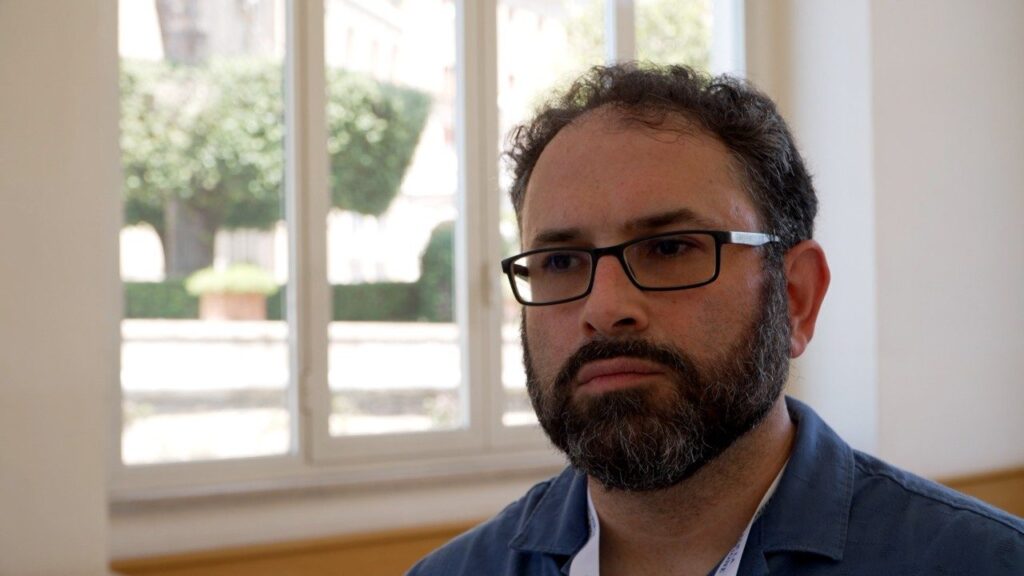
In the wake of the promulgation of Pope Leo XIV’s encyclical “Magnifica humanitas” one of Africa’s leading voices in artificial intelligence reiterates his conviction that Africans must not be excluded in global discussions regarding the development of AI.
By Linda Bordoni
As artificial intelligence transforms the way people work, communicate, learn and make decisions at a remarkable speed, one question is becoming increasingly urgent: Who gets to shape the technologies that are reshaping humanity itself?
For Professor Benjamin Rosman, one of Africa’s leading voices in artificial intelligence research, the answer is clear. If entire regions of the world are absent from the conversation, AI risks reinforcing existing inequalities rather than serving the common good.
Speaking to Vatican Radio following the promulgation of Pope Leo XIV’s encyclical “Magnifica humanitas On Safeguarding the Human Person in the Time of Artificial Intelligence” and his participation in the Vatican conference Preserving Human Faces and Voices, Rosman reflected on the challenges and opportunities presented by AI, the importance of including African perspectives in global discussions, and the moral vision outlined by the Pope in the encyclical.
Rosman is Professor of Computer Science, Machine Learning and Robotics at the University of the Witwatersrand in Johannesburg and Director of the Machine Intelligence and Neural Discovery Institute (MIND), South Africa’s leading interdisciplinary research centre dedicated to understanding intelligence in both humans and machines.
The institute, he explains, brings together researchers from fields as diverse as neuroscience, behavioural psychology, philosophy, ethics, governance, cognitive evolution and the creative arts.
“We’ve brought together academics from a broad cross-section of disciplines that have some sort of interest in core questions around intelligence, whether it’s artificial or natural,” he says.
The goal is not simply to develop new AI applications, particularly for Africa, but to address deeper questions: “What does it mean to engage with different kinds of intelligent entities? How should humans and AI relate to one another? And what can we learn about intelligence itself?”
Shaping AI or being shaped by it?
For Rosman, Africa’s participation in AI development is not simply a technological issue; it is a question of agency and responsibility.
“I think this is very much a question of: Are we to shape AI, or to be shaped by AI?” he says.
As AI increasingly influences every sector of society, from education and healthcare to governance and employment, he believes Africa must have a seat at the table where key decisions are made.
“As a proud African, we need to have our voice represented in this space,” he says. “But that representation can’t just be that we’ve got people who know how to use AI to solve their problems. We need to be sitting at the big table, so to speak, helping shape the development of the technology and the thinking around how it should interface with people.”
The issue extends far beyond technical expertise. It concerns values, culture, language and human dignity.
“If your whole ecosystem depends on using tools built elsewhere, paying monthly subscriptions and sending that value offshore, there are risks,” he explains. “The tools may not be built for the purpose. They may not reflect your cultural norms, your languages or the values that matter in your society.”
While Rosman hesitates to describe the situation as a new form of colonisation, he acknowledges that dependence on technologies developed elsewhere could create new forms of vulnerability.
“It could lead to dependency that is prone to geopolitical risks,” he says. “That’s why it’s really important that Africa – and every community around the world – has a voice in shaping how AI develops.”
The lessons of social media
Rosman sees clear warnings in the experience of social media, a technology that brought undeniable benefits while also contributing to polarisation, manipulation and the erosion of public trust.
“The damage that was caused by social media still resonates with me,” he says. None of these technologies is inherently evil, he explains, yet their design often reflects incentives that do not necessarily prioritise human wellbeing.
“What it has done to our attention, what it has done to the polarisation of society, has really changed the fabric of human interactions,” Professor Roman notes.
The concern, he adds, is that AI may amplify those dynamics on an even greater scale. “This isn’t just social media, (…) It’s touching on our work, our education, absolutely everything.”
At the same time, he warns against another emerging challenge: the race to gather data for AI development.
Many African languages and cultural traditions remain underrepresented in digital datasets. While collecting and preserving such knowledge is important, Rosman cautions that communities must also safeguard ownership and control over their cultural heritage.
“If we collect all of that and put it online, we run the risk that it can simply be scraped by large models,” he says. “People may end up giving up sovereignty over their own data.”
For this reason, he argues, AI governance must include voices from every region of the world. “The correct solution is for there to be people in the core of this discussion from every part of the world.”
South Africa’s role
Asked whether South Africa is prepared to meet this challenge, Rosman offers cautious optimism.
“It’s tough,” he admits. “But I think the net effect is yes.” He points to the country’s strong academic institutions, a growing ecosystem of talented researchers and companies committed to serving society. “There are a lot of smart people starting to find their voices in this space,” he says.
Yet, the professor continues, significant work remains to be done. “There’s a lot that’s disorganised and chaotic,” he acknowledges. “There is a lot of work needed in the way different entities engage with each other and engage with the government.”
Nevertheless, he remains convinced that it is not too late. “This is all pretty urgent, but I think the potential certainly exists to get this right.”
Humanity at the centre
Much of Rosman’s reflection echoes themes found in Pope Leo XIV’s encyclical Magnifica Humanitas. “There was a lot that resonated with me in the encyclical,” he says, noting that at the heart of the document is a simple but essential principle: “The core should be about humanity.”
He points out that, unlike previous technologies, AI is already entering into a unique kind of relationship with human beings: “We are already at a stage where AI stands in a relationship to humans in a way that no other technology ever has.”
Noting that in the encyclical, Pope Leo does not portray AI as either inherently good or inherently bad, Rosman says he is in accordance with his view on the nature of the relationship between human beings and technology and the fact that he insists that human dignity must remain at the centre.
“The way we should be developing and rolling out this technology has to emphasise human dignity and human flourishing,” he says.
He is concerned that the current trajectory of AI development is largely driven by competition. “There’s a global arms-race dynamic. There are different incentives within each company. There’s a lot of money being raised,” he says.
Against that backdrop, Magnifica Humanitas, he says, offers an alternative vision. “It talks about putting humans at the centre—not just concentrating power in some humans, but speaking to the diversity of humanity.”
AI, he says, should exist in the service of creating better conditions for people rather than serving narrow economic or geopolitical interests: “This shouldn’t be a discussion about employment, hoarding wealth and power, or geopolitical balances. It should be about our dignity.”
A need for moral leadership
If human dignity is to remain the guiding principle, Rosman believes stronger governance and greater moral responsibility are urgently needed. “What is needed at this time is stronger governance,” he says. “We need more moral responsibility.”
It is a message that resonated strongly during the Vatican conference, where scholars, ethicists, Church leaders and technology experts gathered to discuss how humanity can preserve its identity in a rapidly changing digital world.
A cautious optimism
Although he describes himself as “generally pretty pessimistic,” Rosman remains hopeful. He believes AI may ultimately prove to be the most significant technological breakthrough in human history.

“AI is the most important technical discovery we will ever make as humanity,” he says, noting that “There is huge potential for flourishing, but also huge potential for disaster.”
His concern is that there may be more ways for things to go wrong than to go right, yet wisdom, he says, can still make the difference: “It usually takes wisdom and clarity from humans to steer things in the right direction.”
Reflecting on his participation in the Vatican gathering and the audience the following day with Pope Leo XIV, Rosman says he left more encouraged than he has felt in a long time.
“You can’t change the rules of the game if you’re inside the game,” he reiterates, but voices capable of bringing together governments, companies and societies around a shared ethical vision can help reshape those rules. “If you have voices of wisdom and moral clarity that can seat all the players around the table and adjust the rules of the game,” he concludes, “then that becomes the way you make progress.”

Professor Rosman and other panelists during the Vatican Conference “Preserving Human Faces and Voices” (@Fatima Mesaud Barreras)