
The World Bank Group and Japan have expanded their partnership. This aims to help developing countries build stronger supply chains and secure energy systems. Geopolitical tensions are exposing weaknesses in global trade and energy networks.
World Bank Group President Ajay Banga and Japan’s Finance Minister Satsuki Katayama signed an agreement for two new initiatives. These initiatives aim to boost economic resilience, attract investment, and create jobs in developing nations.
The programs: Resilient and Inclusive Supply-chain Enhancement Plus (RISE+) and Dynamic Response for Invigorating Value Chains and Energy Security (DRIVE) enhance cooperation between Japan and the World Bank. They focus on two key areas: critical minerals and energy security.
Ajay Banga, President of the World Bank Group, said:
“We appreciate Japan’s leadership in enhancing critical minerals supply chain resilience through RISE+ and strengthening energy security through POWERR Asia” said “These initiatives will help countries turn growing demand for clean energy and critical minerals into investment, jobs, and economic opportunity that improve lives across developing economies.”
RISE: Turning Mineral Wealth Into Economic Growth
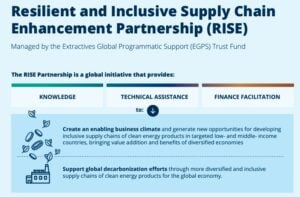
Japan will establish RISE+, a new $20 million facility under its trust fund program. This initiative expands the original RISE Partnership, launched during Japan’s G7 presidency in 2023.
The timing is crucial. Global supply chains face uncertainty as conflicts disrupt trade routes. Concerns about the Strait of Hormuz highlight vulnerabilities beyond just oil markets.
While oil often grabs headlines, the Middle East also supplies fertilizers, industrial materials, and minerals crucial for global manufacturing and clean energy. Disruptions can quickly impact industries worldwide.
Helping Developing Nations Capture More Value
RISE+ aims to help developing countries meet the rising demand for critical minerals. These minerals, such as rare earth elements, are vital for electric vehicles, batteries, and wind turbines.
The program will support infrastructure development, attract private investment, and strengthen supply chains linked to these resources. The goal is to export not just raw materials but also to help countries build industrial capacity, create quality jobs, and generate long-term economic value.
A key focus is connecting public- and private-sector efforts. By coordinating investments and development strategies, the World Bank and Japan hope to help resource-rich countries turn mineral wealth into sustainable economic growth.
Supporting Decarbonization and Local Development
RISE+ also promotes industrial decarbonization. Cleaner infrastructure and improved supply chains can cut greenhouse gas emissions and expand energy access in underserved regions. Better transportation and energy networks can raise living standards and create new economic opportunities for remote communities.
Katayama Satsuki, Japan’s Minister of Finance, said,
“Critical mineral supply chain diversification through RISE+, and promotion of resilient regional supply chains and energy transition in the Asia-Pacific through DRIVE are both win-win policies that contribute not only to the creation of high-quality jobs and sustainable economic growth in developing countries, but also to helping ensure stable supply for importing countries, including Japan. I welcome the opportunity to leverage the World Bank Group’s expertise and policy tools in advancing these initiatives.”
DRIVE Expands Support for More Resilient Energy Systems in Asia
Alongside critical minerals, the new partnership emphasizes energy resilience.
The DRIVE framework complements Japan’s POWERR Asia initiative, a $10 billion program. This program addresses fuel shortages and supply chain disruptions across Asia. The effort has taken on more urgency due to ongoing instability in the Middle East.
So through DRIVE, the World Bank Group will partner with Japanese institutions. These include: Japan Bank for International Cooperation and the Japan International Cooperation Agency. They will support countries most vulnerable to energy supply shocks.
The initiative will also combine sovereign financing, private-sector investment, technical expertise, and policy support. It will help governments improve crisis preparedness, manage supply chains, and secure access to critical energy resources during disruptions.
Supporting Vulnerable Countries
Another goal is to help countries collaborate and pool purchasing power. This will allow them to access essential supplies more efficiently and at lower costs.
Asia’s Clean Energy Is Growing, but So Is Demand
Asia is at the center of the global energy landscape. The region accounts for over half of global electricity demand and is experiencing rapid economic growth. However, countries are on different paths toward energy transition and security.
China has quickly expanded solar power and battery storage, while Southeast Asian nations balance development with rising energy needs. Despite these differences, energy security is becoming a core part of national economic strategy.
Recent data shows this shift.
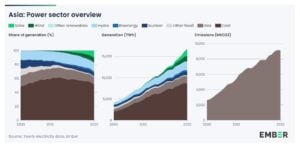
- According to Ember, in 2025, clean electricity accounted for 37% of Asia’s power generation, up from 34% the previous year. Wind and solar energy provided 17% of the region’s electricity, just above the global average.
- Renewable energy sources now account for nearly one-third of Asia’s power mix. At the same time, electricity demand continues to rise, increasing by about 5% in 2025.
But the Hormuz Risk Highlights a Bigger Challenge
Despite advancements in clean energy, Asia still relies heavily on imported fossil fuels.
The Strait of Hormuz is one of the world’s key energy chokepoints. About 80% of the crude oil passing through the strait goes to Asian markets, especially China, India, and Japan.
For Southeast Asian countries, this dependence is significant. Around 55% of ASEAN crude oil imports come from the Middle East, putting a large share of regional energy at risk if supply disruptions occur.
Why Diversification Is No Longer Optional
This reliance creates economic and strategic challenges. Higher energy prices can drive inflation, strain production, and slow growth. Supply disruptions can impact utilities, manufacturers, and transportation networks.
The current situation presents a paradox. Geopolitical tensions strengthen the case for renewable energy as countries aim to reduce fossil fuel reliance. However, these tensions also create short-term uncertainty that can slow investment and complicate energy transition plans.
As a result, governments in Asia are increasingly viewing energy diversification as an economic necessity and a national security priority.
The launch of RISE+ and DRIVE marks a shift in global development priorities. As supply chains grow more complex and geopolitical risks rise, countries seek greater resilience alongside economic growth. The World Bank and Japan emphasize critical minerals, energy security, and industrial development. They aim to assist developing nations in navigating an uncertain global economy and promoting long-term sustainability.