
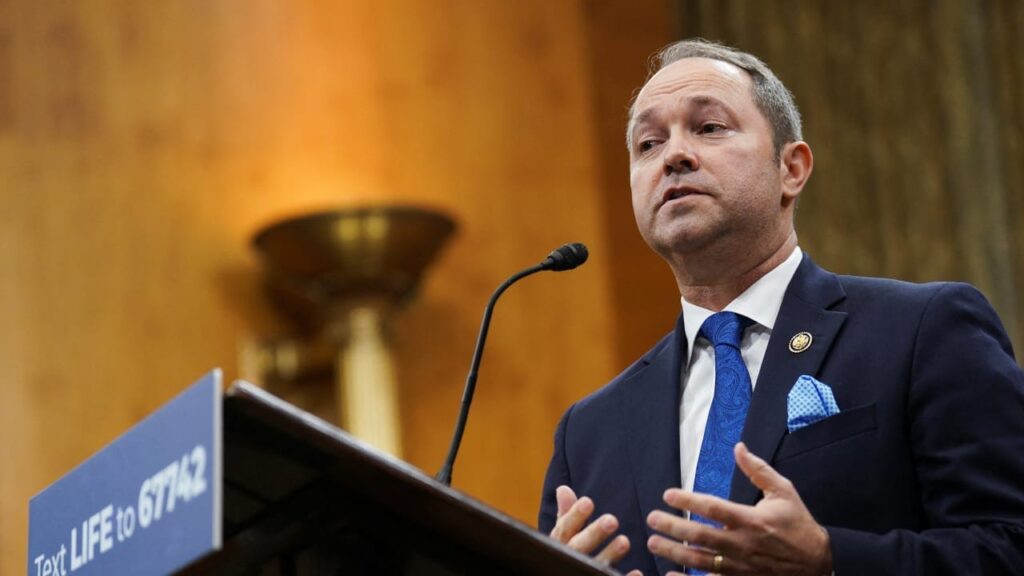
Rep. Marlin Stutzman (R-Indiana) has introduced a non-binding congressional resolution calling for negotiations on a new memorandum of understanding (MoU) between the United States and Israel that would gradually end the annual $3.8 billion in American military assistance to Israel and replace it with a broader framework centered on defense cooperation, trade, and joint technological investment.
The proposal, filed Wednesday, comes as the current 10-year MoU, signed in 2016 and providing $38 billion in military assistance through 2028, approaches its expiration date.
According to Stutzman, the initiative reflects both Israel’s economic transformation and the evolving nature of the alliance between Jerusalem and Washington.
“The idea is to take the relationship between two great allies, the United States and Israel, to a more mature relationship with a trade agreement, a defense agreement, rather than supplemental aid from the United States to Israel,” Stutzman told The Jerusalem Post in an interview discussing the measure.
The Indiana congressman said that Prime Minister Benjamin Netanyahu had provided him with a letter expressing support for the proposal following a meeting last month in Israel between the two.
“The time has now arrived for us to move from aid recipient to partner,” the prime minister wrote in the letter given to the congressman.
Stutzman meets with Netanyahu on defense aid
Stutzman said Netanyahu emphasized Israel’s growing economic strength and desire for greater self-sufficiency.
“As I met with Prime Minister Netanyahu last week, he made mention to me that Israel is now at 10 million people,” Stutzman said. “The economy is approaching a trillion dollars GDP. The country is strong.”
According to Stutzman, Netanyahu argued that “it was important to them that they stand on their own two feet and that the relationship between the United States be of mutual interest, independent countries standing together.”
The congressman stressed that ending direct military assistance would not weaken the alliance but instead redefine it around shared strategic interests.
“One of the things that we want to, first of all, acknowledge is that the relationship between the United States and Israel is strong,” he said, adding that the future partnership would be built around “mutual defense projects and joint economic investments and projects.”
He pointed to expanding technological cooperation as a key pillar of the envisioned agreement.
“The technology that is developed in Israel and the United States could be shared with each other because of our joint interest, joint investments, not only in the United States and in Israel, but other parts of the world between privately held companies,” Stutzman said.
Bill to end US military aid to Israel gains congressional support
The measure has already begun attracting support among congressional Republicans, according to its sponsors.
“We filed the bill yesterday. Abe Hamadeh (R-Illinois) and I are the sponsors of the bill,” Stutzman said, adding that support is emerging from lawmakers across several states, and from pro-Israel advocacy organizations and conservative groups.
“We have outside groups, like Family Research Council and Tony Perkins that support it,” he said. “AIPAC has signed off. We’re building this momentum and this support to move this direction.”
Stutzman argued that the proposal could appeal to both fiscal conservatives and traditional supporters of Israel.
“If you’re a budget hawk, you’re saving money,” he said. “If you are pro-Israel, this builds the relationship between Israel and the United States.”
“I can’t see why Republican or Democrat would oppose this,” he added.
The congressman framed the initiative against the backdrop of growing American skepticism toward foreign aid spending, while distinguishing Israel from many other recipients of US assistance.
“Israel is a very small piece of foreign aid,” Stutzman said. “You look how much money has been sent to Ukraine to fight back against Russia. You look at the amount of money that we spend in Africa on African countries in foreign aid. There’s money that has been sent to Pakistan and Afghanistan, and they don’t even like us very much,” he said.
The congressman said that, in Israel’s case, the country’s strength now justifies a new approach.
“Israel is a superpower in the Middle East,” Stutzman said. “I can’t think of a greater ally to the United States than Israel”.