
As part of our Language of Soccer World Cup series, The Athletic is speaking to supporters of all 48 nations competing at the 2026 edition to capture their unique football culture, distilled into a single phrase. You can read the articles in one place here.
Vollig losgelost — Completely detached
“Patriotism in Germany is complicated. When I was younger, you didn’t really see the country’s flag very often — at least not until the World Cup in 2006 (when they were the host nation).”
Thomas has some wariness. Germany’s political situation is fractious. There are even some contrasting perspectives in his own family, he explains, so he prefers that we don’t use his full name.
But national unity still fascinates him.
“In 2006, I probably wasn’t old enough to really understand it — I was still a teenager, and I didn’t really have anything to compare it to — but you saw the colours everywhere. I remember going out after the penalty shootout against Argentina (to put Germany in the semi-finals) and seeing cars drive by with the tiny flags stuck on their windows.
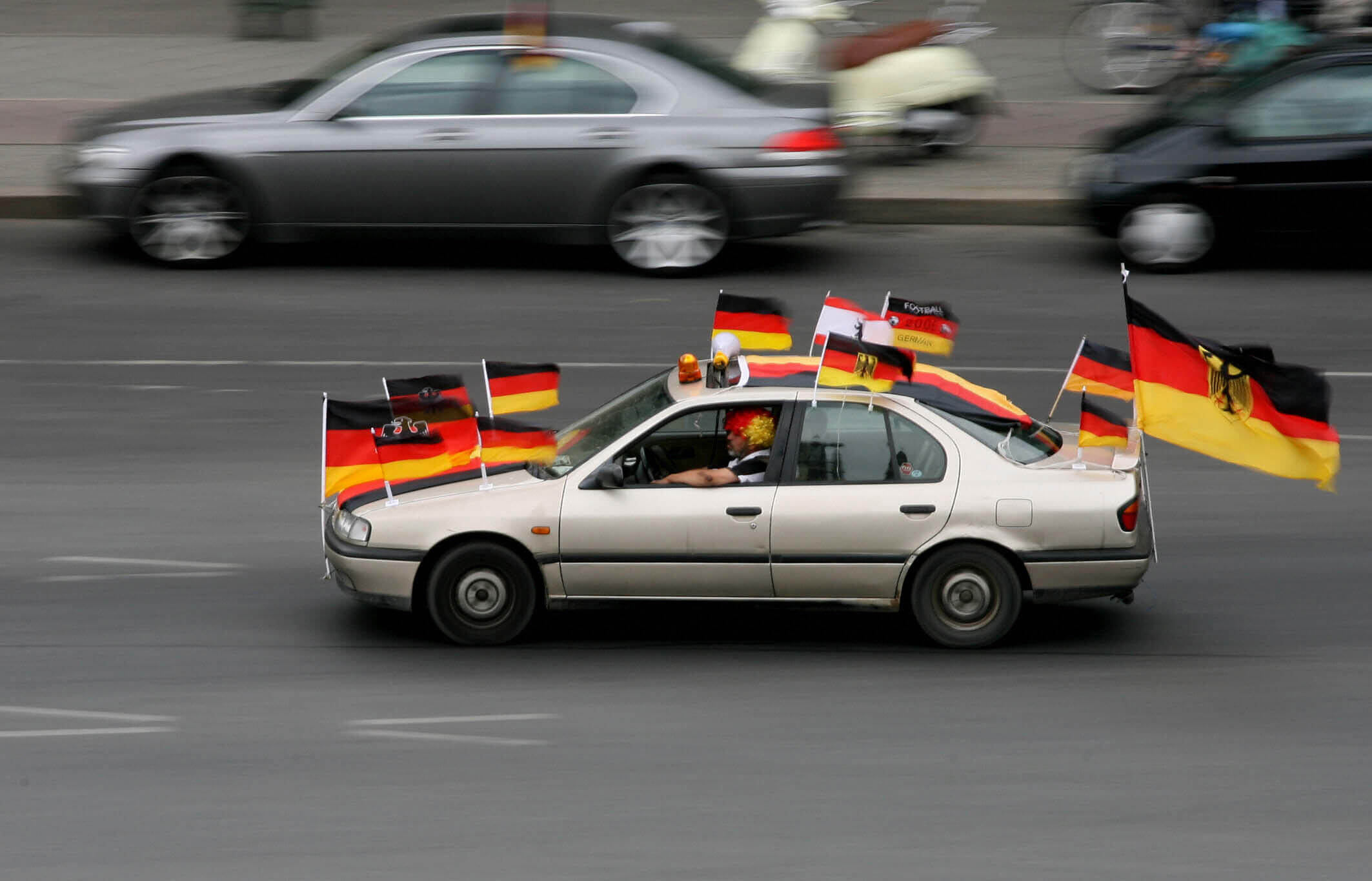
A German fan drives his car through Berlin during the 2006 World Cup quarter-final against Argentina (Sebastian Willnow/DDP/AFP via Getty Images)
“That was really the first time, and I know this sounds stupid, but being German felt… cool?”
Twenty years is a long time.
Germany have not won the World Cup since 2014. And in those two subsequent tournaments, they suffered humiliating group-stage exits, which — combined with various political sagas and scandals — left the national team and its public in an awkward embrace. Getting to the last eight in a home European Championship in 2024 (where they took eventual winners Spain to extra time before losing 2-1) went a long way to repairing that relationship, but a singular supporter identity is hard to pin down.
Malte Thoben is the president of Across The Pitch, a national-team fan club comprising German students currently living in the United States.
“As a national team, we don’t have chants,” he tells The Athletic. “We really just borrow from club teams. It’s not like England. We don’t really have ‘It’s Coming Home’ (Three Lions). Nothing like that. “
In a way, albeit ironically, Three Lions — written by British comedians David Baddiel and Frank Skinner ahead of Euro ’96 — became a German football favourite. After manager Berti Vogts’ side won that European Championship, defeating host nation England on penalties in the semi-finals, the trophy came to their home and the song tagged along with it.
When they returned to Germany, they held a public celebration in Frankfurt. Standing on the balcony of the town hall, Jurgen Klinsmann, the captain, led the thousands below in a gleeful chorus of Three Lions. In the weeks after, inspired by Klinsmann and schadenfreude, it actually reached number 16 in the German charts. By the end of 1996, Baddiel and Skinner were even performing it on German television, as part of a review of the year.
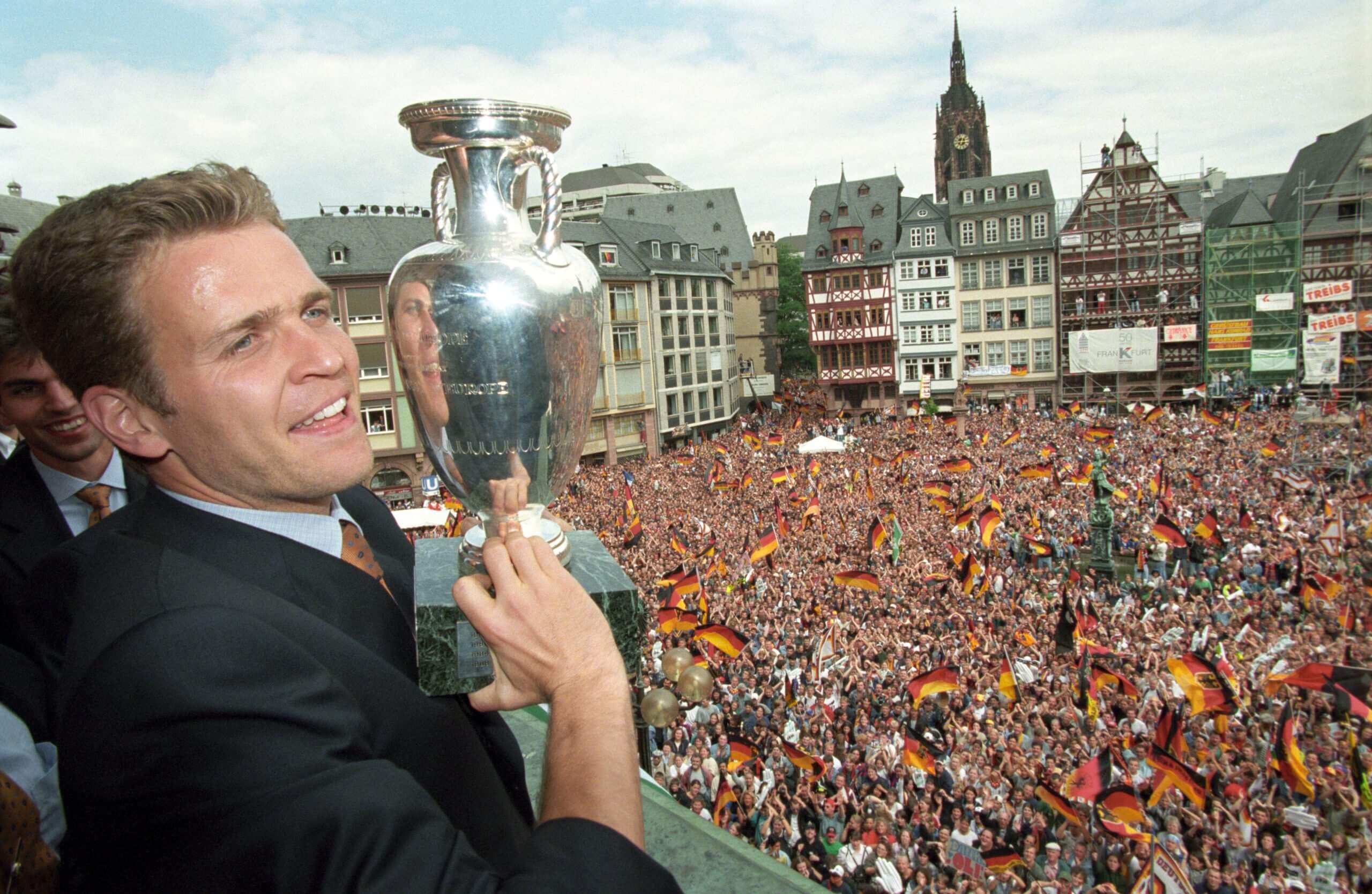
Oliver Bierhoff shows off the European Championship trophy in Frankfurt in 1996 (Arne Dedert/Picture Alliance via Getty Images)
The song has not quite remained on heavy rotation in the years since, but you do still hear it at times; evidence of a sense of fun which the German people are not often credited with but nevertheless runs through the country’s sporting landscape.
In the present day, it’s another unlikely song that has come to unify the fanbase: Peter Schilling’s Major Tom (Vollig losgelost).
A major hit for Schilling in 1983, it has remained embedded within the culture. In 2024, following a fan petition, it officially became the national team’s goal-celebration music — torhymne, in German — and has been the soundtrack to their games more or less ever since.
Understanding why and how is more elusive, even if everyone knows how the song makes them feel.
“I was at three games at the (2024) European Championship — against Scotland (the tournament’s opening group match), Denmark (round of 16) and Spain — and I remember the song from those,” Malte says. “Particularly after the defeat by Spain (a rollercoaster of a game where the Germans equalised in the 89th minute to force extra time, then Spain won it in the 119th minute just as everyone was bracing for penalties), when the sun was setting afterwards. It helped create such good memories.”
Marvin Coors, another Across The Pitch member, describes a cross-generational familiarity which has helped to bind fans from a highly regional and federal country in both a political and personal sense: “I don’t know exactly how old the song is, but it’s really old, and so every German knows it and loves it. It has become incredibly popular.”
Helen, who would prefer we don’t use her surname, belongs to the same fan group and will also be travelling across North America for the games this summer (Germany play Curacao in Houston, Texas, then Ivory Coast in Toronto, Canada, and Ecuador just outside New York City during the group stage). She agrees with Marvin’s point.
“The fact that it’s so old helps too, because I know it, my parents know it, so do my grandparents,” she says. “It’s a song for everyone, and that’s why it worked, I guess. Plus, the lyrics are very euphoric, and so it resonates with successful moments. It got really big on social media, too, and that’s partly because of a saxophone player.”
That saxophone player was Andre Schnura, and he was a story.
Schnura was a music teacher who lost his job shortly before Euro 2024. Suddenly with a lot of free time, he picked up his saxophone, put on an old Germany replica shirt with former striker Rudi Voller’s name on the back and a pair of sunglasses, and started playing for supporters in different cities during the tournament.
By Germany’s last group game, he was a national celebrity and being held aloft by hundreds of people as he played in fan parks across the country. Before that quarter-final with Spain in Stuttgart a couple of weeks later, he was on stage with Schilling there, blowing his saxophone as an accompaniment to Major Tom’s soaring chords.
“Dann hebt er ab und!
Vollig losgelost
van der Erde
schwebt das Raumschiff
vollig schwerelos”
Schnura completed a nationwide tour in the months after the tournament and today, even though he has “retired from public life” per his Wikipedia entry, his trademark sunglasses are in the National Football Museum in Dortmund.
Explaining that ascent needs context. Before those Euros, Germany was desperate to recapture the mood that surrounded the World Cup there 18 years earlier — the flags, the patriotism, the national pride that Thomas spoke about, that formed what became known as the Summery Fairytale. That Schnura and Schilling and, ultimately, the great sense of fun and togetherness were all embraced was largely because everyone was so desperate for it to happen.
As Helen describes, it’s what many Germans search for at football tournaments.
“What I love about the World Cup and the Euros is the immense feeling of unity that spreads across Germany instantly,” she says. “Despite any societal or political problems, everyone comes together. For that month, we get to be proud of our country without hesitation. Suddenly, there are flags everywhere, that are usually almost taboo.
“It makes me sad that open patriotism can feel uncomfortable in Germany. I understand why, but it’s still my country and our beloved soccer team. I think one of my favourite moments will be singing the anthem at my first live soccer game.”
The first anthem, but then the second.
In English, Vollig losgelost means “completely detached”. The lyrics of Major Tom are about an astronaut who chooses to float away into oblivion, beyond the constraints of Earth and humanity. Trying to find irony in its popularity with German football fans — a disconnected group, searching for togetherness — is too deep a reading and overlooks the power of a good chorus.
But it’s an interesting commentary nonetheless.
The Germans are on their way to the 2026 World Cup; as one, and to the sound of a 43-year-old pine for loneliness, set to the seductive chimes of electro-pop.
The Language of Soccer series is sponsored by Google.
The Athletic maintains full editorial independence. Sponsors have no control over or input into the reporting or editing process and do not review stories before publication.