
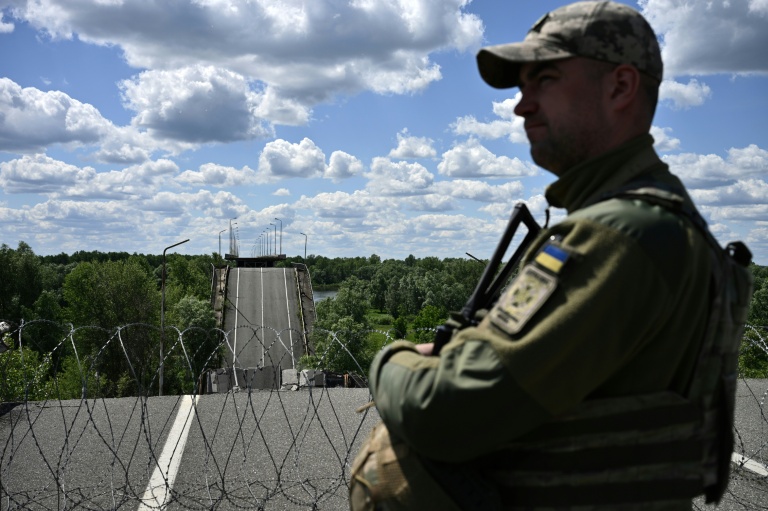
Border guards from both countries kept their eyes fixed on the overgrown road leading to the ruins of what was once a bridge linking Ukraine and Belarus, with fears in Kyiv that it could once again become a flashpoint.
When Russia invaded Ukraine on February 24, 2022, it used Belarusian territory as a springboard, sending thousands of troops across the border to try to capture Kyiv, just 100 kilometres (60 miles) to the south.
In recent weeks, Ukrainian President Volodymyr Zelensky has said multiple times that Russia could be preparing a repeat attack.
Along the 1,000-kilometre (620-mile) border, troops from both sides face each other with suspicion.
“They can see us from across the river, with their cameras,” said the Ukrainian deputy commander of the border post, whose nom de guerre, “Brat”, means “brother”.
Weapon in hand and looking out across the Dnipro river, he was on alert, despite the stillness of the forest.
The post still bears the scars of the Russian attack in 2022, when it was shelled to make way for armoured vehicles.
“We had to blow up this bridge to stop the enemy columns,” Brat told AFP.
– Calm tension –
Moscow and Minsk last month held joint military exercises involving nuclear weapons on Belarusian territory.
Soon afterwards, Zelensky ordered security to be reinforced along the northern border, saying Moscow was trying to draw Minsk further into the invasion.
At the checkpoint, Brat said he had not seen evidence that an attack was imminent.
“We are not currently observing any changes in the situation,” the 31-year-old guard said.
“No armed formations or military equipment are being detected in the border area on the Belarusian side.”
Nearby, rusting signs — a mix of Ukrainian, Belarusian and Russian — swayed in the wind.
Behind coils of barbed wire, Ukrainian guards scanned the opposite bank.
From the air, the border is a stretch of forest, winding river and barbed wire.
Hidden beneath a tree, two Ukrainian border guards who go by the names “Alex” and “Chip”, were watching footage being relayed by a surveillance drone.
It showed Belarusian border guards patrolling the river in motorboats.
The two sides regularly pass each other on the river — keeping their distance to avoid any incidents.
Rival drones also keep watch from the air, careful not to cross the invisible border.
“Perhaps somewhere deep within the territory of the Republic of Belarus, something might be happening,” Chip said.
“But we aren’t seeing it.”
Breaking the silence were cuckoo calls and the hum of a Soviet-era tractor.
– ‘Be ready’ –
Analysts say a new Russian or Belarusian offensive into northern Ukraine is unlikely, pointing to Moscow’s lack of manpower for a major ground operation.
Kyiv had issued similar warnings in 2023 and 2024 but nothing materialised.
Still, many had doubted Russia would launch its full-scale invasion before February 2022.
“It is not a question of whether you believe it or not,” Chip said.
“We must be ready for any situation. As for how it will turn out — time will tell.”
The drone returned, landing softly in the grass as an elderly woman cycled past.
Along the 40-kilometre stretch between the border and Chernigiv, the regional capital, armoured excavators were digging trenches.
Anti-drone nets stretched above checkpoints — measures previously reserved for frontline combat zones.
In the city centre, life appeared calm.
Olga Vasylekno was walking through a sunlit park, past crowded cafe terraces with her son and partner.
Yet she was not completely at ease.
Responding to Zelensky, Belarusian President Alexander Lukashenko said Minsk would “never” deploy troops in Ukraine.
But he also said he knew of “a big target” near the border.
Russia occupied part of the surrounding region for a month after it invaded in 2022, laying siege to the city of some 300,000.
Fears that it could happen again have become a topic of conversation.
“We have to cope with this,” Olga said.
“We ourselves understand where we live, in a city near the front line.”
“Nobody rules out the possibility of this,” she added.
Behind her, cranes were repairing buildings damaged in recent Russian strikes.
“I have faith in our armed forces and believe they won’t let them through,” she said.
Still, her evacuation bag is already packed, just as it was in 2022.
fv/ant/str/jc/phz