
Gokhan Ergocun
05 June 2026•Update: 05 June 2026
- 5.8T plates of food go to waste globally every year before reaching people in need
- 673M people struggle with hunger, while more than 2B lack adequate nutrition
Türkiye’s first lady Emine Erdogan underscored the strategic value of the zero waste movement, saying it is a bridge uniting many ways of fighting climate change and the most transformative power of the climate struggle.
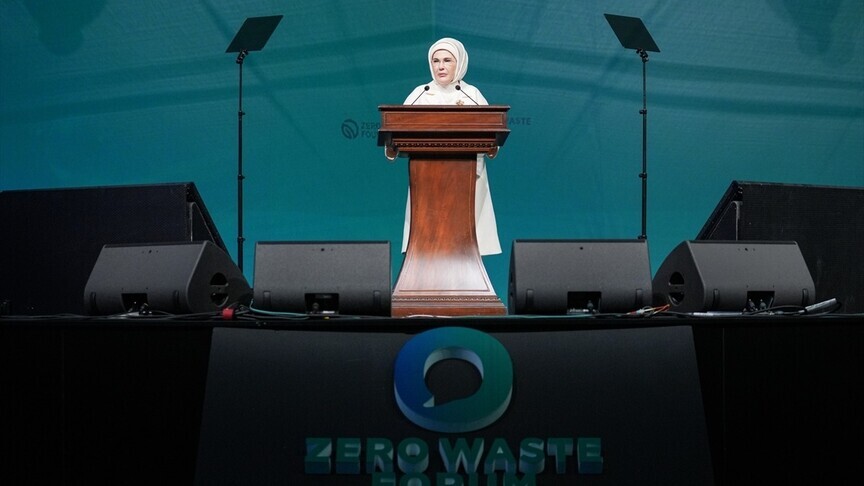
During her address at the opening of the Zero Waste Forum 2026 in Istanbul on Friday, Erdogan stated that officials see the Zero Waste Forum 2026 as a historic gathering where the human family unites around a common ideal.
She added that this strong international participation is a concrete manifestation of President Recep Tayyip Erdogan’s message that the “world is bigger” than five because “humanity is bigger than five.”
Attending the opening of the forum at Istanbul Ataturk Airport, she said Istanbul is the longest-living capital of the world and hosted representatives from 183 countries, more than 500 institutions, and over 5,000 participants today.
She expressed her hope that the synergy rising from the forum will lead to brand-new beginnings for the common future of humanity.
The first lady thanked the Zero Waste Foundation, ministries, and the Istanbul Governorate for their tremendous efforts in organizing one of the most comprehensive international environmental gatherings in the world.
Erdogan highlighted that a 1.6-million-square-kilometer garbage patch in the North Pacific Ocean stands as a monument to the tragedy of humanity recklessly consuming its resources.
She warned that this waste accumulation, which is almost twice the size of Türkiye, reveals the crisis of waste and consumption behind the climate crisis.
The daily dumping of plastic waste equivalent to 2,000 garbage trucks into oceans is not merely a waste management issue, she added.
She emphasized that the spread of microplastics from Antarctica to the summit of Mount Everest is not an ordinary environmental pollution incident.
Humanity’s journey back to its essence
The first lady pointed out the stark contrast in a world where landfills overflow with unworn clothes and discarded food while millions of people cannot meet their basic needs.
Using disposable products destroys both natural resources and fundamental human values by building a false comfort zone out of plastics while damaging the common sense and conscience of humanity, she said.
She stated that humanity is leaving behind a broken scale of justice along with a heavy ecological burden for future generations instead of increasing collective happiness by sharing.
The zero waste initiative serves as a ticket for humanity’s journey back to its essence, she remarked.
Erdogan also noted that the Zero Waste Foundation, launching its operations in 2023 following the movement’s start in 2017, elevated this vision to a new international level.
She explained that the forum coincides with the COP31 Climate Summit that Türkiye will host, offering a crucial opportunity to explain the strategic value of zero waste in climate action.
While there are many ways to fight climate change, zero waste is a bridge uniting all these paths and the most transformative power of the climate struggle, she added.
2 billion tons of wasted food
The first lady proposed zero waste as a climate action ahead of the upcoming summit.
Erdogan shared striking statistics, noting that 5.8 trillion plates of food go to waste globally every year before reaching people in need.
More than two billion tons of food go to waste in fields, restaurants, and markets, consuming nearly one-third of agricultural lands and causing 14% of methane emissions.
She painted a tragic picture of the human cost, reminding the audience that 673 million people struggle with hunger while more than 2 billion lack adequate nutrition.
Half of the children who die before reaching the age of five succumb to starvation, she stressed.
Erdogan underlined the bitter reality that saving just one-quarter of the wasted food could end global hunger completely.
She highlighted that households generate 60% of total food waste.