
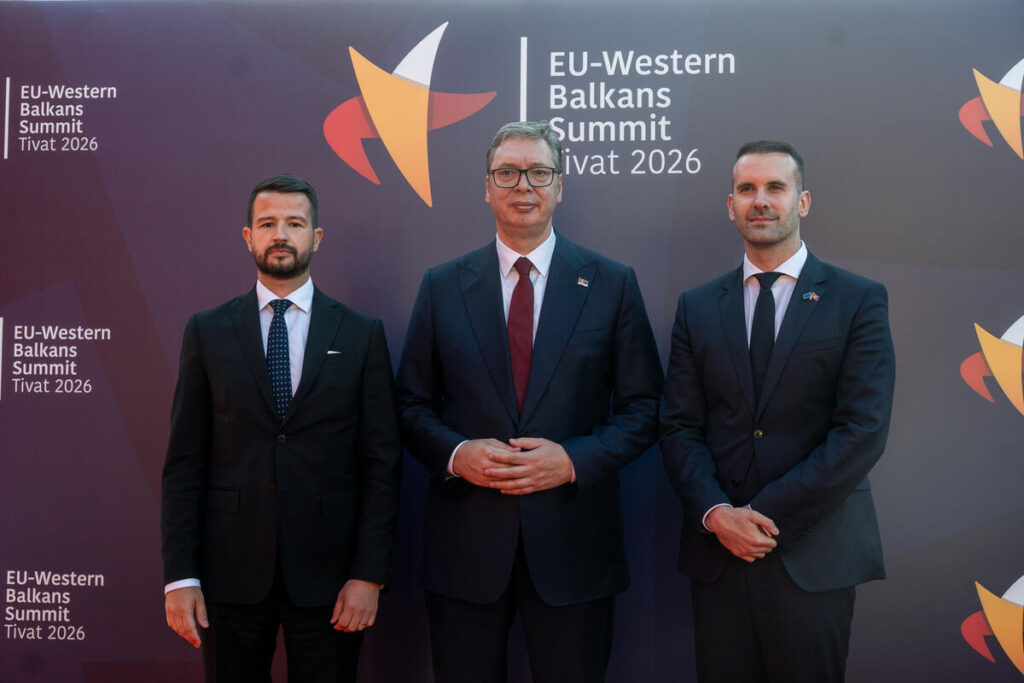
Montenegro is increasingly moving ahead of Serbia in European integration. While Serbia has practically lost external political support and funds from the European Union (EU), Montenegro, in contrast, stands out as a leading country in European integration. Montenegro’s entry into the EU would “deal” a slap in the face to the regime of Serbian President Aleksandar Vučić, according to the interlocutors of the Belgrade-based daily Danas.
They were answering a question from Danas about how Montenegro’s accelerated European path towards the EU affects public opinion and Serbian citizens, while Serbia only receives criticism and even has its payment of money from the Western Balkans Growth Plan delayed due to the character of Aleksandar Vučić’s regime.
Violent attitude towards the rebellious part of the people, corruption, consequent deaths of people, lack of media freedom, absolute control of institutions…
Serbia is in a serious and comprehensive crisis, increasingly isolated internationally
“The citizens of Serbia will only soon learn the extent of the impasse that Vučić’s government has led them into. For now, they are not sufficiently aware of it due to the shameless lies of his media. But the truth can never be hidden forever. The little Montenegro that they despise, thanks to its true commitment to EU integration, is moving away from Serbia more and more rapidly,” Žarko Korać, a retired professor at the Faculty of Philosophy in Belgrade, tells Danas.
As he adds, the latest political scandal in relations between Serbia and Montenegro, related to sending a plane full of criminals and hooligans to Tivat ahead of Vučić’s visit, whom Montenegro expelled from the country at the suggestion of the French intelligence service, has completely opened the question of why Belgrade is increasingly aggressively denying Montenegro’s independence and its independent path to the EU.
“It is as if the referendum on independence twenty years ago never happened and as if Montenegro is some runaway part of Serbia, which it has never been in history. Vučić has previously accused the Democratic Party government of ‘allowing Montenegro to leave’, but in recent months the attacks on Montenegro have become increasingly severe, and it is being accused of being an anti-Serbian and criminal state, which even threatens Serbia,” explains the Danas source.
The question arises, he continues, why is Montenegro now so exposed to attacks, when Vučić’s regime is in a serious crisis because it has lost both external and internal support?
“Croatia is usually attacked according to Šešelj’s favorite pattern, but now Montenegro has taken the lead. The answer should be Montenegro’s foreign policy position and its results in EU integration. While Serbia has practically lost external political support and EU funds, Montenegro, quite the opposite, stands out as a leading country in EU integration. To put it ironically, one ‘eye in the head’ sees ever further, while the other, staring at its navel, sees nothing more. So the answer is simple, Serbia is in a serious and comprehensive crisis, and is increasingly isolated internationally, while Montenegro, despite its weak and divided government, has increasing international support on its path to the EU,” says the Danas interlocutor.
According to him, the Serbian government is clearly having a hard time accepting its inferior international position. Hence, he believes, the courting letter to Trump, the portrayal of the working visit to China as the crowning achievement of Vučić’s wise policy, and the constant attacks on Croatia as a political and military enemy.
With the fall from power of Viktor Orban, the former Prime Minister of Hungary, says Korac, Serbia has lost its last political support within the EU.
“She was left alone in her hatred of her surroundings and the students who knocked on her door. And that was to be expected,” concludes Korać.
“Montenegrin EU membership is a wind in the sails of the Serbian opposition”
On the other hand, Đorđe Vukadinović, political analyst and editor of Nova srpska politika misla, believes that, excluding a small percentage of professionally connected people, as well as those with strong ideological affiliations, the topic of European integration currently does not have much significance and influence on the mood and commitment of the Serbian electorate.
“It hasn’t always been like this, but this is, among other things, the result of Vučić’s long-term rule and the systematic killing of every serious political topic and debate. On the one hand, the government ritually and constantly swears by the ‘European path’, while on the other hand, it periodically runs fierce Europhobic campaigns, and so on in a circle. And it should be said that, to put it mildly, the EU has not exactly broken away from principle and consistency either,” says Vukadinović.
In the end, the outcome is a roughly “half-and-half” situation, where pro-EU sentiment has a relative, but not impressive, majority, as well as not too great mobilizing potential, he adds.
In this light, Vukadinović points out, Montenegro’s rapid entry into the EU would not have too great, or at least not directly, impact on the rating and political situation in Serbia, but it would certainly represent a kind of slap and blow to, above all, Vučić’s vanity.
“However, Montenegrin membership could have a more tangible impact on local pro-European opposition forces and represent a kind of wind in their sails,” Vukadinović concludes.
“Montenegro’s entry into the EU will only further show how much Vučić has set Serbia back”
The representative of the pro-European opposition, the leader of the Democratic Party, Srđan Milivojević, points out for Danas that the attitude of Serbian citizens towards Vučić’s regime is already completely clear: the vast majority of citizens not only do not support this mafia regime, but despise it.
That Vučić himself knows this, he says, is best demonstrated by the fact that he has not been allowed to call elections for a year and a half, but is instead trying to buy time and prolong the regime’s survival through brutal repression, violence and propaganda.
Montenegro’s entry into the European Union will only further demonstrate how far Vučić has set Serbia back. From a country that is the natural leader of the region and should have led the Western Balkans in European integration, he has turned it into a captive state under mafia control, a source of instability and an object of ridicule in Europe.
“I am certain that, thanks to the rebellious citizens and students, Vučić will not remain in power or at large long enough to see Montenegro formally join the European Union. For the sake of Serbia’s prosperity and the stability of the region, he must be removed from power as soon as possible and prosecuted in accordance with the laws of the Republic of Serbia,” concludes the Danas source.
Download the app and follow the news


FOLLOW US ON

News