
PINHÃO, PORTUGAL — This little river town on the Douro River plays a key role in Allen Levi’s charismatic novel “Theo of Golden,” which I had purchased in JFK’s international air terminal before boarding a seven-hour flight to Lisbon. The book’s central character is Theo Zila, 86, a kindly Portuguese man born here in the heart of port wine country.

“Theo of Golden” by Allen Levi.
Provided
The novel is about Theo’s profound, yearlong residence in fictional Golden, which is much like the author’s hometown of Columbus, Ga., near the Chattahoochee River. Beautiful rivers play a spiritual role in this book, and I admit that reading Levi’s beguilingly simple words a week prior to Easter while cruising the Douro River has been, well, a religious experience — especially at sunset when matched with a glass of vintage port wine for which the region is famous.
Douro Valley vineyards are terraced in lovely, long waves up the sides of golden-green slopes complemented by tall eucalyptus forests, stocky olive trees and glorious blankets of white almond blossoms. Magnifico!
Our riverboat overnighted in Pinhão, and the travelers were entertained onboard by a large, authentically attired folk-dancing “family” of locals that included singing musicians playing guitars, accordions and a bass drum. The men, women and children performed while pretending to hoe rows and gather grapes in huge baskets, then haul each load down the hillside to be stomped, infused with brandy and aged for 40 years or so.
Along the Douro River, there are port wine terraces.
John M. Burbage/Provided
As in other Western countries, most folks here are friendly and seem to be very happy. Most drink port wine (red, white and amber) and eat a lot of cod fish prepared in numerous ways, along with various meats and vegetables, cheeses, rice, potatoes and custard tarts (nata) for dessert. In Portugal’s north region, firemen with their spirited marching bands and blaring firetrucks parade through the streets on spring weekends. These volunteer fire brigades proudly celebrate their unselfish commitment to community service.
Wildfires are common here because eucalyptus trees — an invasive species — are extremely flammable. The government placed limits on growing the trees imported years ago from Australia. Farmers generally ignore the legislation, because the wood is profitable as pulp and for heat in home hearths. Unlike eucalyptus bushes, these pervasive trees grow fast and tall like Southern pines, and numerous tracts of burned-out forests stand out — black and skeletal — along verdant mountain sides as dead reminders of happier days.
Townhouses are often painted in pastels akin to those along historic Charleston’s “Rainbow Row” on East Bay Street. Also, as in Charleston, church bells ring profusely on Sundays in Portugal.
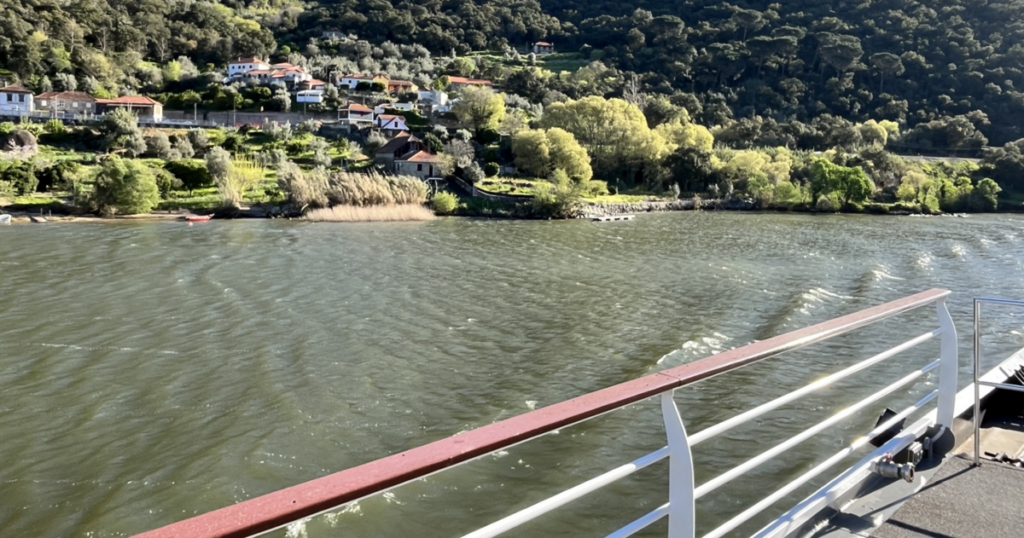
The reflection of green in the water was a lovely sight.
John M. Burbage/Provided
In the medieval city of Guimaraes, considered the cradle of Portuguese civilization, a large gathering of folks smartly dressed in white appear to be line-dancing in a city park among blooming red camellias, yellow tulips and purple pansies surrounded by odd-shaped sycamores, gums and spongy-bark oaks that provide most of the world’s wine corks. I later learned that the dancers were not performing the flamenco-inspired Macarena or anything else. They were participating in an elegant community exercise program.
Northern Portugal’s countryside reminded me of southern Greece with farms, vineyards, olive trees, churches, small industries, colorful villages and block houses with tile roofs and solar panels. Also, a smattering of modern, slow-turning windmills line treeless mountain ridges. Sadly, the counter-productive practice of clear-cutting hardwoods to accommodate fields of high-maintenance solar panels and jet-age windmills seems universal.
Although living in Portugal is cheaper than the United States, average Portuguese salaries are so low that young families cannot afford to purchase houses. Interest on home mortgages is 4.5 percent, monthly pay per family before taxes is equivalent in Euros to approximately $1,400, and the average monthly mortgage payment for a decent three-bedroom domicile is more than $2,000.
A winery, vineyards and almond trees on the Duoro River.
John M. Burbage/Provided
Portuguese people love their coffee extra strong, as does Theo of Golden, who on his first morning walk in the fictional Georgia town is lured into the Chalice coffee shop on Broadway “where the aroma of caffeine hung like a scented cloud,” writes author Levi. “Theo was used to the strong coffees of Europe — the abatanado and café pingado in Lisbon; café con leche in Madrid; expresso in Bologna; café noisette in Marseilles. But American shops had often disappointed him, even in New York … His standards, he had been told, were rather exacting.”
The Portuguese have a coffee tradition that reflects its amazing maritime history, including the colonizing of Brazil in the 1700s where innumerable tons of rich, dark beans were planted, cultivated, picked and packed in barrels on coffee plantations by untold numbers of enslaved Africans and Indigenous people who for two centuries lived, worked and died there.
Like Africans and Native Americans who worked and died in bondage in Charleston and throughout the American South, the enslaved people of Brazil fused hard labor with their music, song and dance to produce a spirited New World culture, which is also popular in northern Portugal.
Beautiful blue and white tiles in Porto, Portugal.
John M. Burbage/Provided
In Levi’s novel, the Crucible coffee shop — with its walls covered in 92 pencil-sketched portraits of a wide array of town residents done by a local artist — is the focal point of love and respect for one another that Theo inspires in virtually everyone he meets. The coffee, the artist, the portraits and Theo’s infectious compassion also play central roles in this most unusual novel.
Having arrived in town just before Easter, “Theo lived in Golden for only a year, from springtime to springtime,” the author notes in his prologue. The old man’s fast-growing array of friends are deeply affected by his genuine love of people, art and the always flowing rivers: the Douro of his childhood as a farmer’s son east of Porto; the Seine of Paris during his glory days; the Hudson of his retirement in New York City; and now the “Oxbow River,” outside a lovely apartment atop three steep flights of stairs in the Ponder House, a few doors down from coffee shop, across the historic promenade and near the enchanting fountain encircled by comfortable benches in downtown Golden.
Flowers bloom in Portugal.
John M. Burbage/Provided
As Theo’s story unfolds, the people Golden’s lives merge into a potent blend of the promise of what the love of God and the respect for all creation are supposed to be. A trip to the golden-green valleys of Portugal’s Douro River underscores the magnificence of this universally appropriate rule.
John M. Burbage is a lifelong newspaper journalist, editor and publisher who lives at Stono Ferry in Charleston and on a farm in Hampton County.