
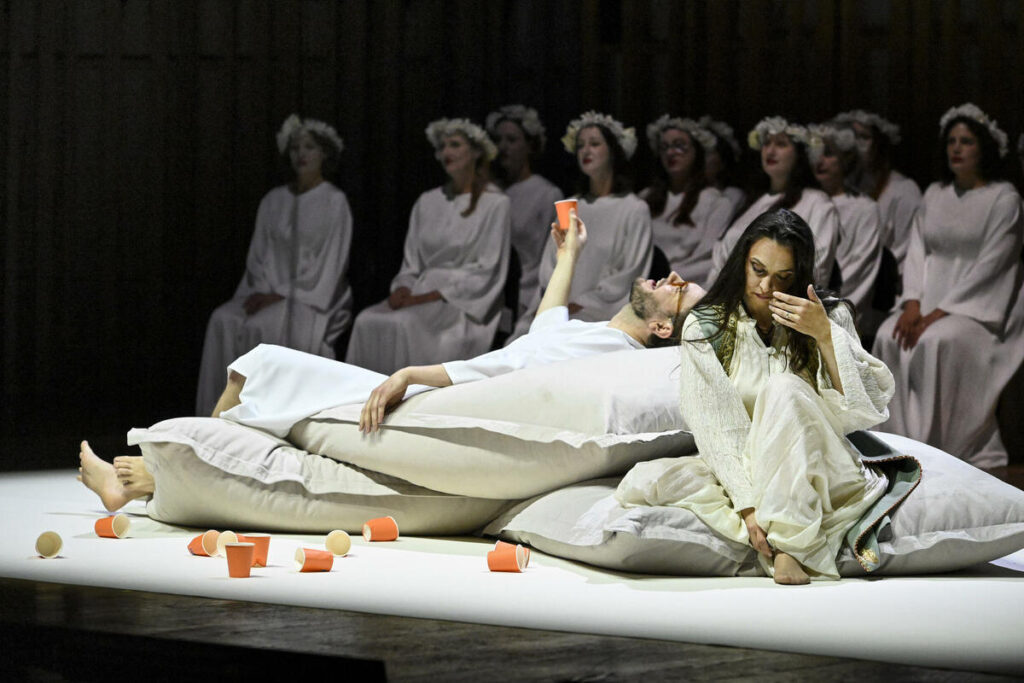
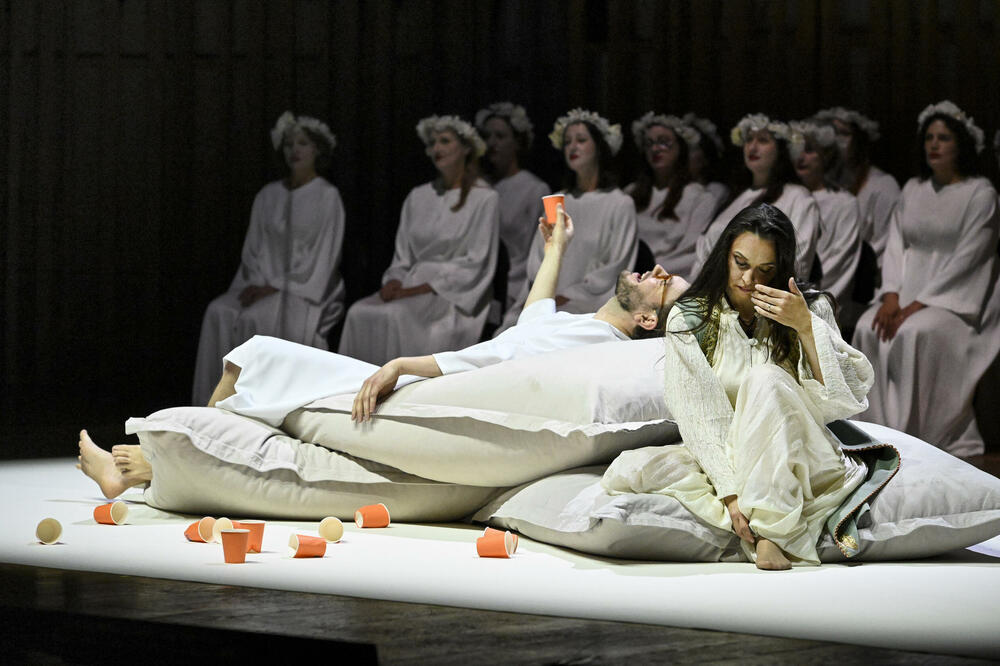
From the performance of “La Montagne noire” in Bordeaux, Photo: Frédéric Desmesure
Did you know that the first opera composed by a woman in the history of the Palais Garnier in Paris was titled Montenegro (La Montagne noire)? It is a masterpiece by a French composer of Irish descent. Ogiste Holmes (Augusta Holmès) from 1895, a fact about which unfortunately very little is known today, both in France and in our region. History has not been kind to female creators: Holmes is only the fifth woman in the history of the Paris Opera (established in 1669) to have her work performed on the big stage. After only 12 performances, the work sank into oblivion forever, and in addition to the undisguised jealousy and misogyny of some critics, she was also accused of “Wagnerism”, the influence of the German composer Richard Wagner who has been hated by the domestic public since the Franco-Prussian War, and whose aesthetics were considered outdated in 1895 (the attention of Parisian listeners was now turned to Debussy and in a more modern expression). Let us also mention that this work was broadcast directly by telephone at its premiere via the “Teatrofon” (which was particularly used by the writer Marcel Proust), a kind of pioneering streaming service of its time.
It is not known what influenced the author in choosing the content for her opera. Montenegro as a theme was affirmed in the French public after it gained independence in 1878 at the Congress of Berlin. French readers and the public perceived this small mountainous country as a bastion of freedom and resistance to the Ottomans, a defender of Christian civilization that did not yield even to Napoleon’s troops, amazed by the natural beauty and intrigued by the exoticism of the local customs (rural life and strict patriarchal culture). Librettist and critic Gale’s weight described this view most eloquently on the occasion of the premiere of the opera Montenegro: “Montenegro is one of the few truly romantic countries left to us; it is still shrouded in a veil of legend. On the slopes of its high mountains, among beeches and wild pines, or in its desolate and rocky gorges, lives a population of highlanders – a people fierce and generous, of bold courage, at the same time warlike and pastoral, loyal to family and homeland traditions, passionately jealous of their freedom. […] There, of course, in addition to the picturesque beauty of the landscape, the peculiarities of costumes, character traits and details of folk customs, everything that is designed to ignite the imagination of a playwright or lyric poet.” He also writes about all this and the presence of Montenegro in the works of French artists and writers Dragan Bogojević, professor at the Faculty of Philology, University of Montenegro, for a special issue of a French magazine The Avant-scène opera dedicated to this title.
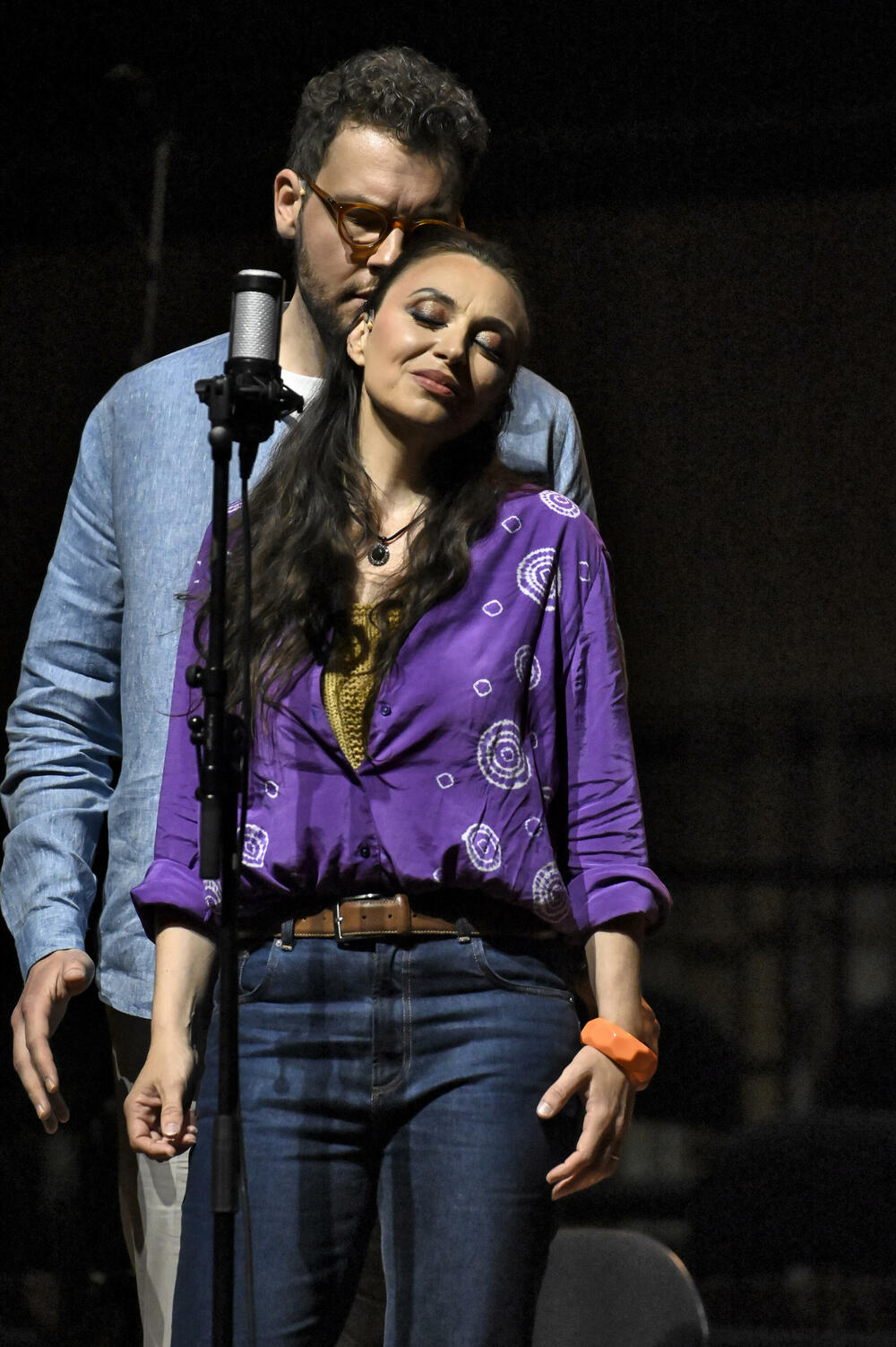
“The Black Mountain”Photo: Frédéric Desmesure
The opera Montenegro is set in 1657, during the Montenegrin struggle for liberation from the Turks. The military leaders Mirko and Aslar triumphantly return from battle, formalizing their brotherhood, bringing the Turkish woman Jamina as war booty. Father Sava blesses the heroes and the people present who are demanding the death of the Turkish woman. However, Mirko saves Jamina from the people’s retribution and, enchanted by her beauty, frees her from slavery and flees the village with her. This violation of honor is not forgiven by his mother Dara, who curses them both, as well as his abandoned fiancée Helena. Aslar sets out in search of his runaway friend and finds him in Jamina’s arms. At first he convinces him to return but then realizes that he is failing, and at the end of the opera he kills Mirko, and then himself. Interestingly, names like Mirko and Sava are also found in operettas Apple juice Johan Strauss the Younger (from 1894) as a possible influence, while in Leharovoj To the merry widow (from 1905) the image of the Montenegrin ambassador in Paris bears the name Baron Mirko Zeta. The name Aslar is closely related to Guslar, and perhaps the composer was also familiar with the work Prospera Merimea Guzla so she included fiddle players in her opera (more as extras and choristers than as players).
The Italian-French foundation Palazzetto Bru Zane, which revives the forgotten operatic heritage of French Romanticism, originally staged this opera in 2024 at the Dortmund Opera, in a production Emily Hel with the participation of a fiddler Bojana PekovicNow Montenegro (La Montagne noire) moves to Bordeaux, for the first French performance of this title in 130 years. Unlike Dortmund, the Bordeaux Opera approaches this work with fewer resources but also with a different logic. The work is performed in the Auditorium concert hall from 2013, which in turn has an orchestra pit and a hybrid purpose, concert-stage performances. The project in Bordeaux involves the recording of a disc, which will be the first ever sound recording of this opera. Director Dominik Pitoaze decides to give a completely original reading in these circumstances: the audience attends a “dress rehearsal” of the recording of the work, where we hear the voices of the sound engineers, technicians, the conductor’s instructions and other things that normally remain hidden from the public during the musicians’ rehearsals. This procedure immerses the audience in the creative process of a work, so that in each subsequent act of the opera the plot moves towards an increasingly staged presentation, while in the last two acts we also have costumes and stage lighting. This metatheatricality is certainly very original and creative, although quite sparse in terms of costumes and scenery, leaving the audience hungry for a slightly richer presentation of a forgotten work.
However, the music is the main focus of this semi-staged performance in Bordeaux. Let us first mention the orchestra with its huge effect that impresses the listeners from the first measure with its thunderous harmonies and dramatic nature dominated by the brass instruments. The heroism and lyricism of the Montenegrin people are musically wonderfully portrayed. The uniformity of the unison sections, the precision of the piccata, the subtlety of the solo violin, the flickering of the flutes, the influence of orientalism with the tarabuka or the fullness of the all orchestral sound makes the ensemble the main protagonist, with the maestro’s very precise and dedicated conducting Pierre DimiseauThe opera house choir also performs convincingly with a full and highly dramatic sound on both sides of the sound spectrum (male and female), with a compact and resonant projection and with rich dynamic nuances that range from pastoral tenderness to heroic expression.
Among the vocal soloists we find primarily the mezzo-soprano Od Extreme (Aude Extrémo) in the role of the seductress and somewhat sorceress Jamina, a character who irresistibly resembles Carmen. This fatal woman is vocally presented with a very wide range, extreme register jumps that the French singer performs with complete stability of tone. She is very convincing and well-nourished in the depths of her range, with a very dramatic expression of full intensity throughout the evening. Zilijan Anrik Mirko interprets with a Wagnerian tenor, powerful but also lyrical, with refined pronunciation and warm expression. Greek baritone Tasis Hristojanis is the only foreigner in the cast, and as a specialist in French melodies, he excels in pronunciation and articulation of the text. The voice is dark and full of substance, very dramatic and long-lasting. The character of Dara interpreted by a mezzo-soprano Marie-André Bouchard-Lesier is driven by patriotism, singing his cry for freedom with a strong chest voice projection and musical phrasing, while Helena is a soprano Elen Karpantje of a softer tone, lighter color and sound apparatus. Father Sava (Guillem Forms) is vocally rich and dark, with clear articulation and resonant, but with considerable vibrato.
The audience at the Bordeaux Auditorium gave the artists a thunderous welcome at the end of this historic performance, which precedes the historic visit Emanuela Markon Montenegro on June 5, which, according to available data, is the first ever official visit of a French president to Montenegro.
Download the app and follow the news


FOLLOW US ON

News