
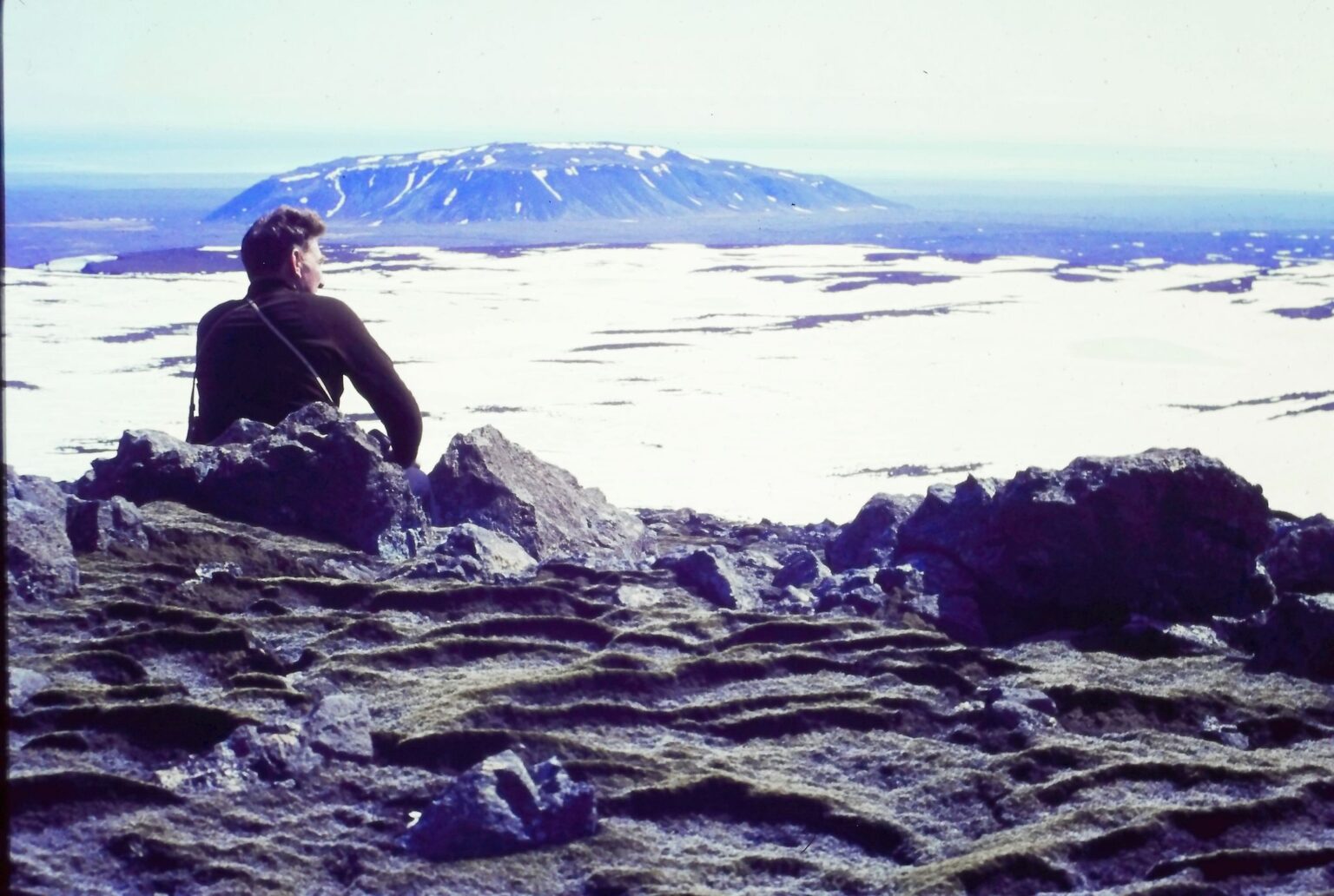
Icelandic Glaciological Society member Árni Kjartansson sits overlooking a glacier in Iceland in a scene from Sara Dosa’s “Time and Water.”
Courtesy of Andri Snær Magnason
Sara Dosa’s work often examines humans’ complicated relationship with the awesome power of nature. But until her latest documentary, “Time and Water,” nature had the upper hand.
“The Last Season” (2014) followed two combat veterans who find a path to healing as they hunt for wild mushrooms in central Oregon. “The Seer and The Unseen” (2019) draws parallels with an Icelandic seer who communicates with elves and other spirits of nature and the unseen forces of capitalism after the 2008 financial crisis.
 “Time and Water”: Documentary. Directed by Sara Dosa. (Not rated. 93 minutes.) Starts Friday, June 5, at the Roxie Theater, 3117 16th. St., S.F. www.roxie.com; and Smith Rafael Film Center, 1118 Fourth St., San Rafael. www.cafilm.org. • Starts June 12 at Rialto Cinemas Elmwood, 2966 College Ave., Berkeley; Rialto Cinemas Sebastopol, 6868 McKinley St., Sebastopol. www.rialtocinemas.com
Her masterpiece, the Academy Award-nominated “Fire of Love” (2022), paid homage to the glorious but doomed romance between two French volcanologists, whose death during a violent eruption may have been wish fulfillment.
Article continues below this ad
Now, the former Berkeley resident returns to Iceland for “Time and Water,” in which poet and science fiction writer Andri Snær Magnason ruminates on his family’s centuries-long relationship with his country’s glaciers. Thanks to climate change, his generation is the first to experience the massive loss of one of Earth’s most valuable resources.
“It’s like my sense of home is slipping away,” Magnason sighs.
A glacial tongue descends into glacial lagoon in a scene from Sara Dosa’s “Time and Water.”
National Geographic
“Time and Water,” which premiered at the Sundance Film Festival in January and played at the 69th San Francisco International Film Festival in April, isn’t a traditional climate change documentary, but rather a personal essay inspired by Magnason’s 2019 book “On Time and Water.”
Generations of his family grew up on farmland near the massive Vatnajökull glacier, the second-largest in Europe, which covers about 8% of Iceland. Among them are his grandparents, Árni and Hulda Kjartansson, who are in their 90s when the film begins.
Article continues below this ad
Árni was an explorer and self-trained scientist, who helped found the Icelandic Glacial Research Society and Air Ground Rescue Team in the 1950s. Hulda is said to be the first Icelandic woman to pilot a plane.
After their wedding in 1956, Árni and Hulda did the most Icelandic thing ever by spending their honeymoon on the Vatnajökull glacier.
A young Andri Snær Magnason stands by rocks on a grassy slope in a scene from Sara Dosa’s “Time and Water.”
Courtesy of Andri Snær Magnason
Utilizing Magnason’s voluminous supply of home movies and supplementing it with cinematographer Pablo Alvarez-Mesa’s spectacular footage of Icelandic landscapes, Dosa portrays the passing of a way of life that hints at an uncertain planetary future.
American composer and electronic musician Dan Deacon’s lovely score adds to the elegiac nature of the film.
Article continues below this ad
Magnason named his youngest daughter after her grandmother, and to see the two Huldas talking at the breakfast table — one 96, the other 11 — is delightful. Iceland has lost some 20% of its ice mass since 1900, half of that since 1990, and he struggles to imagine Iceland when his own daughter reaches 96, which would be after the turn of the 22nd century.
Some of the ice in glaciers existed when the country was settled in the ninth century by Viking explorers. But now, as Magnason puts it, “we lose five years of history every year.”
A person stands beneath the vaulted ceiling of a glacial cave in Iceland in a scene from Sara Dosa’s “Time and Water.”
Courtesy of Andri Snær Magnason
“Time and Water” also includes a funeral for a glacier, billed as the first in history.
In 2014, the Ok glacier had shrunk so much that it could no longer be classified as a glacier. It was declared “dead.” A funeral was planned to mourn its passing, and Magnason was asked to write a eulogy of sorts that could be placed on a copper plaque that was embedded in the remaining ice.
Article continues below this ad
It is addressed to “the future” and notes that in the next 200 years, all of Iceland’s glaciers are expected to melt.
“This monument is to acknowledge that we know what is happening and what needs to be done,” the plaque reads. “Only you know if we did it.”
In a sense, “Time and Water” exists for the same purpose. It too might be a time capsule opened generations later by a vastly different world.