
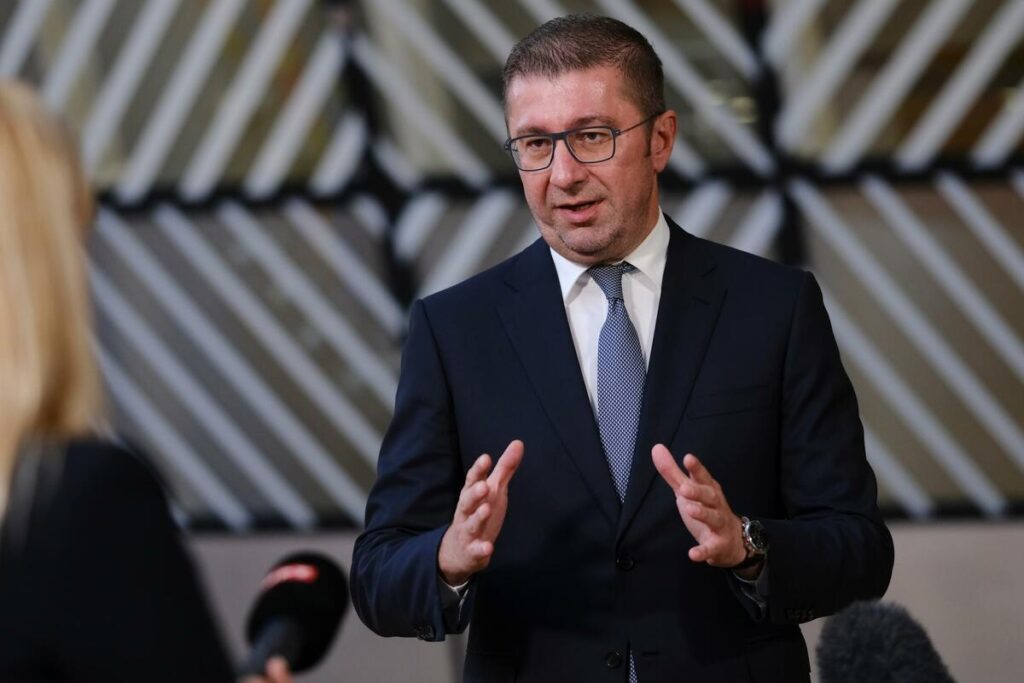
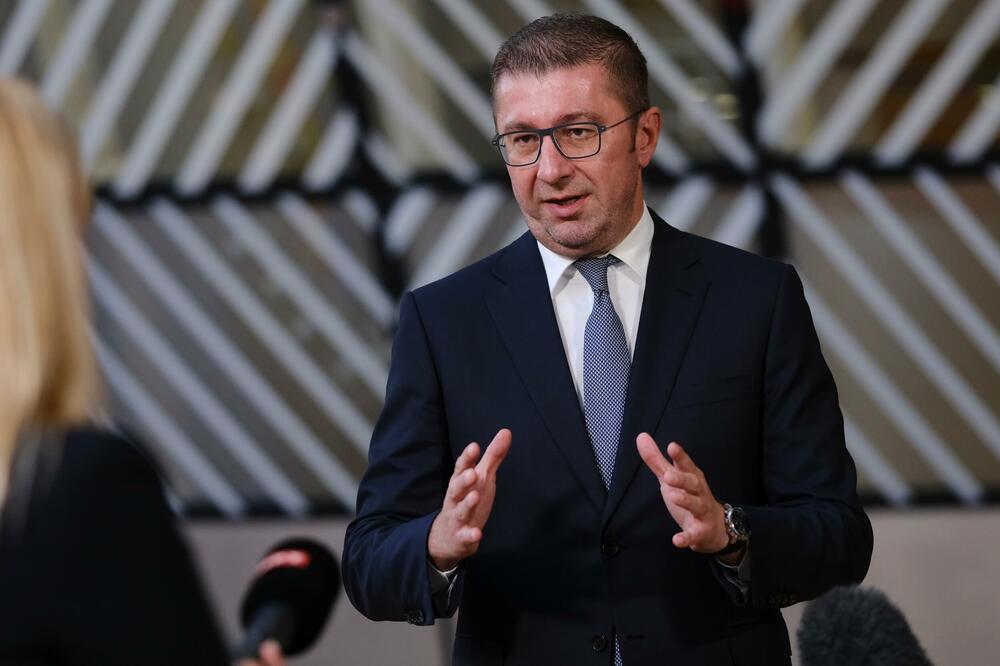
Hristijan Mickoski, Photo: Shutterstock
North Macedonia’s Prime Minister Hristijan Mickoski confirmed today that he will not support constitutional amendments to introduce Bulgarians into the Constitution, as demanded by Sofia, until he has clear guarantees that negotiations with the European Union (EU) on his country’s accession to the EU will not be conditioned by bilateral and identity issues.
“I will repeat for, perhaps, the third time: as long as I am the Prime Minister, I will never support constitutional amendments without a clear end: that we will start the process and that we will finish it, until I have clear guarantees that there will be no more bilateral issues and identity issues. I can only support that type of constitutional amendments. I will never support anything else,” Mickoski told reporters.
The Prime Minister assessed that the messages from yesterday’s EU-Western Balkans Summit in Tivat, Montenegro, were the strongest in the last two years and emphasized that he was particularly pleased that “the enlargement process is not over and that it exists.”
Mickoski said that his optimism after that summit lies in the fact that he was the only one of the Western Balkan leaders to have had bilateral meetings with French President Emmanuel Macron and German Chancellor Friedrich Merz.
Macron and Merz “gave a strong motivation to continue with reforms, to deliver, based on the merit method, not bilateral issues, and this was emphasized several times at the Summit itself,” said the North Macedonian Prime Minister.
Regarding Macron and Merz’s “non-paper” on the gradual integration of candidate countries into the EU, Mickoski assessed it as positive and emphasized that he understood that the institutions in Brussels had already received instructions for the operationalization of that document, which would enable the Western Balkan countries to “greater use of certain tools” and more frequent high-level meetings.
“This represents a significant increase in the level of relations between the Western Balkans and the European Union, that is, this document and this reform provide a mechanism by which we will have greater use of certain tools by the Western Balkan countries and in no way contradicts enlargement. These are two parallel processes. This is one process, and enlargement remains the other process,” Mickoski emphasized.
Bulgarian Prime Minister Rumen Radev reiterated yesterday in Tivat that North Macedonia must make constitutional changes in order to begin negotiations on EU accession.
Previously, European Council President Antonio Costa said in Skopje on June 2 that the adoption of the agreed constitutional amendments remains the only way to formally start accession negotiations with North Macedonia.
In his words, for the formal start of negotiations, Skopje “needs to deliver only what was agreed in 2022 and nothing more.”
North Macedonia’s accession negotiations with the European Union (EU) have been blocked due to a bilateral issue with Bulgaria, which has become part of the Negotiating Framework.
Skopje began the “first phase” of negotiations with the EU in July 2022 by adopting the Negotiating Framework, but in order to move to the “second phase” and start opening chapters, it must introduce Bulgarians into the Constitution, which the conservative VMRO DPMNE party of North Macedonian Prime Minister Hristijan Mickoski has since blocked.
Mickoski, who came to power in mid-2024, had previously offered Brussels and Sofia a solution to overcome this obstacle: a delayed effect of the constitutional changes: that they would enter into force when his country closes negotiations with the EU, or that he would receive guarantees that there would be no other bilateral conditionality. His proposal did not receive support.
Download the app and follow the news


FOLLOW US ON
News