
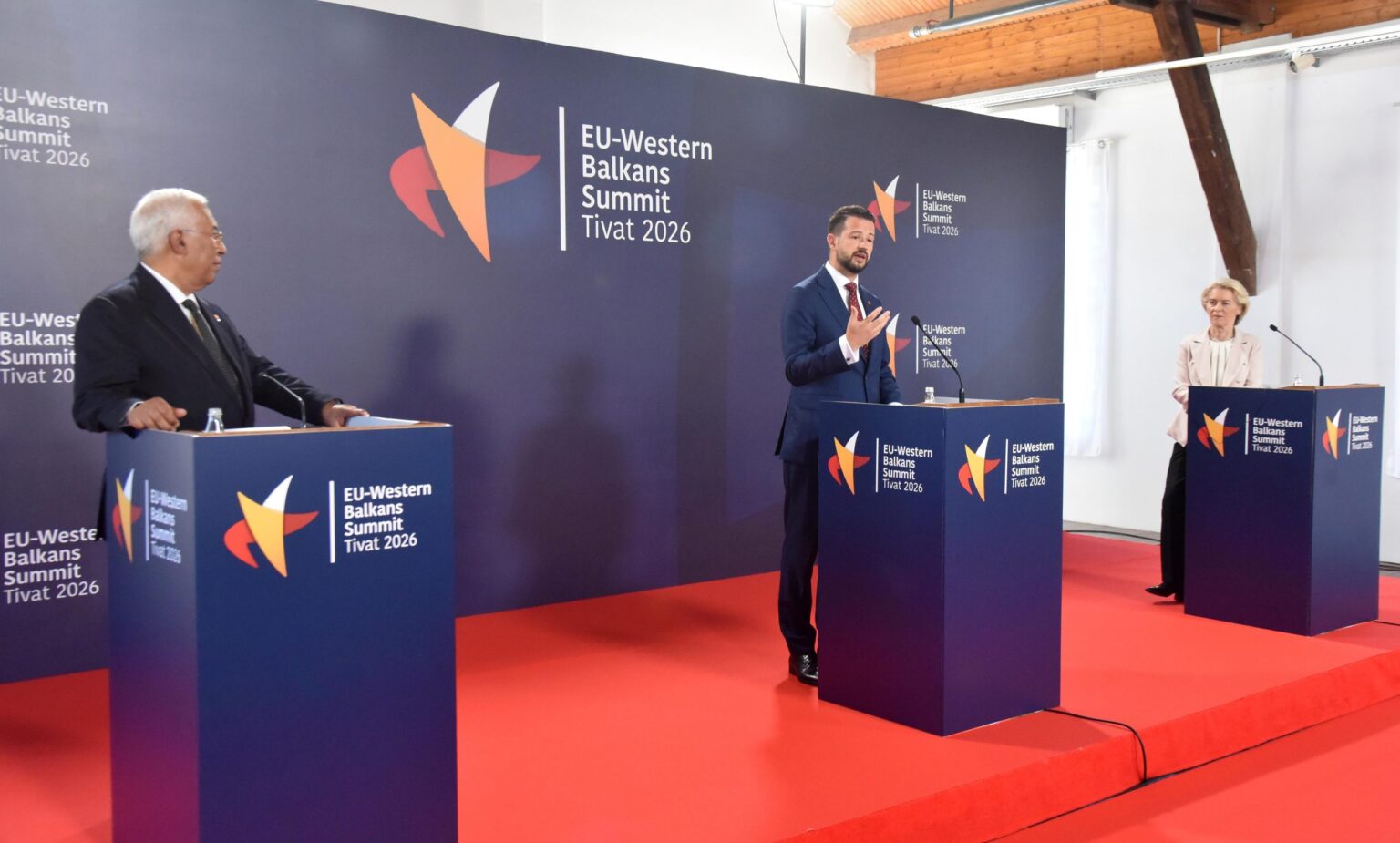
European Union leaders gathered with their Western Balkan counterparts in the Montenegrin coastal town of Tivat for a high-level summit that strongly advanced Montenegro’s EU accession prospects while underscoring ongoing challenges with other candidates, particularly Serbia.
Hosted by Montenegrin President Jakov Milatović and co-chaired by European Council President António Costa, the summit focused on shared prosperity, gradual integration, security cooperation, and the region’s European future. For Montenegro, which marked 20 years of restored independence, the event represented a major diplomatic success and a clear endorsement of its reform path.
President Milatović opened the summit by declaring that Montenegro had “gathered Europe today,” describing it as powerful confirmation of the country’s chosen European path. He stated that Montenegro is ready to take the final step toward membership and aims to serve as an example for the entire region.
European leaders responded with concrete encouragement. European Commission President Ursula von der Leyen praised Montenegro’s impressive reforms and said the goal of joining the EU by 2028 is within reach. The EU has already begun drafting Montenegro’s Accession Treaty – the first such step since 2013 – and urged the country to close remaining chapters by the end of 2026.
In contrast, Serbia emerged as the more problematic country in the region. During bilateral meetings on the sidelines of the summit, German Chancellor Friedrich Merz told Serbian President Aleksandar Vučić that the path to the EU remains open, but Serbia must make a clear strategic choice. Merz reportedly emphasised that Serbia cannot continue swinging between Russia, China, and Europe. “When the answer from Serbia is ‘Europe’, then the answer from Europe will be ‘Serbia’,” he stated.
“A balancing policy [by 🇷🇸 President Aleksandar #Vučić] between #Russia, #China and #Europe is not possible,” 🇩🇪 Chancellor Friedrich #Merz told reporters after today’s #EU-Western #Balkans Summit, where he held a one-on-one meeting with Vučić and later joined talks alongside… pic.twitter.com/Cb7wYgNNHS
— Adi Ćerimagić (@adicerimagic) June 5, 2026
Vučić described his meetings with von der Leyen, Costa, Merz, and French President Emmanuel Macron as productive and expressed hope for progress on Serbia’s European path, while acknowledging that much work remains.
The summit reaffirmed the EU’s commitment to all Western Balkan partners but made clear that tangible progress depends on concrete reforms, particularly in the rule of law, alignment with EU foreign policy, and distancing from non-European influences. Montenegro’s strong performance positioned it as the clear frontrunner, offering encouragement that successful European integration is achievable for the region.
At the Tivat Summit, EU leaders also gave fresh momentum to the concept of gradual or “reverse membership” for candidate countries. A Franco-German non-paper circulated ahead of the meeting proposed that nations such as Montenegro, once they close relevant negotiating chapters, could participate in Council of the EU meetings as observers without voting rights, attend selected European Council discussions, and gain progressive access to the Single Market and EU institutions. This approach aims to deliver tangible benefits and closer integration before full membership, serving as both an incentive for faster reforms and a practical bridge for frontrunners like Montenegro on their path to joining the EU by 2028.
Caption: European Council President Antonio Costa (L), Montenegro’s President Jakov Milatovic (C) and European Commission President Ursula von der Leyen (R) attend the press conference following the EU-Western Balkans summit in Tivat, Montenegro, 05 June 2026. The high-level one-day summit brings together European Union (EU) leaders and their Western Balkan counterparts to discuss concrete integration measures and accelerate the region’s path toward bloc membership. EPA/BORIS PEJOVIC
Updated: June 6, 2026 – 12:59