


Aneta Dodevska*, North Macedonia
Competitiveness will no longer be measured only by low wages and fiscal incentives, but by technological capabilities, innovation and adaptation to the electric revolution.
For more than two decades, North Macedonia built one of the Balkans’ most aggressive models for attracting the automotive industry, offering low taxes, state subsidies, low-cost labour and special economic zones for foreign investors. The result was the transformation of a small Balkan economy into a production base for some of the largest suppliers of Europe’s automotive industry.
Today, the automotive supplier sector accounts for almost half of the country’s exports, employs tens of thousands of people and is dominated by international companies producing components for the world’s largest vehicle brands. But the model once seen as an industrial success story is facing new pressure: the economic slowdown in Europe, the transition towards electric vehicles and geopolitical uncertainties affecting global supply chains.
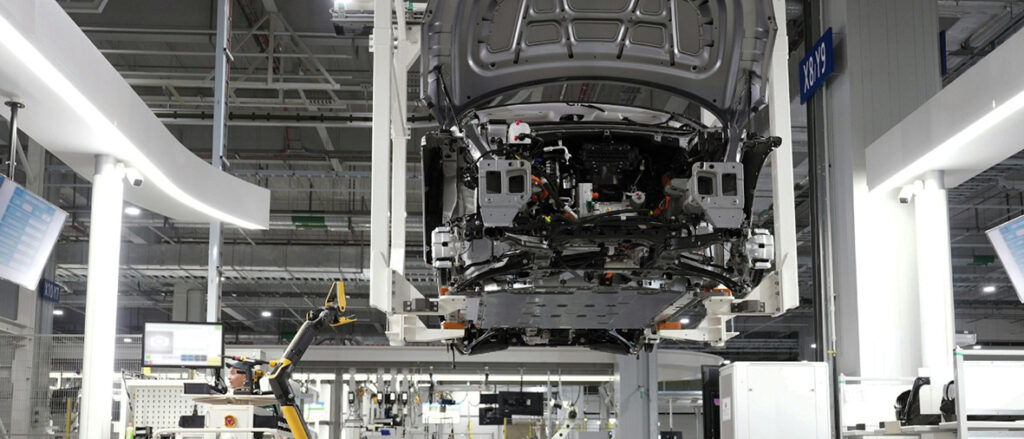
According to data from Invest North Macedonia, around 50 automotive industry companies operate in the country, almost all involved in the production of vehicle and transport parts and components. North Macedonia does not produce vehicles on a large scale. It produces cables, electronic systems, plastic parts, airbags, connectors, heating and cooling systems, seats and other components that end up in Europe’s car factories.
The automotive sector accounts for 53% of exports
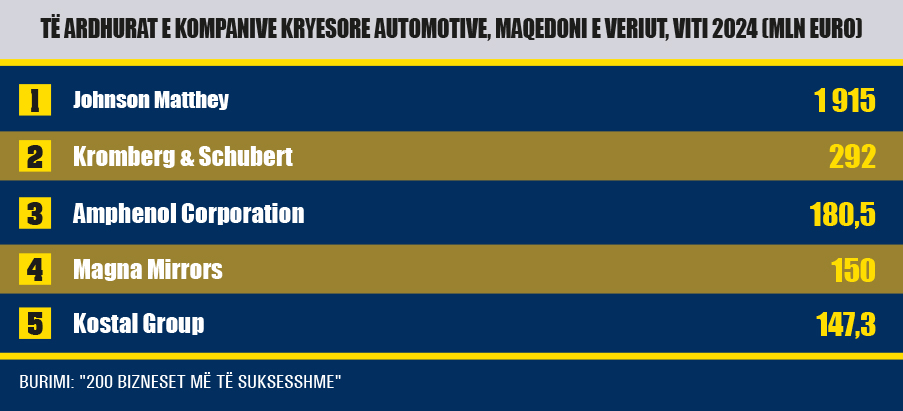
At the centre of this ecosystem are names such as Johnson Matthey, Kromberg & Schubert, Amphenol Corporation, Magna Mirrors and Kostal Group, companies that form the industrial backbone of Macedonian exports. The five leading companies in the sector alone generated more than €2.68 billion in revenues in 2024, according to the publication “200 Most Successful”. Johnson Matthey, the British catalyst manufacturer, tops the list with nearly €1.9 billion in annual revenue, making its plant one of the country’s most important export assets. In terms of profit for 2024, the five leading companies are Johnson Matthey with €63,925,000, Magna Mirrors with €14,272,000, Slovenia’s TAB MAK with €7,677,300, Amphenol Corporation with €6,737,730 and Kromberg & Schubert with €5,405,350.
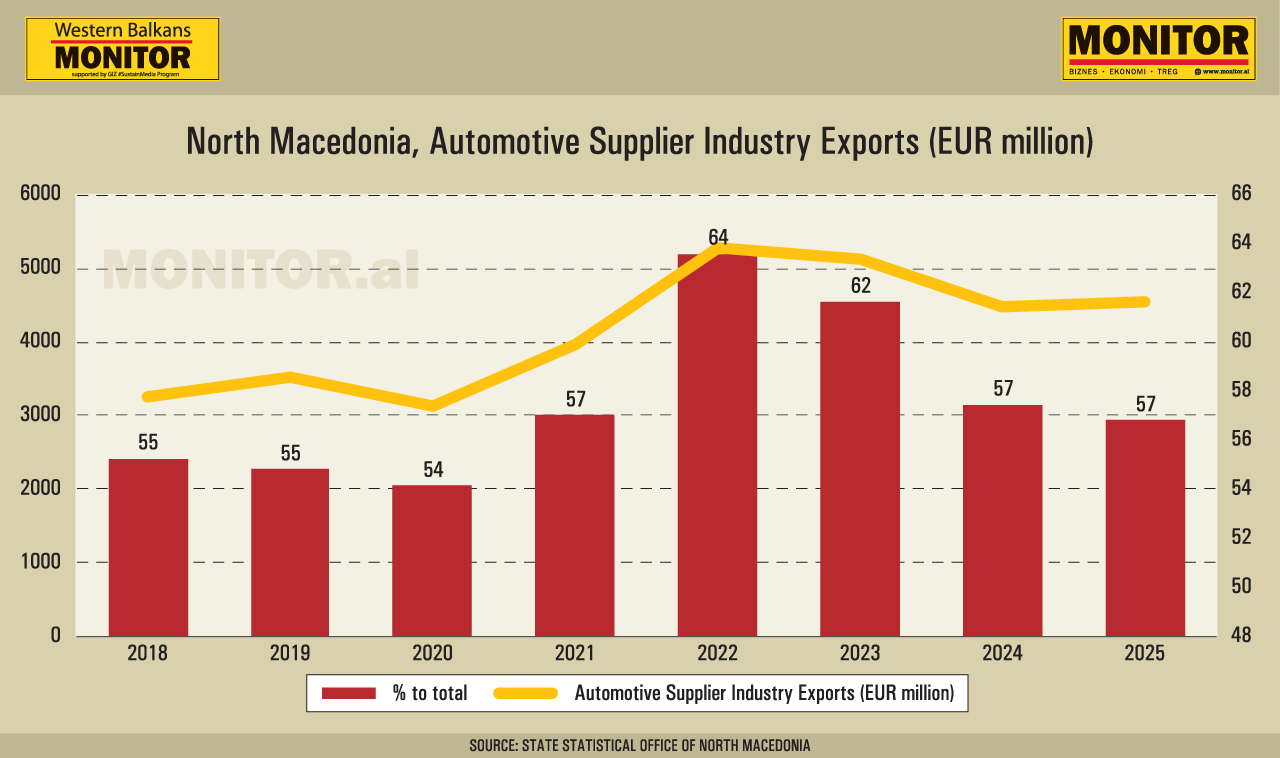
The automotive supplier industry has effectively become the export engine of the economy. According to the Foreign Investors Council, the sector’s exports have fluctuated between €3 billion and €4 billion annually, and in 2024 accounted for 53% of North Macedonia’s total exports.
The importance of automotive exports to the economy is also highlighted by the State Statistical Office: “Trade data by product show that the largest share of exports consists of catalysts with precious metals or their compounds, ignition wiring sets and similar products for motor vehicles, aircraft and ships, seat parts and other catalytic products.”
Germany the dominant market, how global developments affect the industry
In 2025, exports to Germany reached almost €2.9 billion, far exceeding those to any other market, reflecting the Macedonian economy’s direct dependence on the German automotive industry. This dependence is both an advantage and a risk. When industrial production in Europe grows, factories in North Macedonia expand. When demand weakens, the impact is immediately transmitted to exports, employment and investment. The first signs of pressure are already visible.
Van Hool, the Belgian bus manufacturer, now operating under the Dutch VDL Groep, reported a loss of €30.5 million in 2024 despite generating revenues of more than €120 million. The company warned that new tariffs imposed by the United States during 2025 were negatively affecting its operations, as most of its exports had been directed towards the US market.
For North Macedonia’s economy, this serves as a reminder that the automotive industry remains deeply exposed to global trade and political tensions.
“Among foreign industrial investors producing automotive components and related products, the situation is cautious, with signs of a slowdown. The reason is simple: factories depend heavily on European orders. Geopolitical tensions do not usually hit production directly, but they increase pressure on logistics and costs. In a period of continuous energy-price fluctuations, procurement, warehousing and transport are under pressure to reduce costs and optimise processes as much as current conditions realistically allow,” says Viktor Mizo from the Foreign Investors Council of North Macedonia.
The economic and social impact of automotive, how local services have been stimulated
The industry remains one of the largest employers in North Macedonia. The automotive supplier sector employs around 35,000 people directly, while a similarly large number are engaged indirectly.
“Foreign investors in the automotive industry employ around 35,000 people across almost all major cities in the country. In addition, more than 10,000 others are indirectly engaged through local suppliers and service companies working for these investors. No major changes in employment are expected this year. The situation in Europe does not provide grounds to expect large new projects with mass hiring; cost optimisation and ‘silent growth’ are more likely,” says Mr Mizo.
Today, Kromberg & Schubert and Dräxlmaier alone employ around 14,000 people combined, almost half of the sector’s entire workforce. For an economy of around 1.8 million people, this makes automotive a strategic sector not only for exports but also for social stability and the labour market. The country’s economic model has been built on Foreign Direct Investment.
Fiscal incentives and the challenge of transformation
Successive governments have offered aggressive fiscal incentives to attract foreign investment, and the current government continues to maintain this package.
“For investors, the state offers a 10-year corporate income tax exemption, a 100% reduction in personal income tax for up to 10 years, exemption from land development fees, reimbursement of 50% of the investment, state-funded training packages for employees, long-term land leases of up to 99 years at concessionary rates in free economic zones, as well as free connections to natural gas, water supply and sewage networks,” according to the Directorate for Technological Industrial Development Zones. This policy has made the country one of the most competitive destinations in the region for labour-intensive manufacturing investment.
After reaching a record €1.19 billion in 2024, Foreign Direct Investment in North Macedonia fell by around 61% in 2025, to €467.5 million, reflecting the slowdown in capital flows in an economy dependent on European investment. Germany nevertheless remained the dominant investor in 2025, accounting for nearly 30% of total FDI.
However, the debate over the real cost of this model, which seeks to attract foreign investment through low taxes, is becoming increasingly pronounced.
At the national level, discussions continue over whether state subsidies and fiscal incentives for foreign investors are justified when compared with the treatment of domestic businesses. At the same time, the transition to electric vehicles is reshaping the traditional supply-chain structure, creating risks for some existing segments while also opening opportunities for new investments in electronics, battery systems and advanced components.
How the Western Balkans became Europe’s “factory”… what comes next?
*Aneta Dodevska is a journalist and an editor in TV 24 News in North Macedonia
Ky është artikull ekskluziv i Revistës Monitor, që gëzon të drejtën e autorësisë sipas Ligjit Nr. 35/2016, “Për të drejtat e autorit dhe të drejtat e lidhura me to”.
Artikulli mund të ripublikohet nga mediat e tjera vetëm duke cituar “Revista Monitor” shoqëruar me linkun e artikullit origjinal.