
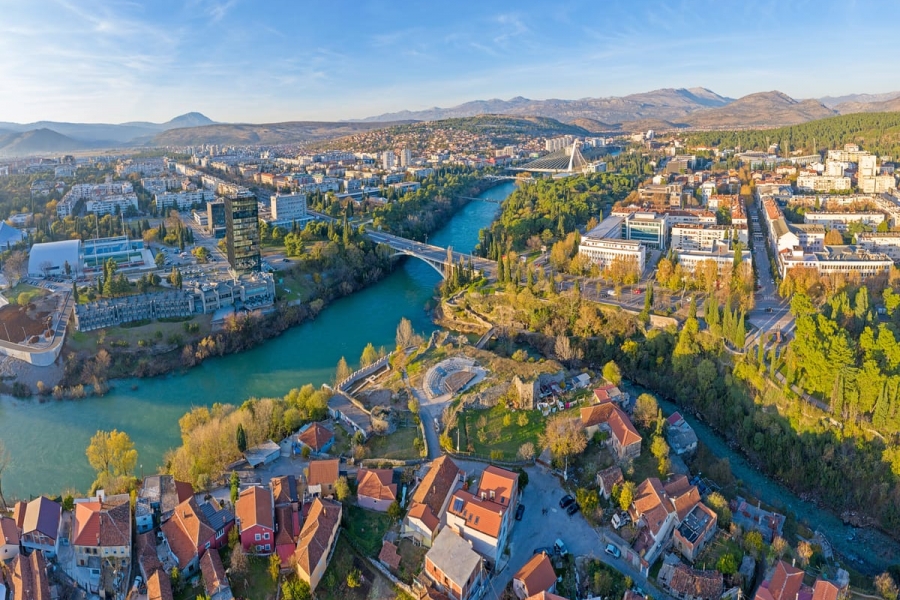
Montenegrin capital Podgorica. Photo: pelago.com
I am from Belarus. My parents emigrated even before the war with Ukraine, and I stayed there with my grandparents, hoping to finish school. But… freedoms became fewer and fewer. In 2022, almost all private schools closed — these so-called bastions of free-thinking, including the one I attended. Only a few private schools close to the government remained, as well as state schools with a huge amount of propaganda. This was the last straw, and my parents started looking for options for me to continue my education abroad.
Initially, it was planned that I would go to school in Warsaw, where they lived. But the situation there, related to chauvinism, seemed unsettling to us. So we found a school in Montenegro, oriented towards Russian-speaking emigrants, primarily those who fled repression.
For example, in my class of 35 people, 30 are those who left for political reasons.
From the first to the ninth grade, the school had a mix of Russian and Montenegrin programs, and from the tenth grade, the International Baccalaureate (IB) began. This is a very strong two-year program, essentially at the intersection of school and university. I had just finished nine grades in Belarus, and we decided to try the IB program.
Admission required passing mathematics and English. Since all instruction is in English, the language level must be B1-B2, and the exam itself consists of reading, listening, and an interview. In general, on the one hand, the exams are quite difficult, on the other hand, if they see your eagerness, they might accept you even with low scores. This happened with one boy; he failed the listening part, but they told him that if he improved it over the summer, they would accept him.
This school differed from all the Belarusian ones I knew in almost every way.
Instead of lessons, there are pairs, and you create your own schedule. All subjects are grouped: mathematics, languages, arts — six groups in total, and you choose one mandatory subject from each. For each, you need to write large papers, like scientific ones. At the same time, the approach is completely different from what I was used to in Belarus. For example, in literature, as we were used to: they teach you to state a thesis and support it with a quote from the text. But in the IB program, on the contrary, they teach you to take a quote and derive a thesis from it. This requires a deeper level of immersion and is closer to the university format.
And in general, the whole approach is like at a university. Here, no one chases after you, no one reminds you of deadlines for submitting work; if you mess something up, that’s your problem.
This entire serious program was superimposed on the Balkan flavor and the culture of “polako” (from the Serbian word “polako,” literally “slowly.” — Ed. note) with its relaxed environment. After Belarusian school, it was very unusual that there was no tension in either studies or communication. Everyone, in principle, doesn’t worry but lives life. Because of this, it was very difficult for me to fit in at first.
It’s quite difficult to study seriously when it’s +30 degrees in September and everyone around is relaxed. True, such an atmosphere also reduced the stress level.
The school had such an emigrant environment, where everyone seemingly had similar fates, but at the same time, it was a diverse cocktail. Someone was from Novosibirsk, someone from Moscow, there were people from Sochi, several from Minsk. All of this felt strange.
And although the boys and girls were good, for the first six months of my studies, I practically didn’t communicate with anyone. I’m shy by nature, it’s hard for me to get along with people, plus the stress of moving. So for several months, my whole life was just home — school — home.
But our program provided that we not only study but also participate in volunteer and creative projects; this service was called CAS — creativity, activity, service. And whether you like it or not, you must accumulate 50 hours each of creative activities, active activities, and volunteer activities. So first, I participated in the play “Alice in Wonderland.” Then, with a Belarusian friend, we decided to organize a concert of Belarusian music, collecting songs from the 19th century to the present day. We played musical instruments and sang ourselves, and invited other children. Some of them learned a little Belarusian thanks to their participation in the concert.
Many people came, and everyone positively received our idea. We collected a good sum for the concert, which we donated to Belarusian political prisoners.
And I finally managed to overcome the barrier — cultural, linguistic — and make friends.
Now I am a first-year student at Charles University in Prague, studying in the social sciences direction — philosophy, sociology. As far as I know, all my classmates entered European universities. I can say for myself that it was not difficult: after our Montenegrin gymnasium, university seems like an easy stroll.