
The air carried a chill in Hengdian, one of China’s best-known hubs for drama and film production. Yu Shutian, a 30-year-old actress, was on her way to set at 3.30am, donned in a floral shirt and darkened make-up to play a rural villain.
Referred to as “China’s Hollywood”, Hengdian – located in the eastern province of Zhejiang – has become an activity centre for the country’s fast-growing micro-drama industry, which produces low-budget, vertically-shot series designed for smartphones.
With frequent travel and short rest times an inescapable part of her daily routine, Yu carries a pervasive anxiety about survival.
“In an era where small actors can be quietly replaced at any moment by [artificial intelligence], having work is a form of salvation,” she said.
In pure macroeconomic terms, Yu – who holds a master’s degree in directing from the University of Sussex – is just one of China’s more than 200 million gig-economy workers. In addition to the spectre of AI, many must deal with unstable income and a relative lack of social security protections.
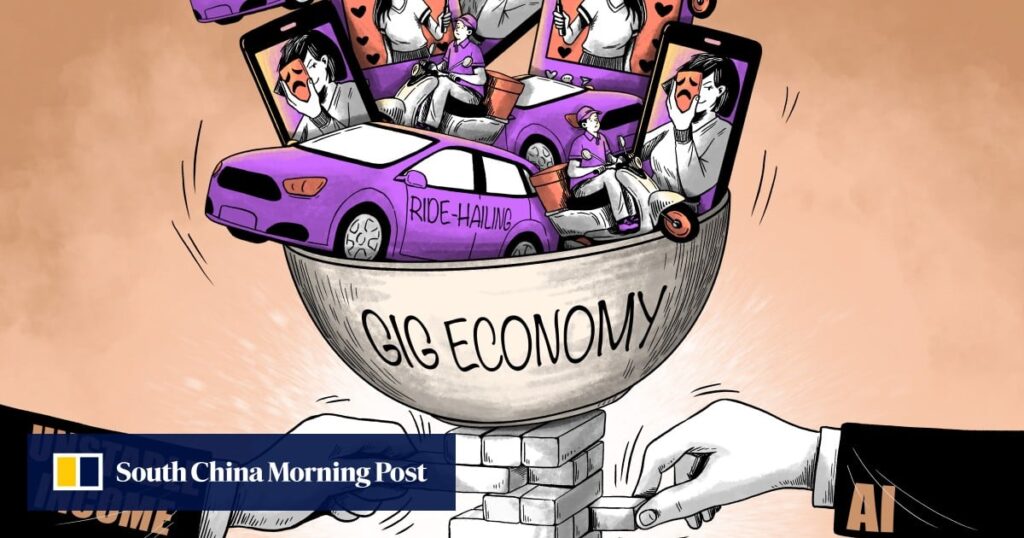
Underscoring a broader structural shift in China’s labour market, the gig economy – ride-hailing drivers, food delivery couriers, digital content creators and many other positions – has so far evolved from a side hustle into a vast reservoir absorbing the country’s unemployment pressures and helping to maintain economic stability.
Yu’s job, which involves so much intercity travel for auditions she typically sleeps four or five hours a night, has become her lifeline amid China’s cooling job market and the impact of AI.