
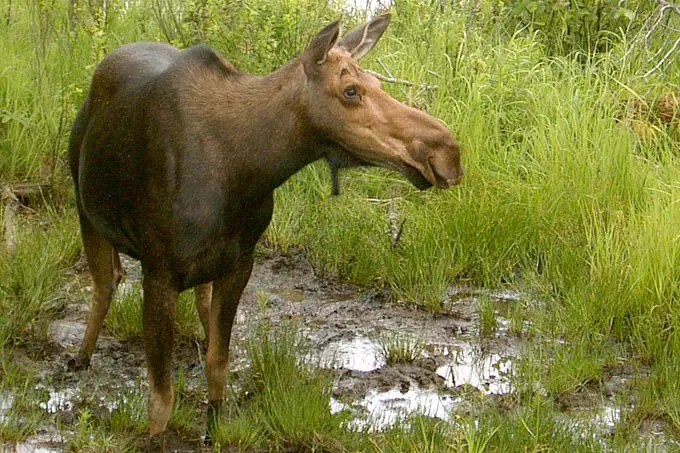
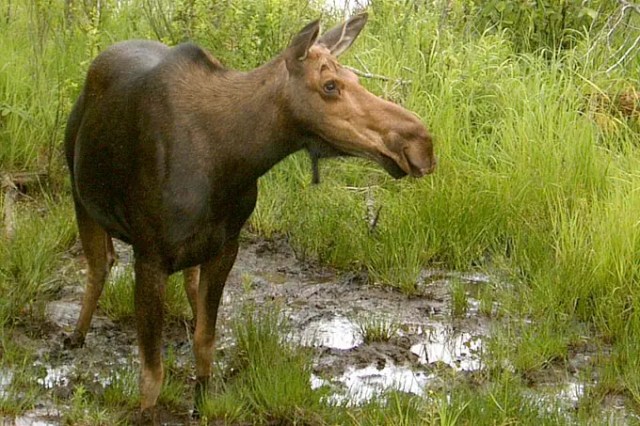
 Moose are returning to Germany after 400+ years of absence. | Image: Ingo Ludwichowski via NABU
Outdoor enthusiasts in Germany’s Bavarian and Bohemian Forests are used to spotting deer, foxes, and the occasional lynx. Moose, however, were supposed to be a thing of the distant past.
Yet over the last decade, sightings of Europe’s largest land mammal have steadily increased across eastern Germany, fueled by a quiet conservation success story unfolding just across the border in Poland. As of 2026, experts believe there are now around 10 to 15 moose living permanently in Germany — a small but meaningful foothold for a species once considered extinct in the country.
Why Moose Are Returning to Germany After 400 Years
Globally, moose are widespread across the northern hemisphere. In North America, their range stretches from Alaska and Canada through the Rocky Mountains and Great Lakes region to the northeastern United States. In Europe, they are found across Scandinavia, the Baltic states, Poland, Belarus, northern Ukraine, and Russia. Germany, however, spent centuries as a blank spot on the map. Once widespread across Central Europe, moose disappeared from the country by the 17th century due to hunting and habitat loss, and repeated reintroduction attempts during the 20th century failed.
The shift began in 2001, when Poland introduced a full hunting moratorium on moose. The population rebounded sharply and is now estimated at around 30,000 animals, according to the German Nature and Biodiversity Conservation Union (NABU).
As numbers grew, young moose began dispersing westward in search of new territory. Some eventually crossed into Germany. Sightings have increased steadily since around 2015, particularly in Brandenburg, Mecklenburg-Western Pomerania, Saxony, and parts of Bavaria. The current permanent population is estimated at just 10 to 15 animals, with another 10 to 15 passing through annually. Small numbers — but historically significant for a country that had none at all for more than 400 years.
Germany’s mix of large forests, wetlands, and relatively low population density in the northeast provides surprisingly suitable habitat. Moose feed on bark, shoots, aquatic plants, and young vegetation — all widely available in these regions. Brandenburg in particular has become something of a hotspot, with broad forests and wetlands offering exactly the kind of landscape these animals thrive in.
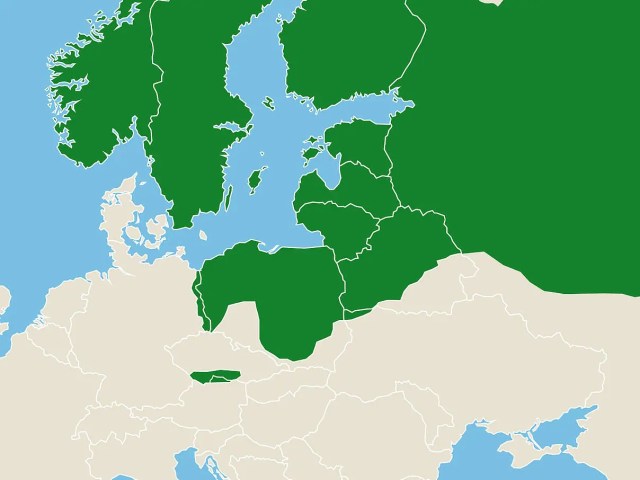 Moose in Europe can be found in Scandinavia, Poland, Czech Republic, Baltic countries, and Russia. | Image: WWF
The Moose That Marked a Turning Point
The return of moose to Germany has recently produced a genuine celebrity. A wandering bull nicknamed Emil the Elk — “Elch” in German covers both elk and moose — began his journey in Poland before moving through Slovakia and Austria, covering more than 500 kilometres (310 miles) and becoming so well known that he was voted “Word of the Year 2025” in Austria. He has his own Wikipedia page, a children’s book, and nearly 26,000 online followers.
His journey has taken him back and forth across the Czech-German border multiple times. After being tranquilized by Austrian wildlife officials near a motorway in September 2025, fitted with a GPS tag, and released near the Bohemian Forest, he continued northwest into Germany’s Bavarian Forest. In spring 2026 he reappeared in Lower Bavaria — spotted crossing roads, halting traffic, and walking calmly past the deputy mayor of Hohenlinden as if he owned the place.
Emil’s story has helped turn a gradual wildlife recovery into something people can follow in real time. He is the most visible symbol of a trend that scientists have been quietly tracking for a decade.
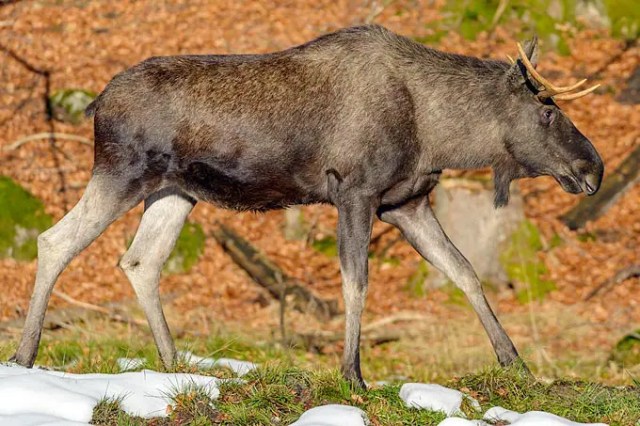 Moose are slowly making a return to Germany. | Image: Christoph Bosch via NABU
The Challenges Ahead
There are no natural predators for moose as bears are extinct and the wolf population is negligible. The biggest threat to moose in Germany is road traffic. Adult moose can stand up to 1.8 to 2 metres (6 to 6.5 feet) at the shoulder, and collisions with vehicles can be severe. Conservation groups have increasingly called for wildlife corridors and green bridges to connect fragmented habitats and allow large mammals to move safely across busy roads and railway lines.
Illegal shooting remains a concern. Moose moving through unfamiliar territory occupy legal grey areas that wolves — protected under EU habitats law with significant enforcement attention — do not. Individual animals passing through private hunting land can be vulnerable in ways that are difficult to monitor or prevent.
Whether Germany develops a self-sustaining moose population will depend on continued growth in Poland, safe cross-border migration routes, and how quickly conservation frameworks adapt to the reality of large mammals recolonizing landscapes they have not occupied for four centuries.
For now, it is a welcome reversal of a four-century trend. The moose is back in Germany — tentatively, quietly, and against most historical expectations. Whether moose will become a common sight in Germany remains to be seen, but after 400 years of absence, the giants of the forest are slowly making their way back.