
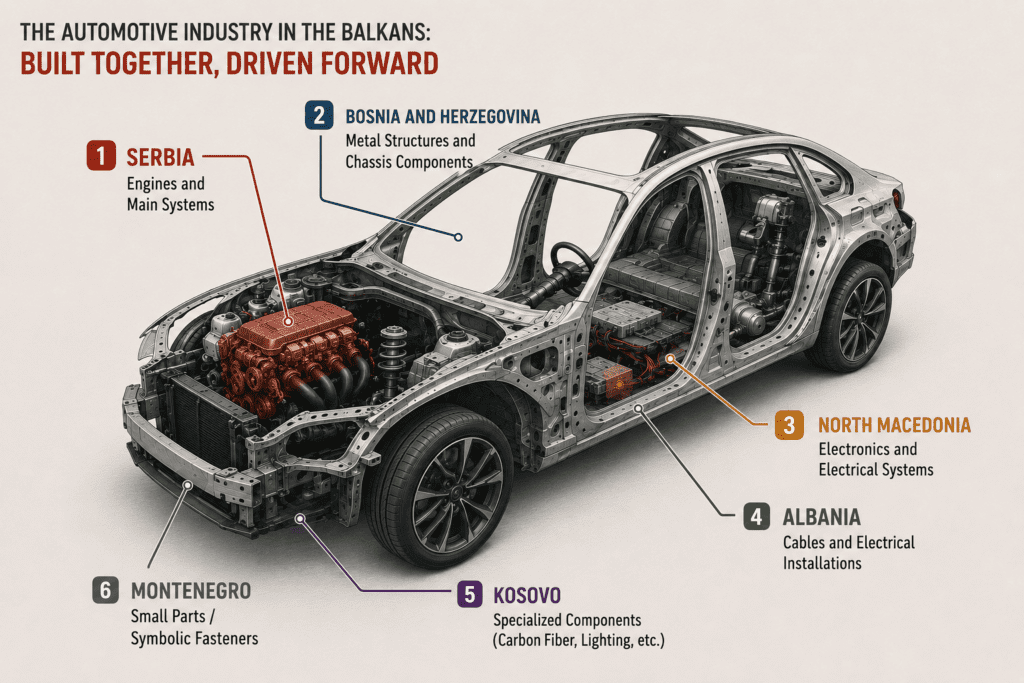


The automotive industry in the Western Balkans is running up against the limits of the model that helped it grow: low costs, foreign investors backed by incentive packages, and limited domestic technology. The region has become part of Europe’s production machinery, supplying global brands with cables, electronics, metal parts and specialised components. But behind this success lie structural weaknesses that vary from one country to another: Serbia depends on foreign capital, North Macedonia on a single sector, while Albania is losing the advantage of cheap labour. Bosnia enters the game with industrial memory, Kosovo with sophisticated niche segments, while Montenegro remains a spectator. As electric vehicles require more software, automation and technical know-how, the region must choose: move up the value chain or remain Europe’s low-cost “workshop”.
By Nertila Maho, Albania; Naida Kurdija, Bosnia and Herzegovina; Sefer Zogaj, Kosovo; Aneta Dodevska, North Macedonia; Ana Milosavljević, Serbia; Ivan Ivanovic, Montenegro
If one were to follow the industrial map of the Western Balkans, one would see a transformation that, only a few years ago, would have seemed impossible. From Kragujevac in Serbia to Tetovo and Skopje in North Macedonia, from Sarajevo to Tirana and Pristina, the region has gradually become a link in Europe’s automotive supply chain. Factories produce cables, electrical systems, metal parts, filters, upholstery, carbon fibre, plastic components and technologies that end up in vehicles made by Volkswagen, Mercedes-Benz, BMW, Audi, Stellantis and other global brands.
“Monitor” has analysed, based on the articles and figures of six economic journalists from the Western Balkan countries, as part of a project supported by GIZ and #SustainMedia, the panorama of the automotive industry in the region.
For more than two decades, the region’s economic model, to varying degrees from one country to another, was clear. Governments competed to attract Foreign Direct Investment through aggressive fiscal packages: low taxes, free land, employment subsidies, free economic zones and infrastructure support. For European manufacturers, the Balkans offered what Western Europe was gradually losing: low operating costs, a relatively skilled labour force and proximity to the European market. This model increased the weight of the automotive industry in Western Balkan economies, turning it in some cases into a main pillar of exports, employment and foreign capital inflows.
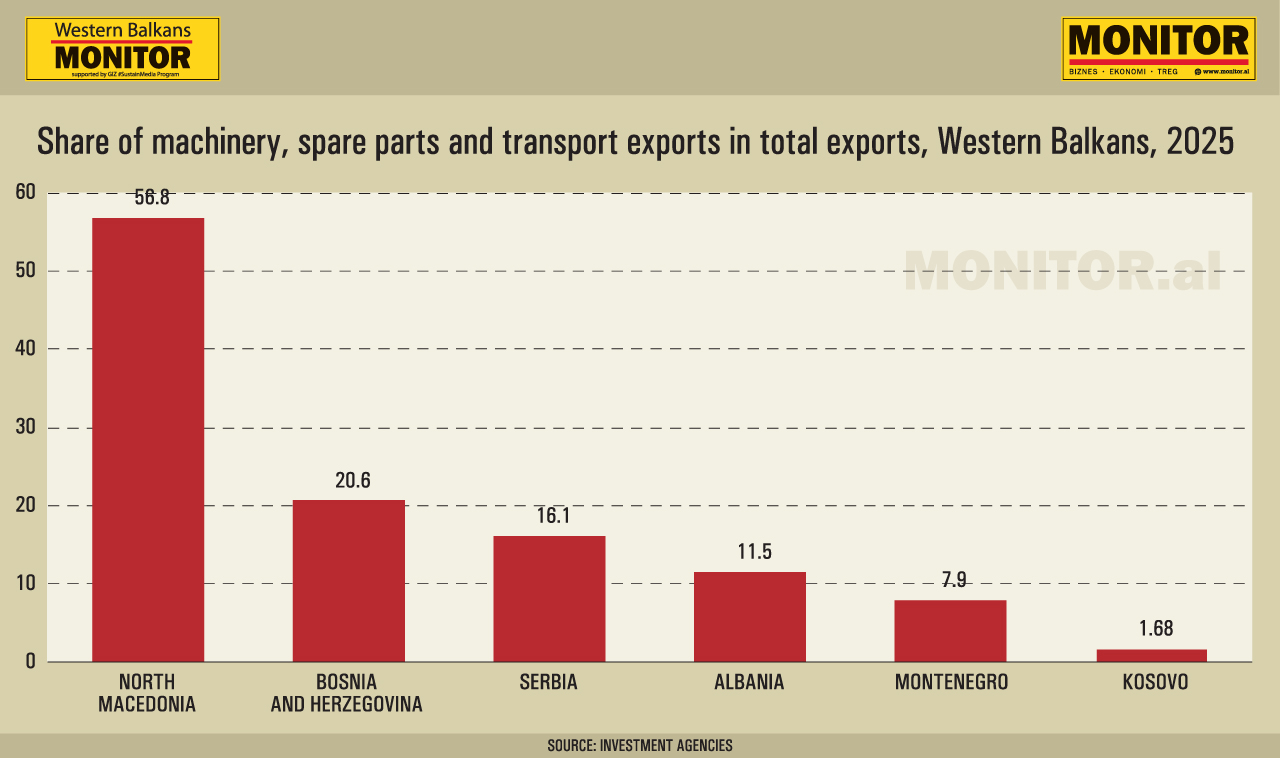
North Macedonia has the greatest dependence on the industry, Serbia remains in the lead
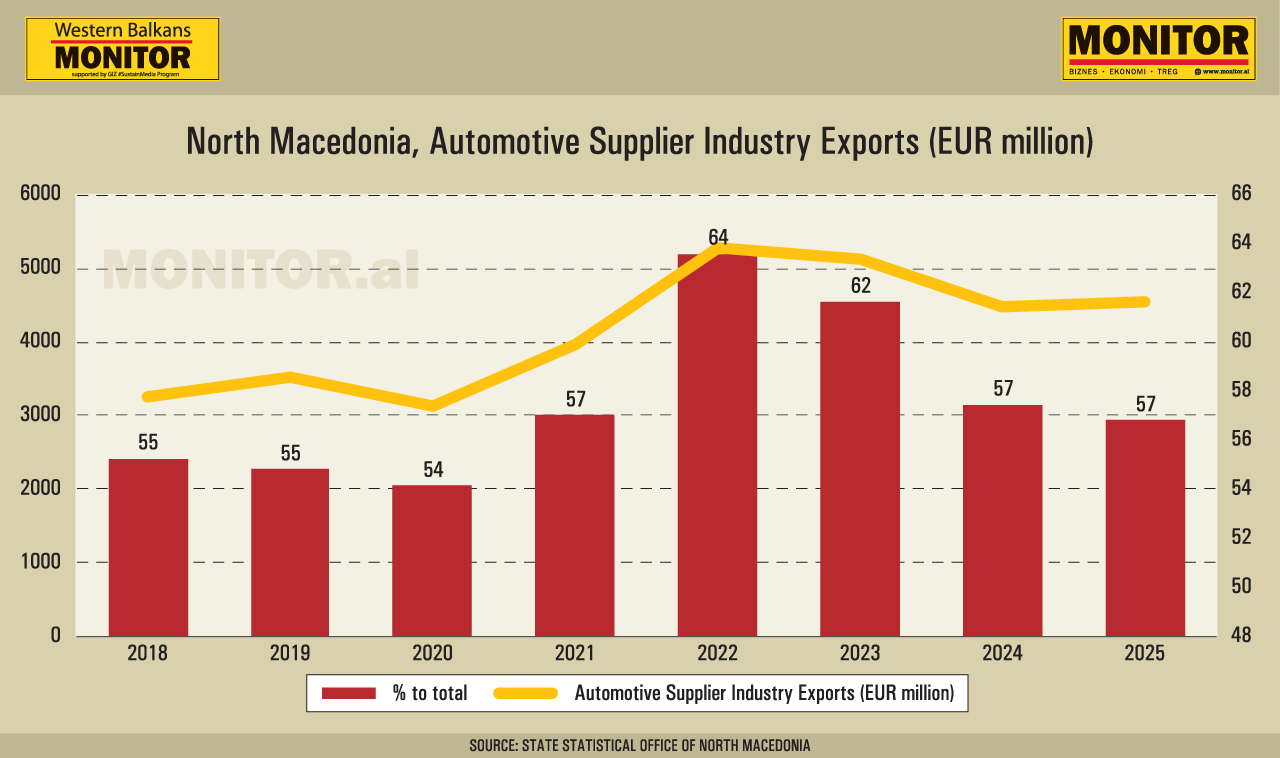
Official data show that North Macedonia’s automotive support industry is not simply a sector within industry, but the main axis of the export economy. More than 57% of the country’s total exports are linked to automotive, with a value ranging between 3 and 4 billion euros a year. On the other hand, at least 35,000 jobs are directly or indirectly linked to the sector, making the industry a critical factor for employment and macroeconomic stability. This means that any slowdown in the German automobile industry is transmitted almost immediately to the Macedonian economy.
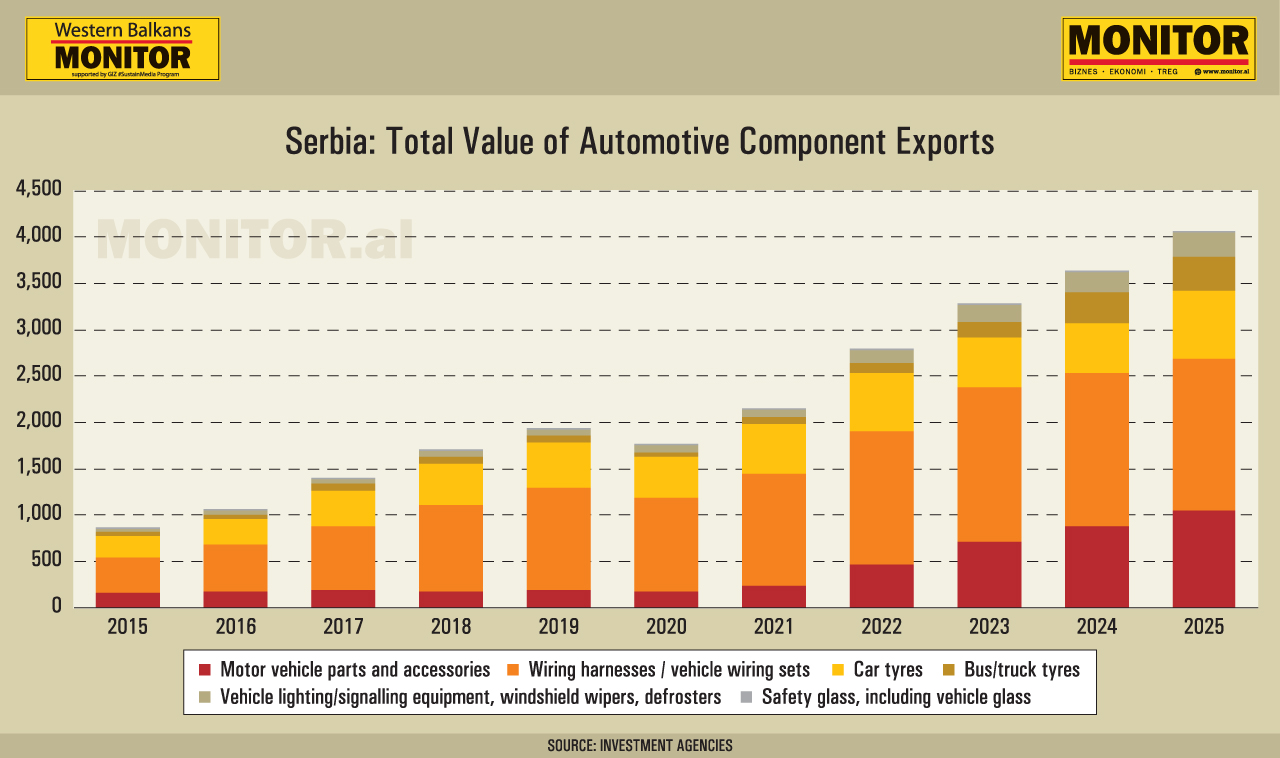
In Serbia, automotive exports exceed 4 billion euros, while the industry generates around 8.8 billion euros in total revenues, accounting for 12.3% of national exports. Unlike North Macedonia, which has 50 companies of this profile, Serbia has a broader industrial base, with 140 supplier companies and major investments from Bosch, Continental, Michelin, Aptiv and Stellantis.
On the other hand, unlike countries built on the model of free economic zones and cheap labour, Bosnia enters this sector with an industrial legacy from the Yugoslav period. This gives the country a stronger technical and engineering base. Exports from the automotive sector alone reached 678.5 million BAM, representing approximately 4.2% of the country’s total exports, which stood at 16.7 billion BAM, or 8.5 billion euros.
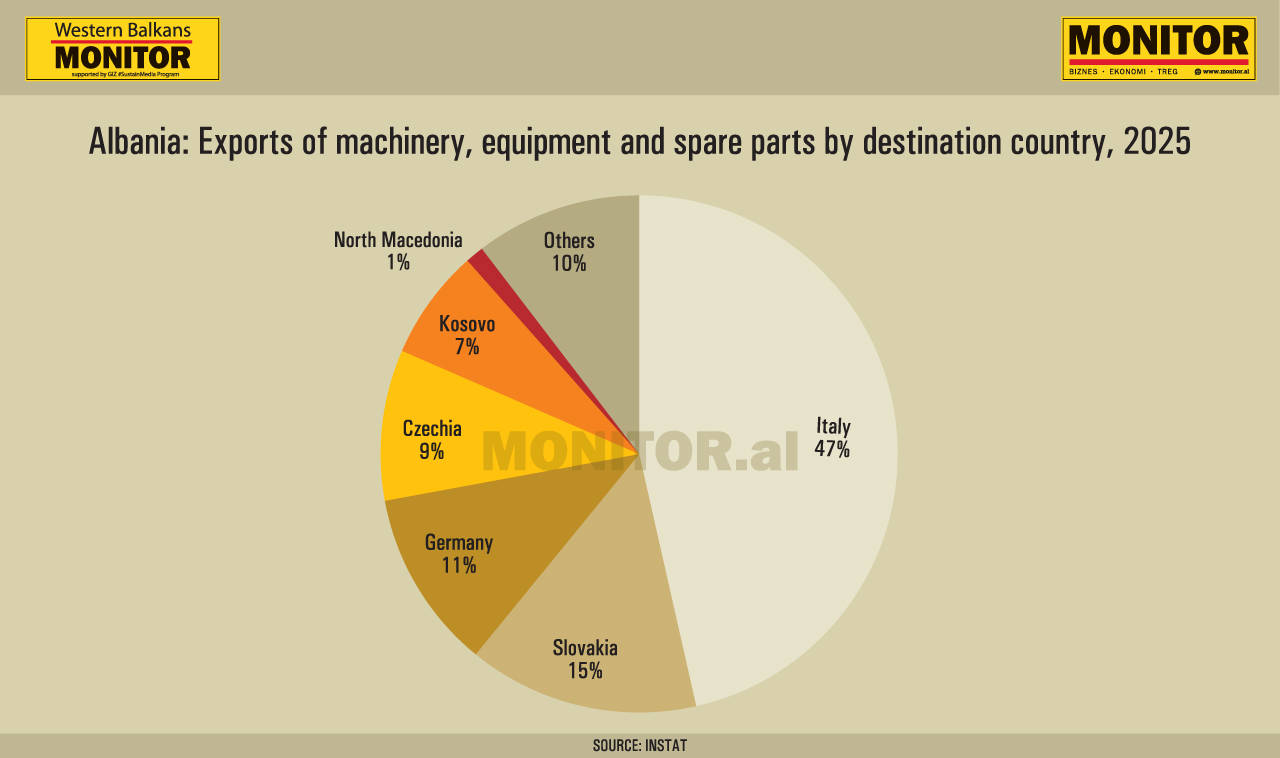
In 2025, Albania recorded total exports of around 346.1 billion lek. Within this structure, the group “Machinery, equipment and spare parts”, which also includes products manufactured by the automotive industry, reached 39.7 billion lek, accounting for around 11.5% of the total. This places the group among the segments with visible weight in the country’s export basket, but still far from the dominant role that automotive has in the region’s more industrialised economies.
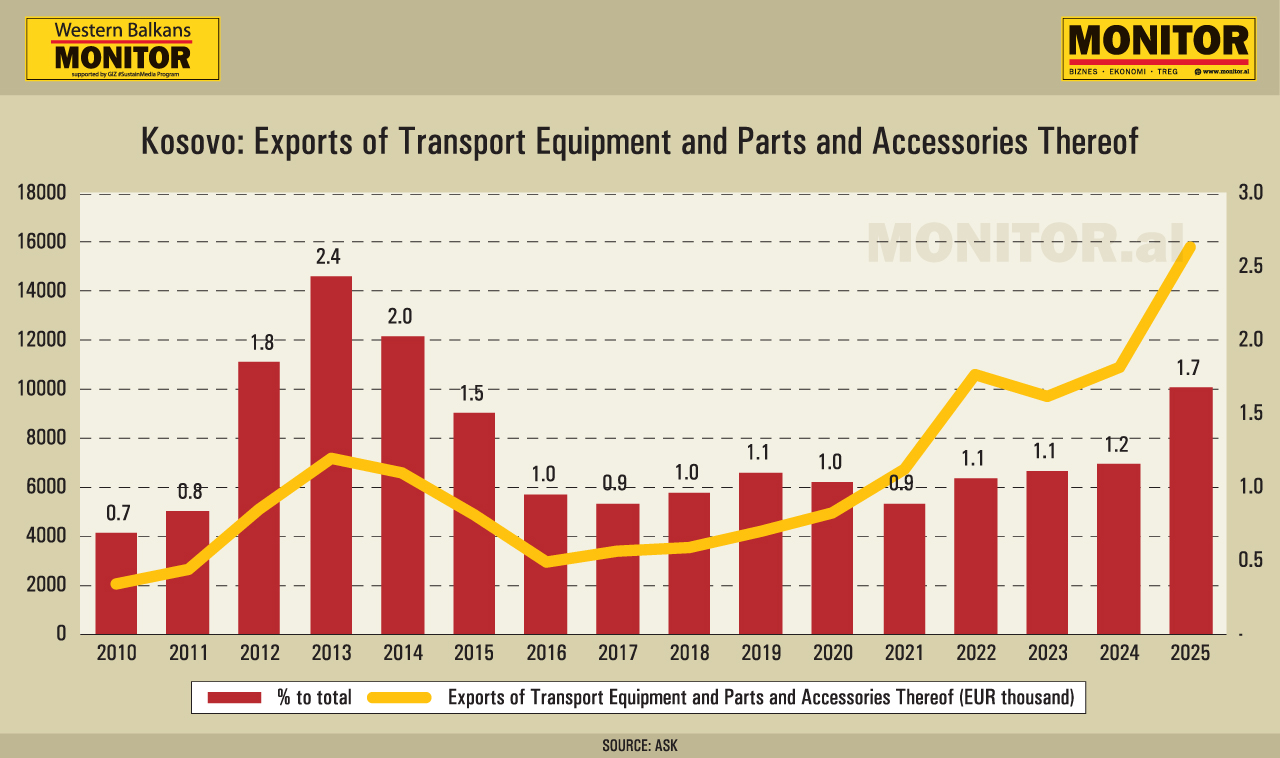
Kosovo remains the smallest automotive economy in the Western Balkans. Sector exports in the first four months of 2026 reached just over 3 million euros. According to data from the Kosovo Agency of Statistics, the group “Machinery, mechanical and electrical equipment” remains a small segment in Kosovo’s export basket, but is gradually gaining weight. Its exports grew faster than total exports, rising from 4.3% of the total in 2020 to around 4.8% in 2024, a sign that Kosovo is slowly building an industrial base of this profile, although still far from the scale of Serbia or North Macedonia. However, unlike the region’s traditional models, Kosovo companies are trying to enter highly specialised segments, such as decorative carbon-fibre components or textile lighting for premium European brands. The strategy is not volume, but specialisation.
Montenegro remains practically outside the automotive production map. The figures show an economy oriented more towards consumption than industrial production: in 2024, the country imported vehicles worth around 420 million euros, while automotive exports were only 12.4 million euros.
Overall, the region presents three different models. North Macedonia is the economy most dependent on automotive, Serbia is the largest industrial centre, while Bosnia preserves the most traditional production base. Albania and Kosovo are still building an automotive support industry, without yet achieving high added value, while Montenegro remains outside the industrial cycle. What stands out is that all economies, with the partial exception of Bosnia, rely mainly on the low-value links of the European supply chain: assembly, components and labour-intensive work.
Germany as the leading automotive investor
Data reported across the region show that Germany accounts for the largest share of investment in the automotive supplier industry. In North Macedonia, this dependence is particularly direct: exports to Germany reached nearly €2.9 billion in 2025, while Germany remained the dominant investor, accounting for almost 30% of FDI inflows. In Serbia, automotive exports are directed mainly to Germany, Hungary and the Czech Republic. The closure of the German-owned Dräxlmaier and Leoni plants, affecting around 4,000 jobs, illustrates how shocks in the German automotive industry are transmitted almost immediately to Serbia. In Bosnia and Herzegovina, Germany is the most important market for automotive parts, accounting for 18.21% of exports in 2025, while the country’s historical connection with Volkswagen remains part of its industrial identity. In Kosovo, Germany’s role is reflected more through supply chains: “Made in Kosovo” components have entered the Volkswagen Group and are used in Audi models. In Albania, the German presence is linked to both capital and employment, through companies such as PSZ Albania and Forschner Albania. Germany is not merely an export market for the region; it is the customer, the investor, the technical benchmark and the primary source of cyclical risk for the Western Balkans automotive industry.
A region between dependence and opportunity
The Western Balkans has entered the European map of the automotive industry. Its factories produce cables, metal parts, electrical systems, upholstery and components that end up in vehicles made by some of the world’s largest brands.
This marks a major shift for a region that for many years was seen more as a consumer market than as a production base. Today, the Balkans is not only a buyer of cars; it also helps produce them.
But this is where the dilemma begins. The region produces a great deal, but decides little. Technology, design, brands and the largest profits remain largely in the hands of foreign investors.
Serbia is the largest industrial centre, North Macedonia the economy most dependent on automotive, while Bosnia relies on its long-standing production tradition. Albania and Kosovo are trying to find their place, while Montenegro remains on the margins of this development.
For years, the formula was simple: low wages, favourable taxes, subsidies and proximity to the European market. This brought investment, exports and jobs.
But that formula is now nearing exhaustion. Labour costs are rising, the available workforce is shrinking due to emigration and population decline, while the European car industry is slowing down. At the same time, the age of electric vehicles is changing the rules of the game and requires more technology, software and automation, not just manual labour.
This places the region before a difficult choice. It can remain the place where parts are assembled for others, or it can begin to build more knowledge, engineering capacity and higher-value products. But for this, it needs investment in skills, technology and domestic companies; otherwise, we risk remaining at the bottom of the chain.
The question that will define the next decade is whether the Western Balkans can move higher up the global value chain or whether it will remain forever the low-cost labour arm of the European, and wider, automotive industry.
The dilemma
The question that will define the next decade is whether the Western Balkans can move higher up the global value chain or whether it will remain forever the low-cost labour arm of the European, and wider, automotive industry.
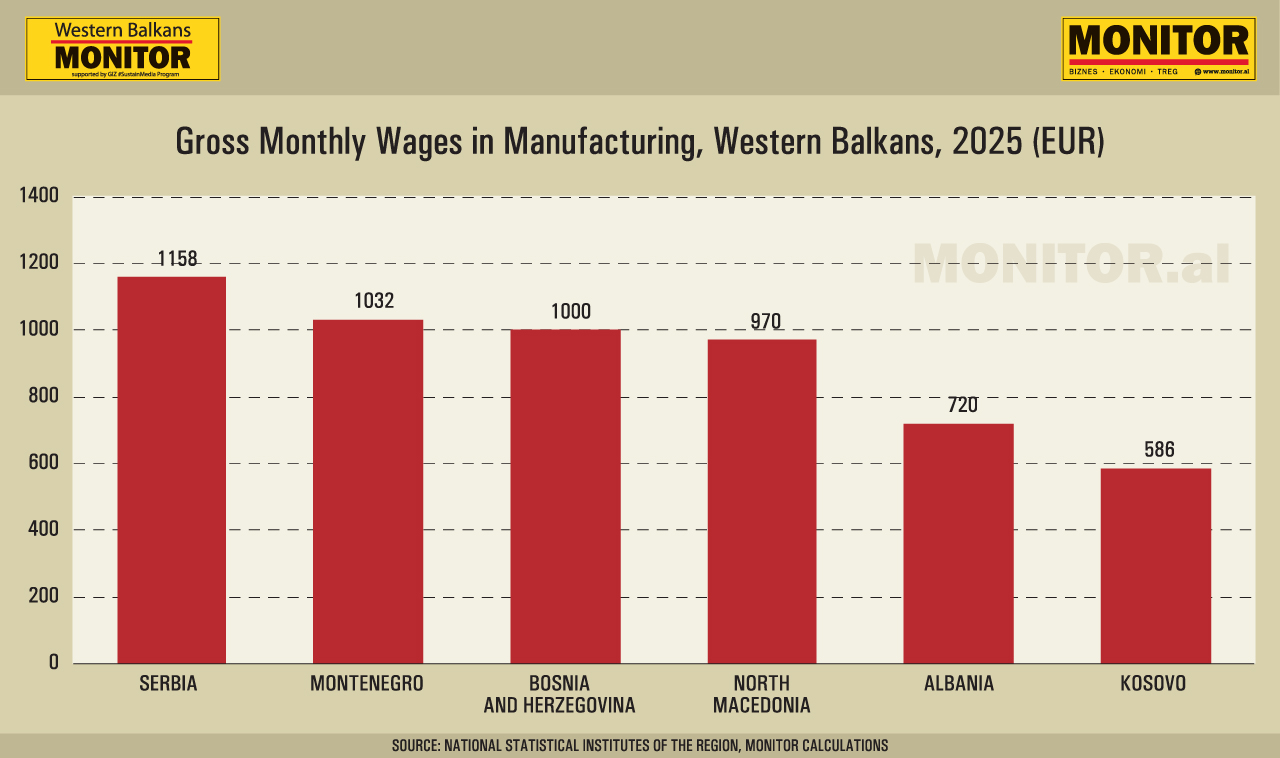
Labour costs, Kosovo and Albania still the cheapest
In 2025, the Western Balkans shows a clear differentiation in labour costs in the manufacturing sector, with Serbia leading the region and Kosovo remaining the market with the lowest cost. Specifically, according to data processed by “Monitor”, based on data from the statistical agencies of the respective countries, the gross monthly wage in Serbia reaches €1,158, while in Montenegro and Bosnia and Herzegovina it stands at €1,032 and €1,000 respectively. North Macedonia appears to be close to the regional average, with €970.
Albania, on the other hand, remains competitive compared with the rest of the region in terms of low labour costs, with a gross wage of €720, while Kosovo ranks last, at only €586 in the manufacturing sector, preserving its low-cost labour advantage. Seen in this context, labour in Serbia costs twice as much as in Kosovo and more than 60% more than in Albania.
The race for incentives
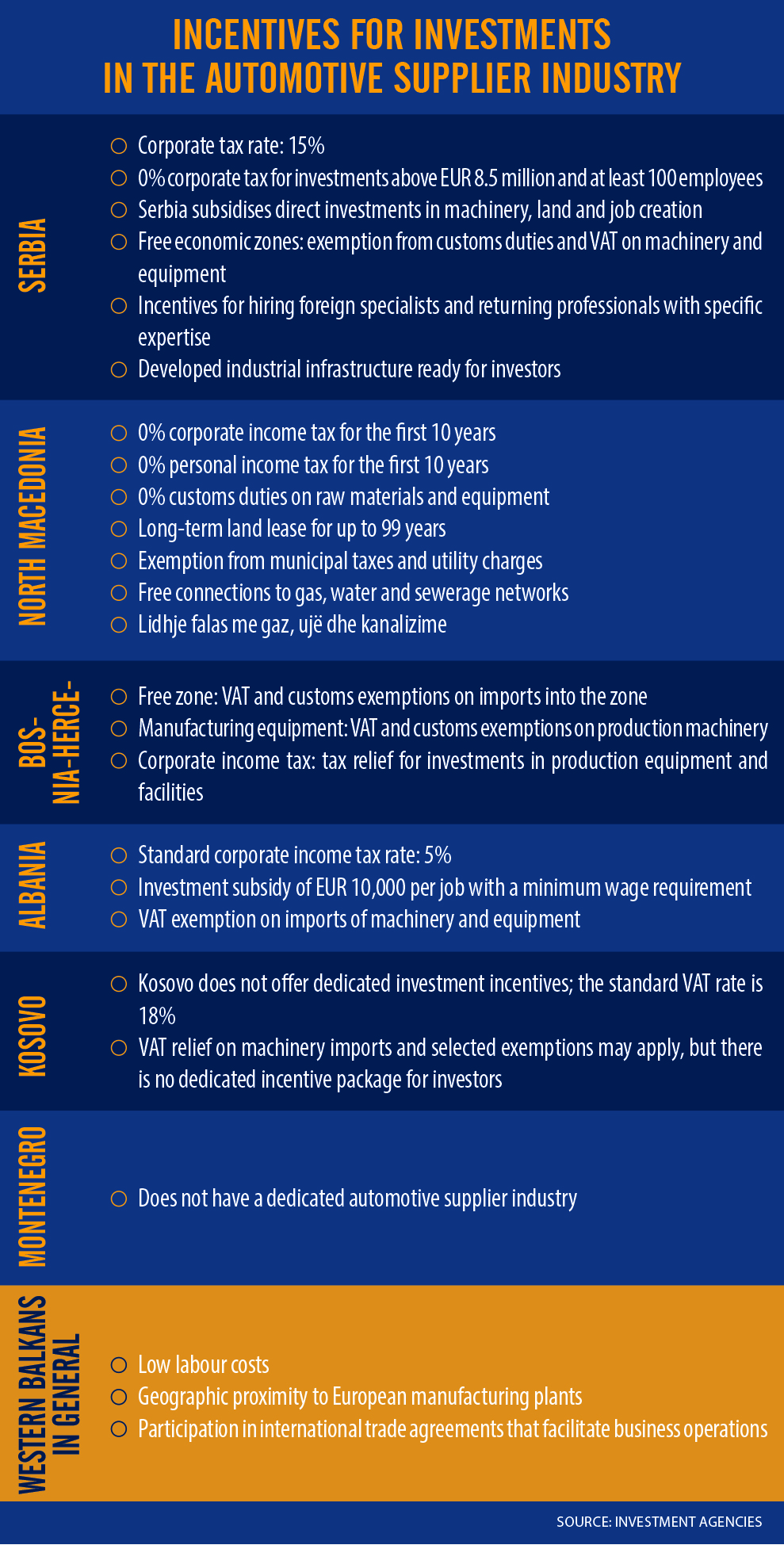
For years, the Western Balkans has been engaged in a quiet race for the automotive industry, with Serbia and North Macedonia emerging as the most aggressive players through low taxes, economic zones and fiscal exemptions.
Based on the data, Serbia appears to rely on a comprehensive package: a 15% corporate income tax, a 10-year exemption for large investments, job subsidies and free economic zones. North Macedonia goes even further in the TIDZs, the free investment zones, with 0% corporate income tax, 0% VAT and 0% customs duties on raw materials and equipment.
Bosnia and Herzegovina offers fewer direct grants, but provides facilities in free zones and has an industrial base in metals, equipment and components. Albania competes with a 5% corporate income tax for the automotive sector, subsidies for minimum wages and VAT exemption on machinery, while Kosovo remains without a dedicated sectoral package.
In essence, the model followed by the region has been built on low labour costs, fiscal incentives and gradual integration into European supply chains. This model has brought production and labour-intensive components, but the next phase will be more difficult.
As the Western Balkan countries seek EU integration, the advantage will no longer be measured only by low taxes or fiscal exemptions. The pressure will shift towards productivity, technology, clean energy, European standards and the ability to produce higher value-added components.
Serbia, between Europe and China in the automotive industry
The Serbian government has positioned the country as a key point in the global supply chain for multinational automotive companies, particularly from the EU and, increasingly, from China. Through a wide range of government incentives, the state has managed to attract investments worth billions of euros.
Foreign companies are offered free trade zones, tax relief, construction land at reduced prices or free of charge, state-funded infrastructure, training subsidies and more. More than 50 foreign companies have benefited from such programmes, including Michelin, Bosch, Aptiv, Continental and Lear.
Often seen as the crown jewel of Serbian manufacturing, the country’s automotive industry has recently begun to falter. Despite billions of euros in exports and major foreign investment, job cuts and factory closures since 2025 have raised concerns about the sector’s sustainability. On the other hand, the crisis in Europe’s automotive industry is also creating new opportunities for Chinese investors.
Serbia’s automotive exports exceeded €4 billion in 2025, accounting for 12.3% of total exports. Around 140 suppliers generated €8.8 billion in revenues in 2024, or 3% of Serbia’s GDP.
Read the full article on Serbia’s response at the link:Serbia, between Europe and China in the automotive industry
North Macedonia’s successful automotive model enters the transition test
For more than two decades, North Macedonia built one of the Balkans’ most aggressive models for attracting the automotive industry, offering low taxes, state subsidies, low-cost labour and special economic zones for foreign investors. The result was the transformation of a small Balkan economy into a production base for some of the largest suppliers of Europe’s automotive industry.
Today, the automotive supplier sector accounts for almost half of the country’s exports, employs tens of thousands of people and is dominated by international companies producing components for the world’s largest vehicle brands. But the model once seen as an industrial success story is facing new pressure: the economic slowdown in Europe, the transition towards electric vehicles and geopolitical uncertainties affecting global supply chains.
The automotive supplier industry has practically become the export engine of the economy. According to the Foreign Investors Council, sector exports have fluctuated between €3 billion and €4 billion a year and in 2024 accounted for 53% of North Macedonia’s total exports.
Read the full article on North Macedonia’s response at the link: North Macedonia’s successful automotive model enters the transition test
Bosnia has the tradition, factories and know-how. But are they enough to convince investors to come?
The automotive industry remains one of the main engines of economic development in Bosnia and Herzegovina. Companies in this sector are among the fastest-growing and most technologically advanced in the country, particularly in management, organisation and the implementation of modern technologies.
Domestic companies are mainly focused on the production of mechanical parts and components, usually made of steel and aluminium. Most operate in secondary production, not on the main stage of global brands, but behind the scenes where the value chain is built.
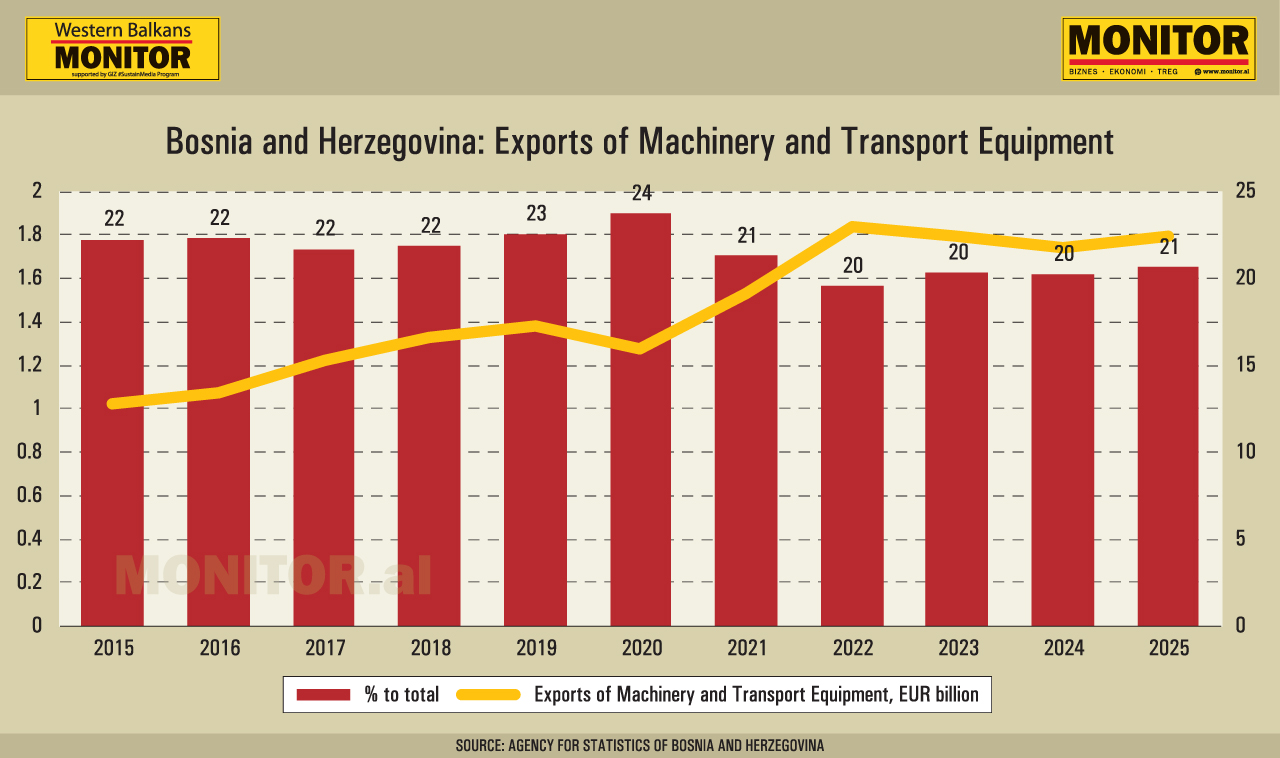
In 2024, exports reached 678.5 million BAM (€347.07 million). In 2025, Germany accounted for 18.21% of exports, Austria for 15.68% and Italy for 11.79%. The main products are vehicle parts, aluminium wheels, exhaust systems, engines, transmissions, braking systems, pumps, filters, textile and leather products, and components made of metal, rubber and plastic.
Read the full article on Bosnia and Herzegovina’s response at the link: Bosnia has the tradition, factories and know-how. But are they enough to convince investors to come?
Albania, Automotive industry between growth and the loss of the low-cost advantage
Albania’s automotive industry is currently at a turning point. Foreign trade data show that exports of the “machinery, equipment and spare parts” group, which includes automotive industry components, reached around 39.7 billion lek in 2025. This represents an increase of approximately 6% compared with 2024, following two years of contraction. Over a longer horizon, the sector has changed scale, with export values about 3.7 times higher than in 2015, reflecting an average annual growth rate of around 14%. Nevertheless, the fact that 2025 remained almost at the same level as the 2022 peak indicates that the period of sustained growth has come to an end. The industry is still growing, but at a slower pace, with higher costs and greater uncertainty.
Two factors are putting pressure on the industry from within: the exchange rate and labour costs. First, companies sell in euros, but a large share of their expenses is in lek. When the euro weakens, converted revenues shrink, while wages, energy, domestic services and administrative costs do not move in the same direction. Second, while the situation for basic labour appears more stable than two or three years ago, when sudden departures from jobs were a widespread phenomenon, the challenge has now shifted to a shortage of staff at the managerial level.
Read the full article on Albania’s response at the link: Albania, automotive industry between growth and the loss of the low-cost advantage
In the shadow of Europe’s giants, Kosovo seeks its place in the automotive industry
Kosovo appears to have placed a modest bet on the automotive industry as it seeks to build a position in the supply chains of global automotive giants through the still very limited production of vehicle parts and components. Today, it remains a small, fragmented and largely unnoticed industry within an economy that continues to be dominated by imports and consumption.
In the first four months of 2026, exports from the industry amounted to just over €3 million, making the automotive supplier sector little more than “a drop in the ocean”.
Yet within this modest picture, several small stories of industrial transformation linked to the sector appear to be emerging. On the outskirts of Pristina, MUNDA Kosova is one of the companies that has begun producing textile lighting systems for automobiles, a specialised segment particularly used in premium and electric vehicle models.
Another model is being developed by Koshi Group, a company specialised in the production of decorative automotive parts made from carbon fibre. Its products are used by brands such as Fiat Abarth, Alfa Romeo and Lamborghini, while its exports extend to the United States, Japan and the European Union.
Read the full article on Kosovo’s response at the link: How “Made in Kosovo” parts are entering Volkswagen and Lamborghini supply chains
Montenegro, the Balkans’ automotive outsider
While other Western Balkan countries have gradually built production bases for the automotive supplier industry, Montenegro continues to remain mainly an import market, with a limited role in production and a minimal presence in European industrial chains. The small economy on the Adriatic coast today functions more as a logistics, distribution and vehicle consumption hub than as a producer of parts or technology linked to the automotive industry.
Read the full article on Montenegro’s response at the link: Montenegro, the Balkans’ automotive outsider
Ky është artikull ekskluziv i Revistës Monitor, që gëzon të drejtën e autorësisë sipas Ligjit Nr. 35/2016, “Për të drejtat e autorit dhe të drejtat e lidhura me to”.
Artikulli mund të ripublikohet nga mediat e tjera vetëm duke cituar “Revista Monitor” shoqëruar me linkun e artikullit origjinal.