
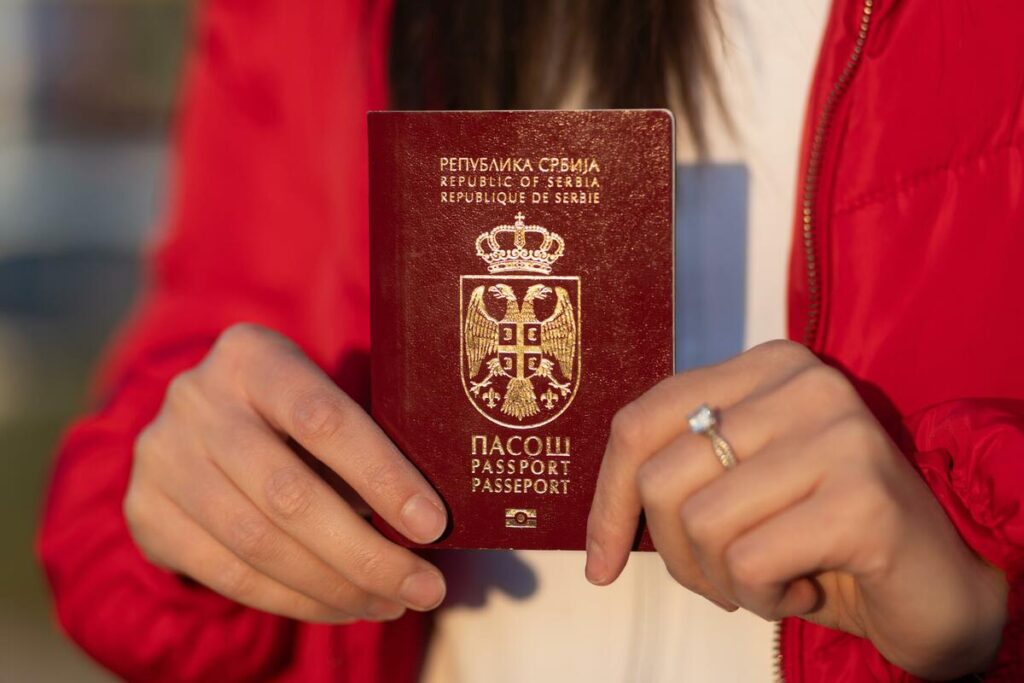
A woman holds a Serbian passport (Illustration), Photo: Shutterstock

07.06.2026. 13:39h
Although citizenship policy is under the jurisdiction of Serbia, the increased number of Russian citizens who, by acquiring Serbian citizenship, gain the opportunity to enter the European Union (EU) without a visa represents a potential security challenge for the Union, according to the European Commission (EC).
In the latest EC document, which assesses Serbia’s progress in chapters 23 and 24 relating to the rule of law, the institution states that the number of citizenships granted to Russian citizens has increased in the past period.
“Despite Serbia’s sovereign right to decide on its citizenship and naturalization policies, the accelerated acquisition of visa-free travel rights to the EU for Russian citizens by granting Serbian citizenship, the number of whom has increased compared to previous years, poses potential security risks for the EU,” the EC non-paper, which Radio Free Europe has access to, states.
This document was the subject of discussion at the level of diplomats of EU member states at the end of May.
“Serbia must improve the screening of visa applications submitted by citizens of countries considered to pose a risk in terms of irregular migration or security,” it states.
Recently, several EU member states have been pressuring the EC to propose legislation that would make it easier to deny tourist visas to Russian citizens due to the Russian invasion of Ukraine.
According to EU data, the number of tourist visas issued to Russian citizens for the Schengen area increased to almost 480.000 in 2025, the highest level since the beginning of the Russian invasion of Ukraine in 2022.
Serbian President Aleksandar Vučić has already announced that Serbia will not introduce visas for Russian citizens.
According to the terms of the Growth Plan, Serbia should introduce visas for at least three countries by the end of the year.
Serbia’s visa policy is “only partially aligned” with the EU’s visa policy on the list of third countries whose citizens require a visa to enter the EU, according to the rule of law report for Serbia.
Currently, 12 so-called third countries enjoy visa-free travel with Serbia, but not with the EU: Armenia, Azerbaijan, Bahrain, Belarus, China, Indonesia, Jamaica, Kyrgyzstan, Kazakhstan, Russia, Suriname, and Turkey.
“No further progress has been made in harmonization with EU visa policy since December 2024, when Serbia fulfilled its obligations under the Reform Agenda on harmonization with the EU visa regime with at least three countries whose citizens require a visa to enter the EU,” the document states.
Through the reform agenda, Serbia has committed to introducing a visa regime for at least three of the listed countries.
The value of this obligation within the Growth Plan amounts to slightly more than 27,1 million euros.
Failure to meet this obligation by the end of 2026 would result in the loss of that amount of financial resources.
Serbia has planned to implement this obligation by the end of December 2024 in its Reform Agenda for the Growth Plan.
The EC, however, granted all countries in the region a so-called grace period, or extended period.
For obligations that were to be fulfilled by the end of 2024, that deadline has been extended by 24 months, i.e. until December 2026.
In the meantime, before the possible introduction of visas for at least three countries, the EC is requesting Serbia through documents to tighten the rules for issuing visas to citizens of countries that still have a visa-free regime with Serbia but do not have one with the EU.
The Commission believes that this would ensure greater control and compliance with EU standards, as well as reduce the inflow of irregular migrants to the EU among third-country nationals entering Serbia with valid visas.
Download the app and follow the news


FOLLOW US ON

News