
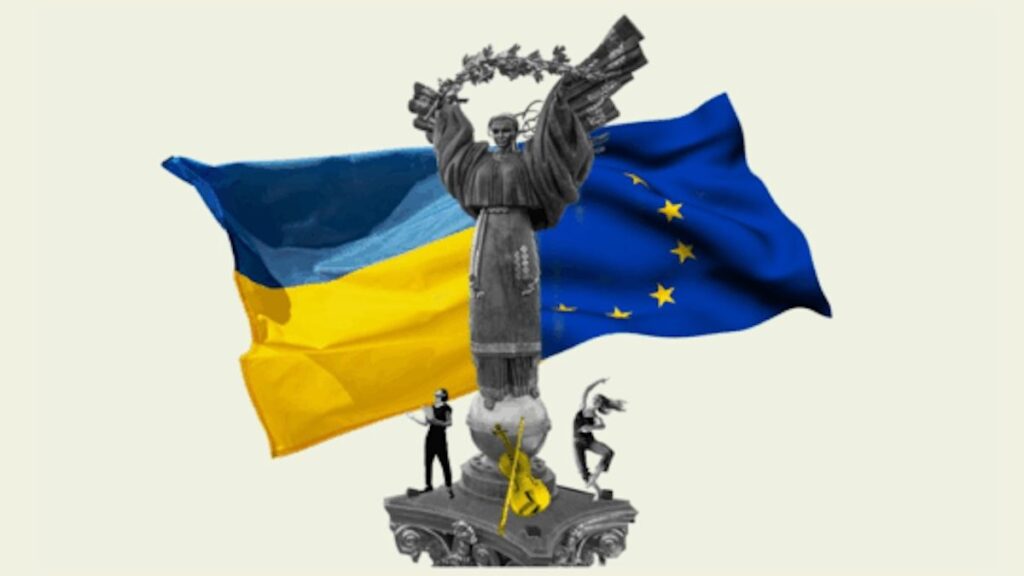
Wouldn’t you like as a member of your club an applicant who has just humiliated your most dangerous enemy through an audacious attack? That is what Ukraine did last week with its drone strikes on an oil terminal at St Petersburg, sending clouds of smoke into the air just as Vladimir Putin was hosting his flagship economic forum in that city designed to portray Russia as a perfect investment destination.
Yet although both Ukraine and its smaller neighbour, Moldova, will be given permission on June 15th to start their formal negotiations to join the European Union, the path to that membership still looks strewn with obstacles.
If you look at Europe through a lens of defense and security, nothing could be more obvious than that Europe needs Ukraine just as much as Ukraine needs Europe.
Anyone wanting to learn how to defend against drones or missiles – whether from Russia, from terrorist groups or anyone else – knows that Kyiv is the place to call. Anyone wondering how to expand their defence production rapidly, how to modernise it for the era of cheap drones and artificial intelligence, knows that Ukraine holds many of the answers, whether as a supplier, a partner or an adviser.
That emergence of Ukraine as Europe’s leading country for defense-industry innovation is of course the result of four years of war but also of hundreds of billions of euros of funding from the EU and from member governments.
The famous report on EU industrial competitiveness by Mario Draghi in 2024 called for the creation of an EU single market for defense production and for vast amounts of investment financing for defense and other sectors. It is an irony that by far the biggest and most successful example of that happening is in a country that is not yet a member of the EU, Ukraine.
Moreover, anyone looking at the history of Ukraine’s battle against Russian domination and then military assault will quickly see that the country’s desire to be European is deeply rooted. The popular protests in Kyiv in 2013-2014 that overthrew a Russia-affiliated president were protests in which the EU flag was as prominent as Ukraine’s own flag.
One of the main issues that led to President Viktor Yanukovych’s ousting was a proposed free-trade agreement with the EU that he sought to reject despite the Ukrainian Parliament having already accepted it. In a 2015 documentary film, “The Great European Disaster Movie” for which I served as executive producer – which featured plenty of skeptical and critical voices against the EU in Britain, France and elsewhere – by far the most powerful and emotional voices in favor of the EU were from Ukrainians.
The go-slow forces in Europe
Admittedly, now that Victor Orban is no longer Hungary’s prime minister it is hard to find European leaders who are explicitly opposed to Ukraine’s membership. Everyone claims to be in favor of it. But dig a little deeper and you will find many countries keen at least to slow the process down and some that might choose to block it altogether.
Italy is at the forefront of those wanting to slow it down. Giorgia Meloni says that she supports Ukraine’s accession but that countries in the Balkans, by which she means Albania, Bosnia & Herzegovina, Serbia and North Macedonia, should take precedence.
Meloni’s desire to show favor to Italy’s close neighbor and her desired asylum-processing partner Albania can be understood as a natural diplomatic gambit. But this could also become a way to ensure that Ukraine’s entry is delayed for years, given the clear problems concerning democracy, the rule of law and Russian interference in Serbia, in particular.
The most crucial opponents, however, lie in two of Ukraine’s biggest neighbours, Poland and Hungary.
The man who defeated Orban, Peter Magyar, is not going to demonize Ukrainians as enemies in the way that Orban tried to. But although he has lifted Hungary’s veto over Ukraine’s commencement of formal accession negotiations and Orban’s block on the EU’s €90 billion loan to finance Ukraine’s war effort over the next two years, the issue of the status and rights of the approximately 100,000 Ukrainians who are of Hungarian ethnic origin remains sensitive politically in Budapest.
Poland’s objections are even more visceral, notwithstanding the fact that unlike Hungary the country has housed vast numbers of Ukrainian refugees during the four-year war. President Volodymr Zelenskyy recently caused outrage among Poland’s political leaders when he gave posthumous honors to one of the former leaders of the Organization of Ukrainian Nationalists. This was a pro-independence group that during the Second World War was involved in a massacre of Poles in what is now western Ukraine but which in 1918 had been seized by Poland.
Conflicting agricultural interests
A more down-to-earth objection to EU membership for Ukraine is rooted in the traditional EU sport of agricultural protectionism.
The EU already accounts for 65% of Ukraine’s goods exports. The free-trade agreement that was negotiated in 2014 and has been in provisional force ever since then was deepened even further in 2022 when the EU abolished remaining tariffs on goods from Ukraine in order to support Ukraine’s economy after the Russian invasion. However tariffs on food imports were reintroduced in June 2025 under pressure from farmers and their political allies in Poland and Hungary.
Full Ukrainian entry to EU would inevitably involve those food tariffs being abolished again, which gives Polish farmers ample reason to oppose it, or at least to slow it down drastically by demanding a long transition period for agricultural trade. One of the reasons why Russian imperialists have coveted Ukraine for centuries is the fact that its wheat fields are so large and fertile.
EU enlargement decisions require all 27 existing member countries to agree and to ratify the decision through their own parliaments or by referendums. Inevitably, this hands a lot of power to objectors, even when the moral and political case for Ukrainian entry is so obviously strong.
Chancellor Friedrich Merz of Germany recently proposed that Ukraine should be given an interim “associate” status, through which it could gain many of the advantages of EU membership more swiftly and easily. President Zelenskyy reacted angrily, claiming to be insulted by the idea. He is right to feel insulted but in the end that may not be good enough grounds to reject some formula similar to Merz’s idea.
The top priority for Ukraine and for all of Europe must be defense, so that giving Ukraine a formal role in defense planning, production and military co-operation will be an obvious first step once some sort of ceasefire has taken place. Ukraine will not be able to join NATO, but the next best thing will be formal ties with the European members of NATO.
At the same time, after a ceasefire the economic pressures on both Ukraine and the EU will be intense and will demand cooperation. The costs of reconstruction will be huge, and the strain on Ukraine’s already diminished population of 28 million people (excluding people in areas currently occupied by Russia) will be immense. Unlike with other enlargements, the big issue will not be outward immigration but rather the task of attracting back most of the more than five million Ukrainian refugees. Without them, Ukraine will have a labor shortage.
These will be huge shared financial and demographic challenges, challenges that will not wait until the bureaucratic and political processes of negotiation are concluded. So both sides will be forced to compromise, on the speed of integration of Ukraine and on the symbolic labels given to describe Ukraine’s new status.
But, as the emotional voices at the end of our 2015 film showed and the war has now proved, Ukraine is now firmly a European, westward-facing nation. We must all find ways to welcome it, as rapidly and as smoothly as possible.
This article, an earlier version of which was first published in Italian translation by La Stampa, is republished with permission.