
The U.S. House of Representatives passed on June 8 a bill requiring a report on Russian and Chinese influence and intelligence assets in Georgia, as well as a 5-year strategy on bilateral relations with Georgia.
The bill, H.R. 7668, titled “Countering China’s Control of the Caucasus Act,” was introduced on February 24 by Republican Rep. Joe Wilson of South Carolina, a vocal critic of Georgian Dream, and co-sponsored by Democrat Rep. Steve Cohen of Tennessee. As it has passed the House without objection, the bill now heads to the Senate.
If adopted by the Senate, the act will require – “not later than 180 days after the date of the enactment” – the Department of State to submit a “classified report” to Congress that examines “the penetration of Russian and Chinese intelligence elements and their assets in Georgia” and “the potential intersection of Russian and Chinese influence and cooperation in Georgia.”
(A similar requirement has been one of two amendments approved on June 5 by the U.S. House Committee on Armed Services for inclusion in the draft U.S. National Defense Authorization Act (NDAA), the annual must-pass bill.)
The act would also require the State Department to submit the “5-Year United States Strategy for Bilateral Relations with Georgia” “not later than 180 days” after its enactment.
The strategy must outline “specific objectives for enhancing bilateral ties which reflect the current domestic political environment in Georgia.” It must include “a determination of the tools, resources, and funding” that should be available to achieve those objectives, as well as “an assessment of whether Georgia should remain a top recipient of United States funding in the Europe and Eurasia region.”
The strategy would also include “a determination of the extent to which the United States should continue to invest in its partnership with Georgia” and “a determination of whether the Government of Georgia remains committed to expanding trade ties with the United States and Europe and whether the United States Government should continue to invest in Georgian projects.”
The measure, another initiative by Rep. Wilson, comes amid what appears to be a continued effort to push Georgia-related actions amid stalled progress on the MEGOBARI Act, a bill foreseeing sanctions on Georgian officials. It also follows intensifying contacts between the U.S. and Georgian officials as part of the Georgian ruling party’s stated efforts to “reset” bilateral relations, which hit a low late in 2024.
The vote came hours after a report that Steve Nicandros, co-founder of the Texas-based oil company Frontera Resources, who had previously been reported to have lobbied against anti–Georgian Dream efforts, reached out to Rep. Joe Wilson with a letter seeking a meeting on Georgia to discuss, among others, the investment environment in the country and Georgia’s role in the Middle Corridor.
The alleged letter, dated June 8, was published on X by journalist Laura Kelly of The Hill, who had in the past reported on Nicandros’ alleged efforts to stall Wilson’s MEGOBARI Act. “GOD donor Steve Nicandros is back in Washington advocating improved U.S.-Georgian Dream relations, reaching out to Rep. Joe Wilson who is leader of holding GD accountable for election fraud, support for Iran and repression of Georgian people,” the journalist wrote.
House Debates
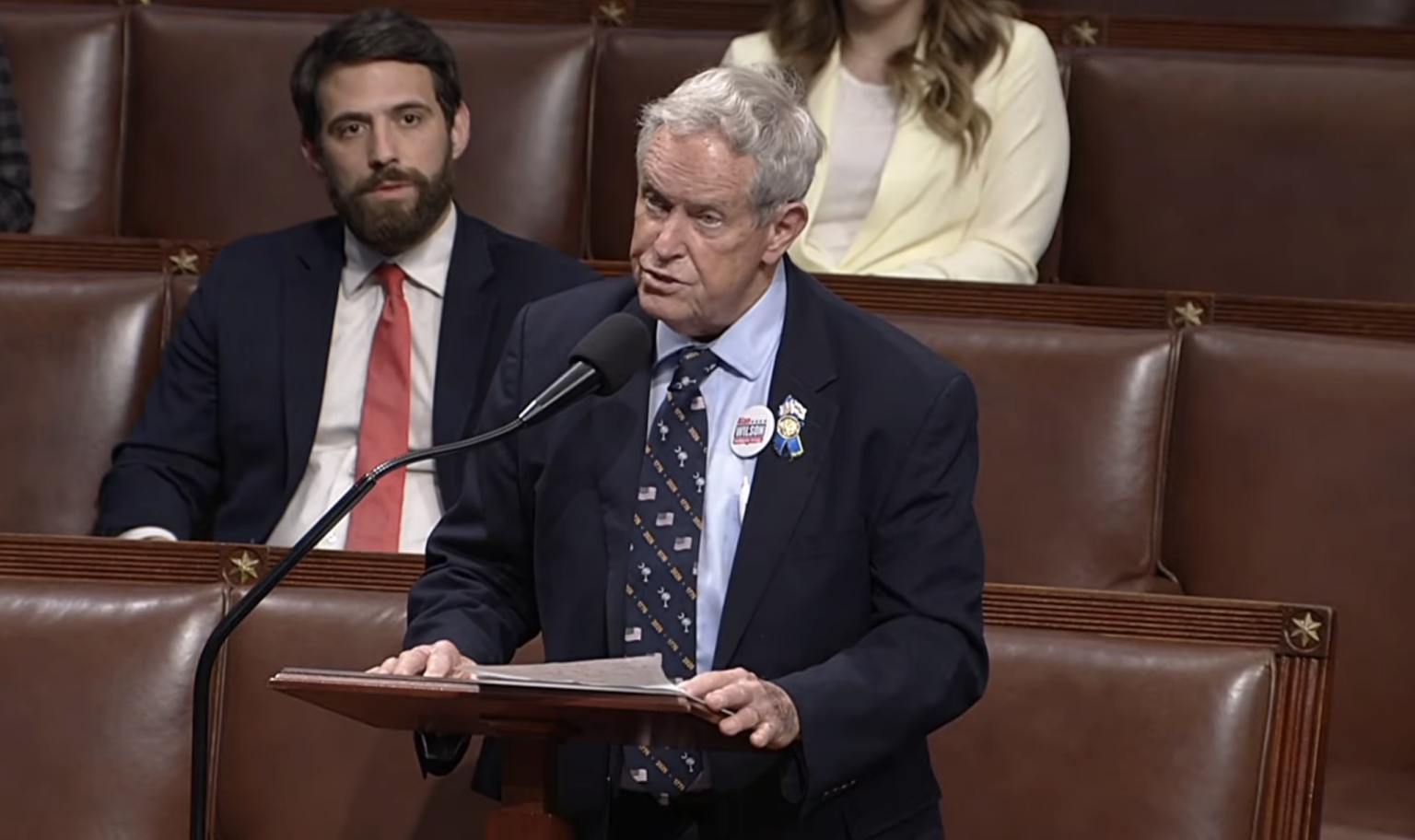
During the June 8 House floor proceedings before the vote, representatives of both Republicans and Democrats spoke in support of the bill. Rep. Joe Wilson was particularly extensive in his criticism of the Georgian Dream government.
“The illegitimate Georgian Dream team regime is in the process of selling out the country to the Chinese Communist Party and […] war criminal Putin and Iran, against the wishes of the Georgian people and the interests of the United States. The election was rigged in Georgia,” he said, adding that Georgian Dream has been peddling “the vilest anti-American propaganda” and insulting President Donald Trump by “accusing him of acting ‘as an agent of deep state.’”
“The behaviour of this rogue regime threatens all that President Trump has accomplished in the South Caucasus and must change,” he added.
Wilson then focused on the importance of the controversial Anaklia Deep Sea Port project, saying, “The sea route of the Middle Corridor must run through Georgia, and the Chinese Communist Party is set […] to own and control the strategic deep port of the region – Anaklia Port on Black Sea.”

“The Georgian Dream nightmare regime, with fair and free elections, must abandon its anti-American course, release political prisoners and politically motivated prosecutions, ensure a fair election environment, revoke draconian laws that are suffocating U.S. businesses, and seek to end the repression of free speech,” he further said.
“The Countering China’s Control of the Caucasus Act ensures that Chinese and Russian covert operations in the country are brought to light, and the United States strongly considers whether Georgia should remain a top recipient of aid while it attacks America with its propaganda on an almost daily basis.”
In his opening remarks, Republican Rep. Brian J. Mast of Florida said, “Over the last few years, there have been serious questions raised about the status of democracy and the prevalence of malign influence from U.S. adversaries” in Georgia.
“To this day, Russia occupies 20% of Georgia’s sovereign territory following its 2008 invasion,” he stressed, adding, “Despite efforts to militarily resist Russia, concerns remain over Russia’s long-standing influence in Georgia.”
“Equally concerning is the influence of the People’s Republic of China,” he further said, noting, “In the last few years, this led to the Chinese consortium being selected over a U.S. company for developing a massive seaport project,” referring to the Anaklia port.
“Competition is good,” he said, “But when it comes to critical infrastructure like this, our partners should take into consideration the risks posed by PRC.”
According to him, the bill, in addition to requiring the assessment of Russian and Chinese intelligence activities and influence in Georgia, will “also require a strategy for the future relationship between the United States and Georgia, and help us assess if Georgia is serious about a path of improved relations.”
Later, he also said, “It is time for the United States in Georgia to move forward. But doing so requires clarity on what is happening in their country behind the scenes and their responsible strategy for future engagement.”
Supporting the bill, Democrat Rep. Ami Bera of California said in his opening remarks, “In recent years, the current Georgian Dream government, as well as foreign malign influence from Russia and China in Georgia, have threatened Georgia’s hard-fought democratic gains, corrupted some of its state institutions, and caused a rift in the U.S.-Georgia relations, and between the Georgian government and its people.”
He linked the bill to the MEGOBARI Act, saying it serves as a “response to this deterioration.”
“The goal is to let the Georgian people know that we stand by them in their quest for democracy, respect for their rights, and deeper integration into the Euro-Atlantic community,” he said, adding, “This legislation ensures we are clear-eyed about what that continued support from the U.S. to Georgia will require, and provide a framework for appropriate cooperation with the Georgian government going forward.”
Later, he added that the bill “does not seek to malign the Georgian government, but rather [to] demonstrate to the people of Georgia that the United States remains committed to its Euro-Atlantic aspirations.”
Also Read:
Copy URL
URL Copied