

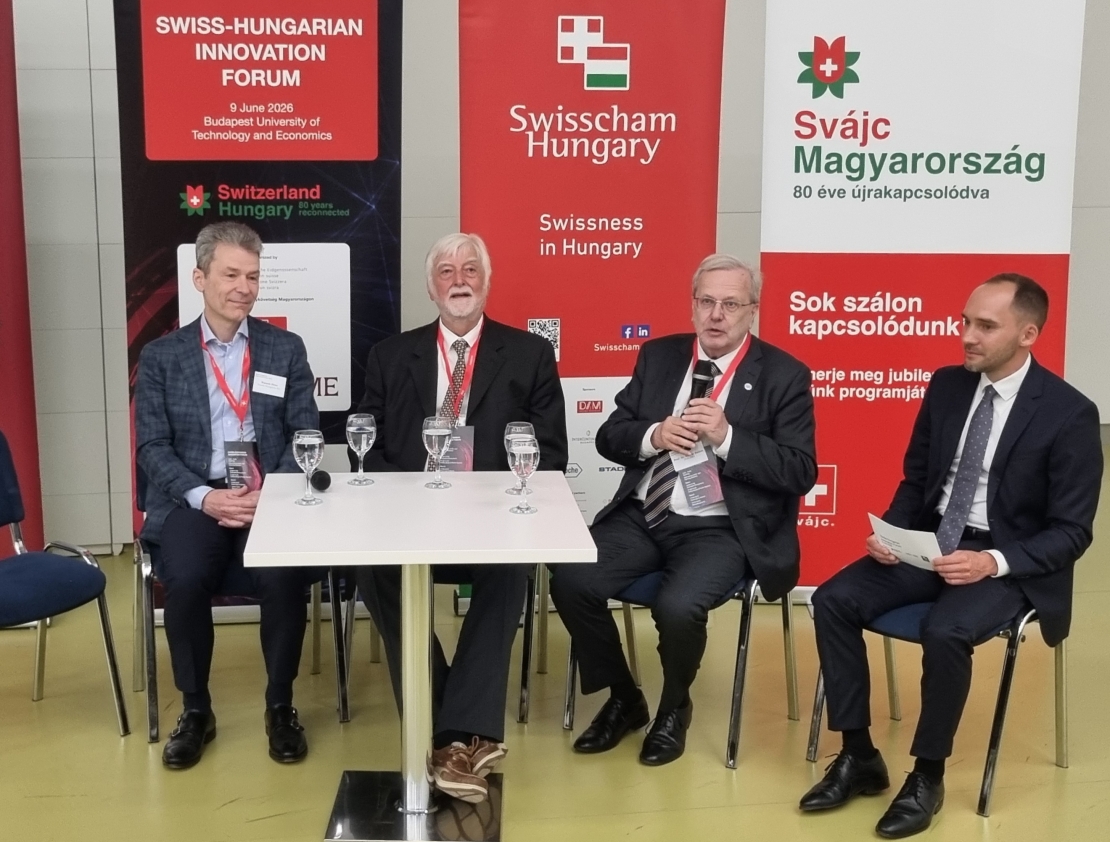
(L-R) Péter Noszek, Prof. Alexander Zehnder, Prof. Balázs Gulyás, Balázs Dobos
The first Swiss-Hungarian Innovation Forum on June 9th was jointly organized by the Embassy of Switzerland, the Budapest University of Technology and Economics, and Swisscham Hungary Swiss-Hungarian Chamber of Commerce. The event was held at the University of Technology and Economics (BME) in Budapest. The conference, titled “Switzerland and Hungary Build a New Innovation Bridge: World-Leading Expertise Meets Hungarian Technological Ambition”, was attended by Alexander Renggli, Ambassador of Switzerland to Hungary, as well as leading Hungarian and Swiss experts on innovation and business.
In his opening remarks Ambassador Renggli reminded his audience at the BME that this year Switzerland and Hungary celebrate 80 years since the resumption of diplomatic relations. “While this anniversary reminds us of our strong ties, today is above all about the future – a future shaped by innovation”, he added.
He spoke about Switzerland’s global role in technological and scientific innovation, but the Ambassador also pointed out that Hungary has its own strong engineering traditions, excellent universities, talented researchers and a growing technology sector. In his view,
Switzerland brings experience in building innovation ecosystems, commercializing research and connecting science with business.

Ambassador Alexander Renggli. Photo: Embassy of Switzerland, Dávid Harangozó.
In his speech, Ambassador Renggli highlighted the fact that over 900 Swiss companies operate in Hungary, employing around 33,000 people and contributing to economic development, industrial modernization and integration into global value chains. Continuing in this successful relationship, through the Second Swiss Contribution’s Research Programme Hungary, Switzerland is investing 9.5 million Swiss francs to strengthen research excellence, promote international scientific cooperation and enhance innovation capacities.

Péter Horváth, State Secretary for Science and Innovation. Photo: Embassy of Switzerland, Dávid Harangozó.
The Swiss-Hungarian Innovation Forum‘s aim was to give new momentum to innovation, business, and scientific cooperation between the two countries. Its central focus was on how research results can be transformed into marketable solutions, ideas into businesses, and cooperation into economic growth.
Switzerland has ranked among the world’s innovation leaders for many years and holds first place in the 2025 Global Innovation Index for the fifteenth consecutive year. One of the key lessons of the Swiss model is that
competitiveness depends not on the performance of a single actor, but on a well-functioning ecosystem in which universities, research institutes, companies, startups, investors, and supportive institutions and regulatory frameworks work closely together.

Photo: Embassy of Switzerland, Dávid Harangozó.
The keynote addresses were delivered by BME Rector Hassan Charaf, and State Secretary Dr. Péter Horváth. Innovation-related topics were introduced by János Levendovszky, Vice Rector for Innovation at BME. The forum also featured a panel discussion with leading international and Hungarian experts – including Alexander Zehnder, former President of the Board at ETH Zurich and representatives of major industry and research organizations such as Nestlé and HUN-REN – offering insights into the functioning of innovative ecosystems.
“The forum opens a new perspective for BME as an active partner joining Switzerland’s dynamic innovation ecosystem,” said Rector Hassan Charaf. “BME’s participation is expected to strengthen international research collaboration, accelerate technology transfer, and create new opportunities for future innovators”, he added.

Prof. Alexander Zehnder speaks during the forum. Photo: Hungary Today
The Swiss–Hungarian Innovation Forum conveys a clear message: innovation may become the next major field of cooperation between the two countries. Swiss experience, Hungarian engineering and scientific expertise, and collaboration among business actors can create new opportunities for translating research into practical applications and entering international markets, the organizers emphasized.

Featured Photo: Hungary Today