
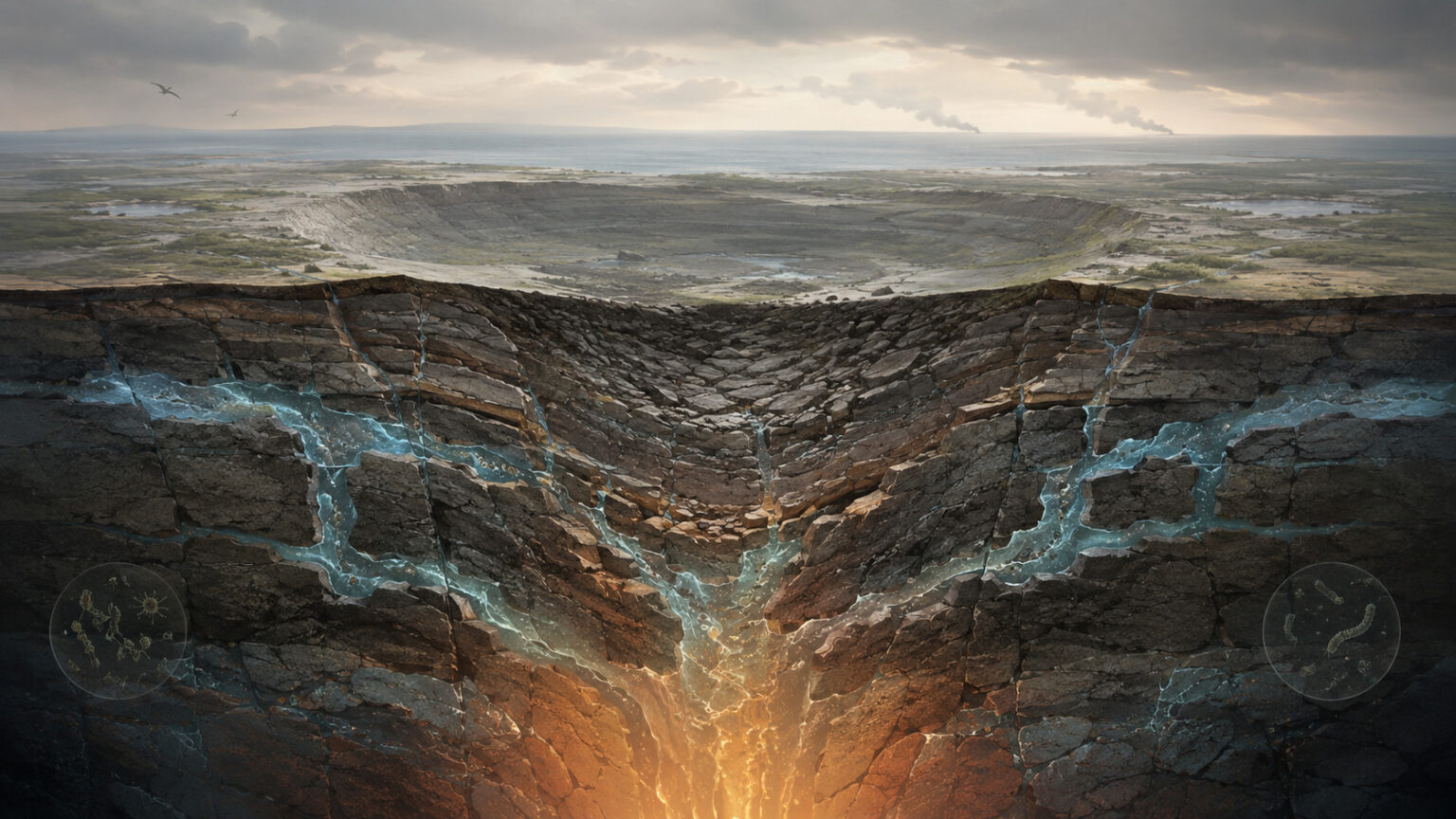
 Credit: ZME Science.
The asteroid that struck Earth 66 million years ago is usually remembered for ending the age of dinosaurs. However, a new study provides evidence that the same impact may have generated an underground environment capable of supporting life for far longer than anyone expected.
The study authors suggest that hot water continued circulating through rocks beneath the Chicxulub crater for at least eight million years after the impact. This is a major revision of previous estimates, which suggested the system remained active for roughly two million years.
“Wherever on Earth you find flowing warm water, you find life, and we’ve known for a while that asteroid impacts create hydrothermal systems. Previous research undertaken in the early 2000s suggested that the system created by the Chicxulub impact lasted for about 2 million years,” Annemarie Pickersgill, lead study author and a research fellow at the Centre for the Isotope Sciences (SUERC) of the University of Glasgow, said.
If these findings are confirmed, the Chicxulub site represents the longest-lived hydrothermal system known to have been created by an asteroid impact.
Reading a geological clock hidden inside the crater
On modern Earth, similar environments are found around volcanic regions and deep-sea vents, where microorganisms thrive without relying on sunlight. Scientists have long wondered whether impact craters could create similar habitats.
However, determining how long those environments survived has been difficult because direct evidence from inside ancient craters is rare.
To investigate the crater’s history, researchers examined rocks recovered during a drilling expedition that targeted Chicxulub’s peak ring, a circular zone of uplifted rock formed during the impact. The team focused on minerals that formed when hot fluids moved through fractures created by the collision.
Those minerals effectively recorded the timing of hydrothermal activity. By measuring argon isotopes trapped within the crystals, the researchers determined when the minerals formed and, by extension, when hot water was still circulating underground.
The dates revealed a surprisingly long timeline. Some minerals formed shortly after the asteroid struck Earth about 66 million years ago, while others formed around 58 million years ago. The results indicate that the crater remained hydrothermally active for roughly 8 million years.
“We find that hydrothermal activity persisted for at least 8 million years (Myr), which is approximately four times longer than previously estimated by numerical simulations, palaeomagnetic records, and petrographic interpretations at Chicxulub, making it the longest-lived impact-generated hydrothermal system documented on Earth,” the study authors note.
What kept the hydrothermal system alive
The researchers then tested whether such a long lifespan was geologically plausible. Using updated numerical simulations, they reconstructed how heat and water likely moved through the damaged crust beneath the crater.
“We used those advances to explore in unprecedented detail the complex interactions between heat, rock composition, and water flow the Chicxulub impact induced, allowing us to explore the ways that the hydrothermal systems changed over time and determine how long they stayed active below the crater,” Evangelos Christou, one of the study authors and a former researcher at the University of Glasgow, said.
The models showed that the impact had created an ideal setting for long-term activity. The collision shattered rocks deep underground, opening pathways that allowed water to circulate. At the same time, heat left behind by the impact and heat naturally rising from Earth’s interior helped keep the system operating for millions of years.
The study also highlights the importance of the crater’s peak ring. Compared with surrounding rocks, this region may have provided especially favorable conditions for water flow, allowing the hydrothermal system to persist much longer than expected.
What the findings could mean for Earth and other worlds
So you can say asteroid impacts can do more than cause destruction. This possibility is particularly interesting for researchers studying the early Earth, as billions of years ago, impacts were much more common than they are today.
“The porous, fractured rocks created by impacts create microenvironments where microorganisms can be protected from radiation and extreme temperatures. Those conditions give life the chance to take hold and flourish, and that is likely what happened here on Earth billions of years ago,” Pickersgill said.
The findings may also influence the search for extraterrestrial life. Mars preserves countless impact craters, many formed during periods when liquid water was more abundant on the planet. Some of those craters may once have hosted underground hydrothermal systems similar to the one identified at Chicxulub, making them attractive targets for future exploration.
“As we look to the future of space exploration, these findings could help future missions to other planets determine which impact craters might have been most likely to sustain life,” Pickersgill added.
However, the researchers caution that their samples (on which the current study is based) came from a limited part of the crater, meaning the full extent of the hydrothermal system remains uncertain.
Future studies will aim to determine whether similar long-lived activity occurred throughout the crater and to better understand the geological conditions that allowed the system to endure.
The study is published in the journal Communications Earth & Environment.