
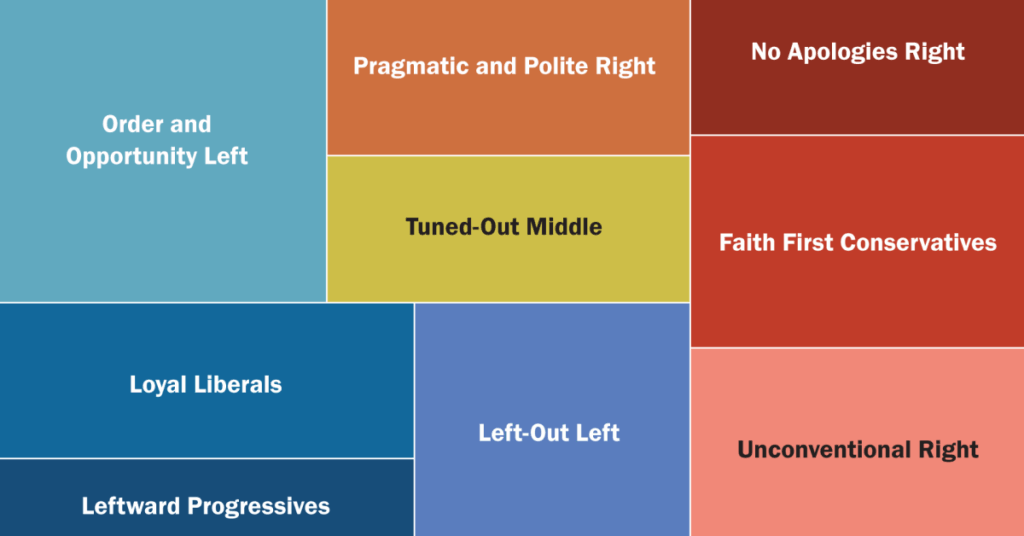
About this research
This Pew Research Center study goes beyond Americans’ partisan attachments and vote choices to explore the values and attitudes that underlie the political landscape and the Republican and Democratic parties. We did this by creating a political typology, which classifies the public into nine groups based on their responses to 30 questions about government, economics, immigration, elected officials and other topics. To learn more about this project, jump to “About the political typology.”
Why did we do this?
Pew Research Center conducts research to help the public, media and decision-makers understand important topics. We have studied Americans’ political values and attitudes, and their views on politics more broadly, for decades. This is the ninth version of the political typology; the first was conducted nearly 40 years ago.
Learn more about Pew Research Center.
How did we do this?
We surveyed 10,357 U.S. adults from Nov. 17 to 30, 2025. Everyone who took part in this survey is a member of the Center’s American Trends Panel. The survey represents the views of the full U.S. adult population. We then used a statistical technique called cluster analysis to divide people into nine groups. (For more on the process of dividing people into groups and surveys used for analysis, jump to Appendix B.)
Here are the survey questions used for this analysis, the detailed responses and the survey methodology.
Unconventional Right are a Republican-oriented group with conservative values in many areas – but not across the board. Largely supportive of restrictions on immigration and concerned about its impact on the country, they are also skeptical of efforts to promote diversity in workplaces and schools.
 Allie Sullberg
Unconventional Right are one of nine groups in Pew Research Center’s 2026 Political Typology. To learn more about the typology, start with the overview. To find which group is your best fit, take the quiz.
While Unconventional Right are generally in favor of smaller government, they are more divided over the role of government in healthcare, education and aid to lower-income Americans. And on some social and cultural issues, including abortion, their views are more mixed. In contrast to groups to the right of them, they are uncomfortable with looser gun laws and are not as opposed to same‑sex marriage.
Those who voted in 2024 largely backed Donald Trump, but their support has softened. While they were not as strong in their support for Trump in 2024 as some other groups, they voted for him by a wide margin (79% vs. 16% for Kamala Harris among those who voted). Trump’s standing among Unconventional Right has fallen off more steeply than among most other groups: As of April, 53% approve of Trump’s handling of his job, down from 78% in the weeks after he was sworn in.
Unconventional Right are:
- Generally conservative on immigration, racial attitudes, sexuality and gender identity. But they are less hard-line on these issues than Faith First Conservatives and No Apologies Right.
- Less critical of traditional U.S. allies and international institutions than groups to their right. More want U.S. decision-makers to account for allies’ interests, and they are more favorable toward NATO.
- Younger and less religious than other Republican-oriented groups. They are less likely than other groups with Republican majorities to say religion is very important in their lives.
- Far less politically engaged than those to their right. They are not particularly interested in politics and follow news about it far less closely than other Republican-oriented groups.
What is the political typology?
Pew Research Center’s political typology divides the American public into nine political groups based on responses to 30 questions about people’s social and political values and beliefs.
The goal of this long-standing project is to go beyond partisan leanings or vote choices to provide a deeper understanding of the American political landscape. This is the ninth version of the political typology – the first was conducted nearly 40 years ago.
These questions were asked in a survey of 10,357 U.S. adults conducted Nov. 17-30, 2025, using Pew Research Center’s American Trends Panel – a nationally representative panel of randomly selected U.S. adults.
For more on the cluster analysis process used to create the groups, the questions used, and how we look at data across multiple surveys, visit Appendix B.
Take the typology quiz to find out which political typology group you fit into.
Political affiliation, voting and engagement
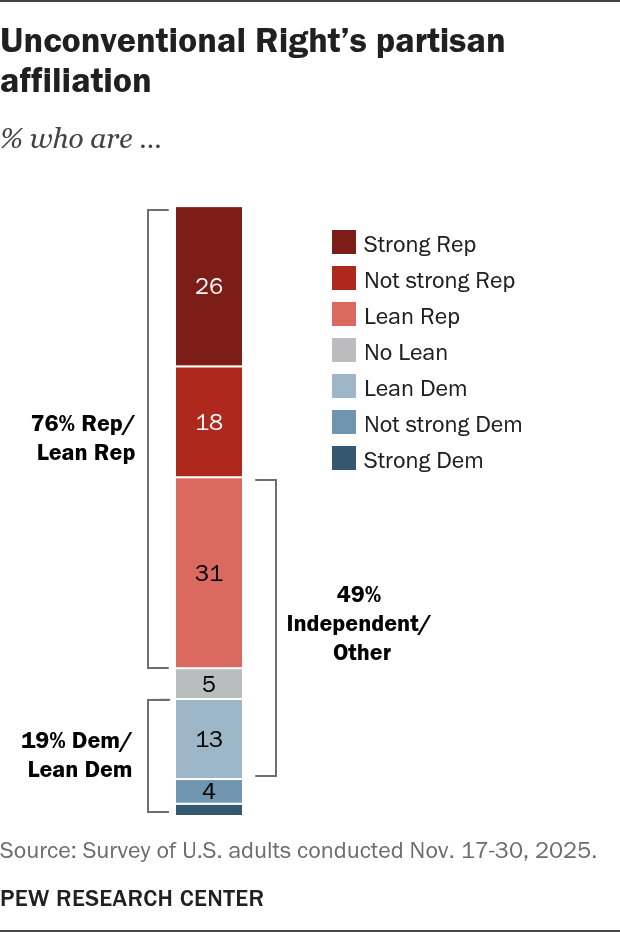
Though Unconventional Right are a largely Republican and Republican-leaning group, their attachment to the party is relatively low. And they are as likely to call themselves moderate as to describe themselves as conservative.
Unconventional Right’s partisan affiliation
% who are …
Source: Survey of U.S. adults conducted Nov. 17-30, 2025.
PEW RESEARCH CENTER
Unconventional Right’s partisan affiliation
% who are …
Source: Survey of U.S. adults conducted Nov. 17-30, 2025.
PEW RESEARCH CENTER
- 76% are Republicans or Republican leaners (19% are Democrats or Democratic leaners).
- But just 26% are strong Republicans.
In fact, about half say they are independent or align with another party – though most of this segment leans to the GOP.
While almost none describe their views as liberal (4%), roughly half (46%) say they are conservative; the same share (46%) say they are moderate.
Unconventional Right are moderately politically engaged. They are less likely than other Americans to vote, to follow politics or to say it really matters which party controls Congress after the 2026 elections.
- 55% voted in the 2024 election.
- 42% say it really matters who wins control of Congress this November (compared with 60% of Americans overall).
Key attitudes and beliefs
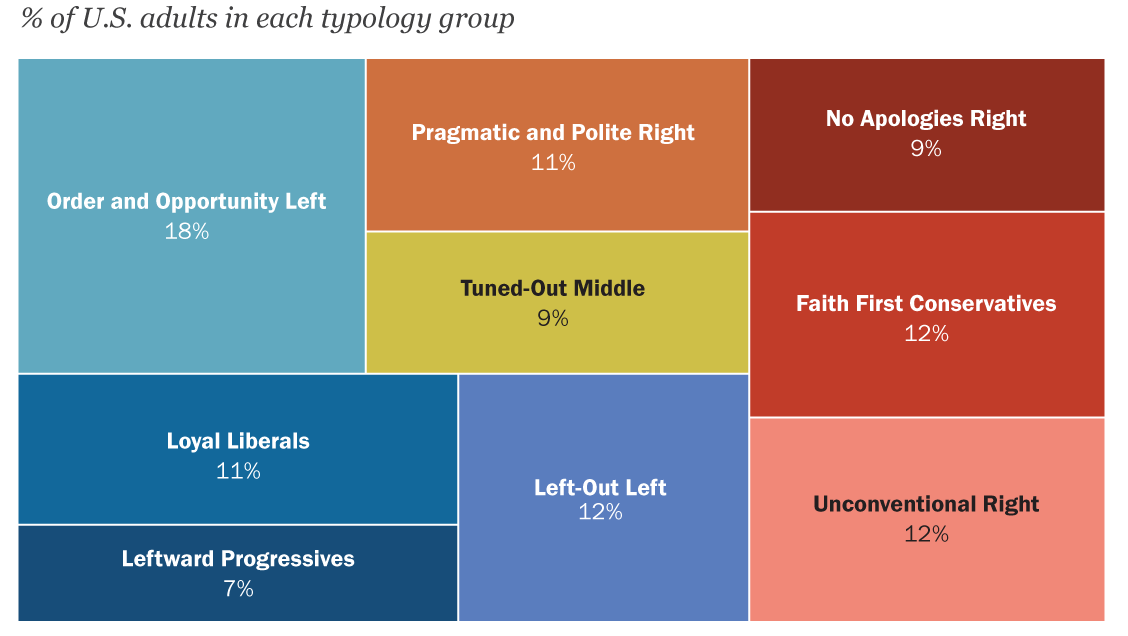
Unconventional Right’s views on diversity, the role of the federal government and removing people who live in the U.S. illegally generally align with groups further to their right. Fewer than half say having a population with many different races, ethnicities and religions strengthens the U.S. (45%). About half (49%) say the government does not have a responsibility to provide an adequate standard of living. And they are more supportive of deporting immigrants who are living in the U.S. than groups to their left.
Unconventional Right: Small-government advocates who hold conservative views on immigration and race but are less uniformly conservative on other social issues
% who say …
The U.S. being made up of many different races, ethnicities and religions strengthens society
Federal government does not have a responsibility to provide an adequate standard of living for all Americans
Undocumented immigrants should not be allowed to stay in the country legally
They have a favorable opinion of NATO
Abortion should be legal in all or most cases
It is not important to use language that other people do not find offensive
Note: For full question wordings and distributions, refer to the detailed tables. The April 2025 question about government responsibility to provide adequate standard of living had a sample size of 114 Tuned-Out Middle, for a margin of error of plus or minus 10.4 percentage points at the 95% confidence level.
Source: Surveys of U.S. adults conducted April 7-13, June 2-8 and Nov. 17-30, 2025, and Jan. 20-26 and March 23-29, 2026.
PEW RESEARCH CENTER
Unconventional Right: Small-government advocates who hold conservative views on immigration and race but are less uniformly conservative on other social issues
% who say …
Note: For full question wordings and distributions, refer to the detailed tables. The April 2025 question about government responsibility to provide adequate standard of living had a sample size of 114 Tuned-Out Middle, for a margin of error of plus or minus 10.4 percentage points at the 95% confidence level.
Source: Surveys of U.S. adults conducted April 7-13, June 2-8 and Nov. 17-30, 2025, and Jan. 20-26 and March 23-29, 2026.
PEW RESEARCH CENTER
But Unconventional Right’s views are less conservative when it comes to international organizations, abortion and several other issues. They are much more favorable toward NATO than groups to their right, and a modest majority (56%) say abortion should be legal in all or most cases. They are also more likely to say the government has a responsibility to provide health insurance (48% say it does; 51% say it does not).
They also stand out for being less concerned with using inoffensive language than many Americans: 47% say it is not important to them to use language others do not find offensive, compared with 29% of all Americans
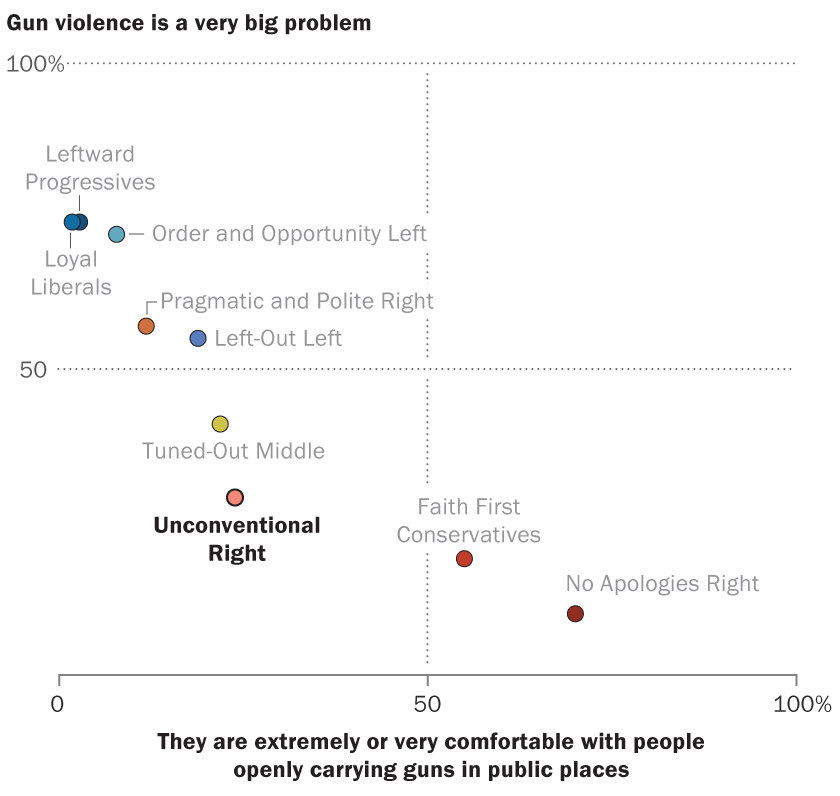
Views on guns don’t align neatly with other groups
Unconventional Right’s views on guns stand out from other typology groups
% who say …
Source: Surveys of U.S. adults conducted Nov. 17-30, 2025, and April 20-26, 2026.
PEW RESEARCH CENTER
Unconventional Right’s views on guns stand out from other typology groups
% who say …
Source: Surveys of U.S. adults conducted Nov. 17-30, 2025, and April 20-26, 2026.
PEW RESEARCH CENTER
Unconventional Right’s views of the role of guns in society fall in line with conservative positions in some ways and with liberal positions in other ways.
Like Faith First Conservatives and No Apologies Right, Unconventional Right are far less likely than other Americans to see gun violence as a very big problem in the country: Just 29% say it is.
But when it comes to openly carrying guns in public, Unconventional Right hold views closer to the rest of the groups.
About a quarter of Unconventional Right (24%) say they are extremely or very comfortable with open carry. Clear majorities of Faith First Conservatives (55%) and No Apologies Right (70%) are comfortable with open carry – no more than a quarter in any other group expresses this level of comfort with openly carrying guns.
Jump to the detailed tables to learn more about Unconventional Right and the other typology groups.