
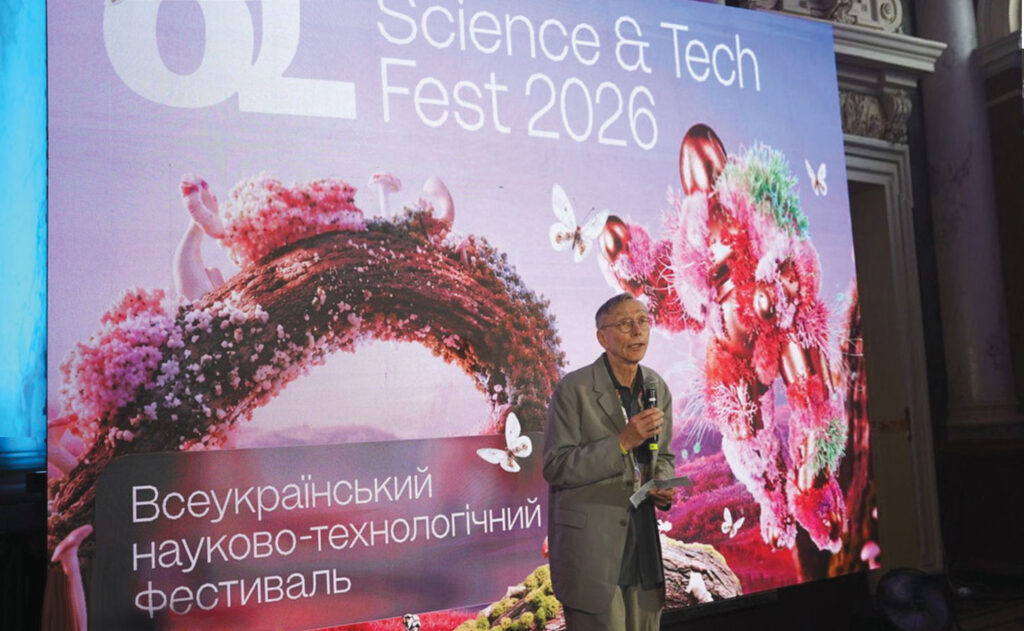
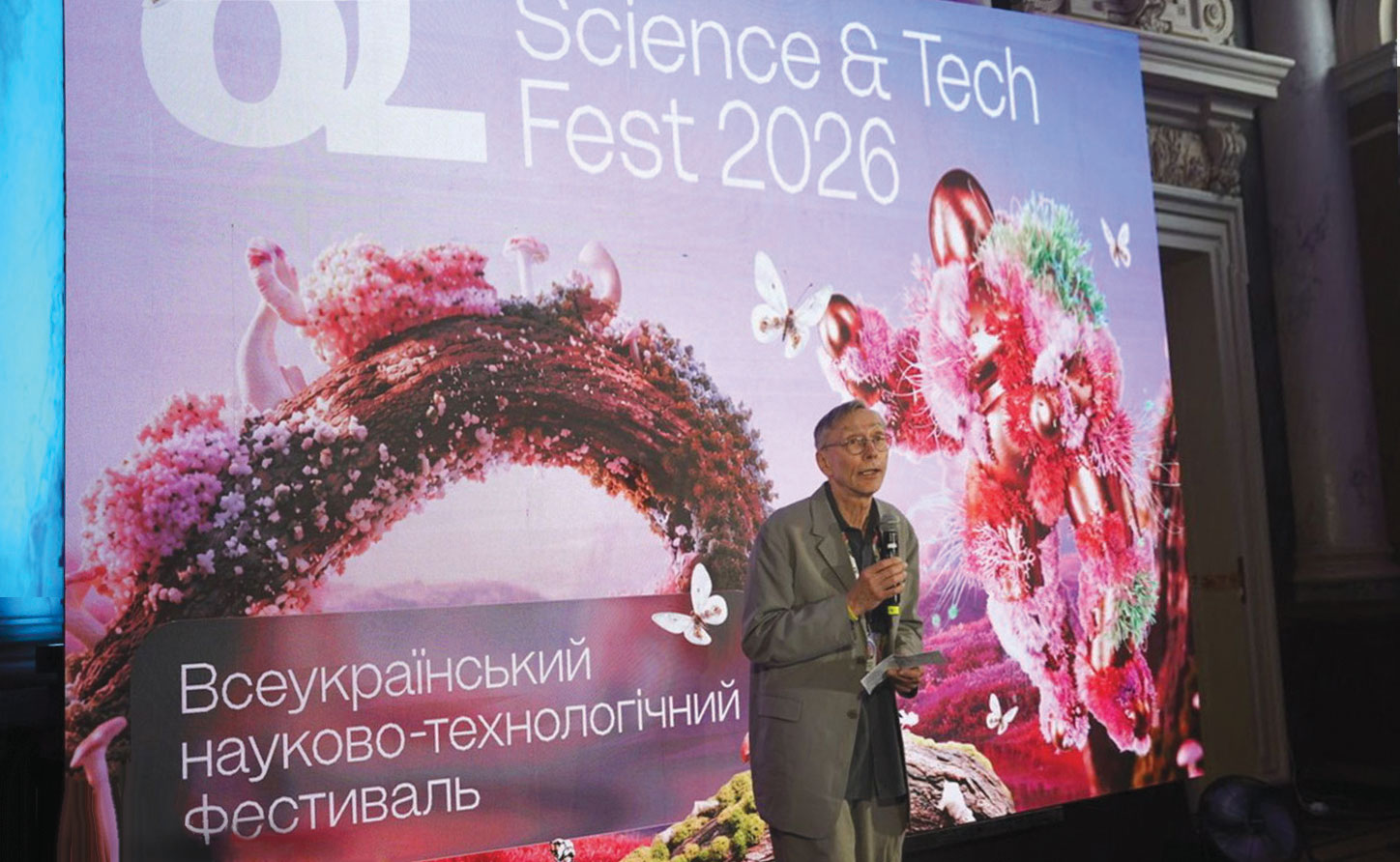
 Tvory Nobel laureate Svante Pääbo addresses participants at the OL Science and Tech Fest 2026 in Lviv, Ukraine.
LVIV – More than 1,300 participants gathered in Lviv for the OL Science and Tech Fest 2026, a nationwide science and technology festival that brought together internationally renowned researchers, Ukrainian scientists, educators and students for Ukraine’s National Science Day.
Held on May 29-31, the festival marked its fifth edition and transformed the campus of Lviv Polytechnic National University into a center of scientific discussion and technological innovation.
The event featured lectures by Nobel Prize laureate Svante Pääbo, British neurosurgeon and author Henry Marsh, and British physicist and plasma researcher Nicholas Braithwaite, as well as exhibitions, workshops, interactive zones and discussions highlighting Ukrainian scientific achievements.
Organized by the youth organization Tvory, OL Science and Tech Fest has grown into one of the country’s leading science outreach events. This year’s theme focused on science not as an abstract concept, but as a living experience that shapes everyday life.
Festival organizers described the event as an effort to make science more accessible and inspiring for a broader audience, particularly young people.
The three-day program began on May 29 with a science, technology, engineering, arts and mathematics (STEAM) workshop for educators at the Lviv Open Lab. Led by Mr. Braithwaite, founder of OpenSTEM Labs and a prominent British plasma physicist, the workshop focused on modern approaches to science education and ways to engage children and teenagers in STEAM fields.
The main festival day was held on May 30 at Lviv Polytechnic. Visitors attended lectures by international speakers, participated in panel discussions, explored innovation expositions and took part in science-popularization activities and master classes.
Among the headline speakers was Mr. Pääbo, the Swedish geneticist who received the 2022 Nobel Prize for his pioneering work on research techniques for ancient DNA and human evolution. During his lecture, he discussed the origins of humankind and the importance of paleogenetics in modern science.
Mr. Marsh, a British neurosurgeon known internationally for his medical work and best-selling books, focused his discussion on the future of health care and developments in medicine.
Those unable to attend in person could watch lectures and discussions through online broadcasts on YouTube, but thousands attended the event in person.
“Lviv celebrates its 770th anniversary this year. It is a city with a great history, where there has always been room for inventions, technologies, research and outstanding people who have moved the world forward. Therefore, it is no coincidence that today we are once again returning to science as something that makes us stronger,” said Andriy Moskalenko, deputy mayor of Lviv.
“OL Science and Tech Fest is about the unique opportunity to be in one space with a Nobel laureate, Ukrainian female polar researchers, a neurosurgeon, a physicist and scientists who are changing our understanding of the world. Such events provide a very important positive impulse and remind us that when we are together, we are stronger,” Mr. Moskalenko said.
A separate highlight of the program was a panel discussion titled “Who creates modern science? The experience of Ukrainian female researchers in Antarctica.”
The discussion brought together five participants from Ukrainian Antarctic expeditions to the National Antarctic Scientific Center: oceanographer Nataliia Dikul, physician Ivanna Koturbash, meteorologist Anastasiia Chyharyeva, geophysicist Anna Soina and microbiologist Mariia Pavlovska.
The researchers shared their experiences working at Ukraine’s Akademik Vernadsky research station, discussed scientific work in Antarctica and spoke about the contributions of Ukrainian scientists to international research projects.
The festival also featured two thematic exhibitions. One, titled “Freedom in the Equation,” explored why Ukraine has historically lacked Nobel prizes in science, arguing that generations of talented researchers were destroyed or displaced by Russian and Soviet repression and wars.
Another exhibition, “Ukraine in Antarctica: Research and Resilience,” presented 30 photographs dedicated to the 30th anniversary of Ukraine’s Antarctic studies, offering visitors a glimpse into the Akademik Vernadsky station, the research vessel Noosfera and the daily lives of polar explorers.
An innovation expo showcased technological developments and scientific projects by Ukrainian teams and startups. Interactive science zones, exhibitions and activities designed for visitors of different ages complemented the program.
According to organizers, one of the festival’s objectives was to demonstrate that science can reach beyond academic institutions and become part of public life.
“I was happy to become part of OL Science and Tech Fest. The fact that such a festival took place in Ukraine during this difficult time demonstrated the resilience of Ukrainian society. It also showed how important science and technology are for society,” Mr. Pääbo said.
“Fundamental science matters for the challenges humanity faces, but it is also important for the development of individual countries. Today, Ukraine demonstrates strength in innovation and technological solutions, and many countries around the world can turn to Ukraine for expertise and collaboration in areas such as artificial intelligence, remote control and emerging technologies. Ukraine has much to be proud of, especially in science and technology,” Mr. Pääbo said.
The festival concluded on May 31 with a public question-and-answer session featuring Mr. Pääbo and Tetiana Kidruk, chief executive officer of the Borodatyi Tamaryn publishing house. Participants had an opportunity to ask questions directly and discuss paleogenetics, ancient DNA research and Mr. Pääbo’s best-selling book, “Neanderthal.”
“For us, it was important that OL Science and Tech Fest become an event where science goes beyond a narrow professional environment and becomes accessible to a wide audience,” said Oleh Malets, head of the youth organization Tvory.
“This year in Lviv, we brought together international scientists, Ukrainian researchers, educators, young people and technology teams. We want young people who attend such events today to see real examples before them and understand that science is a path they can also pursue to realize themselves. Perhaps one of them will become a Nobel laureate, researcher or scientist who will change the world,” he said.
Beyond science and education, the festival also served as a platform for charitable initiatives. Organizers continued their Create for the Army campaign, coordinated by Tvory since the beginning of the year. Through community support and partnerships, the initiative has raised more than 5 million hryvnia ($120,000) for specialized ground robotic systems for Ukrainian service members. As part of the campaign, a Tesla Model 3 was raffled among donors during the festival.
Now held annually, OL Science and Tech Fest seeks to bring together scientists, entrepreneurs, startups, educators and young people from across Ukraine. In a country where scientific institutions continue to function despite the challenges posed by Russia’s ongoing war, organizers said the festival aims to remind Ukrainians that research, education and innovation remain essential to the country’s future.