
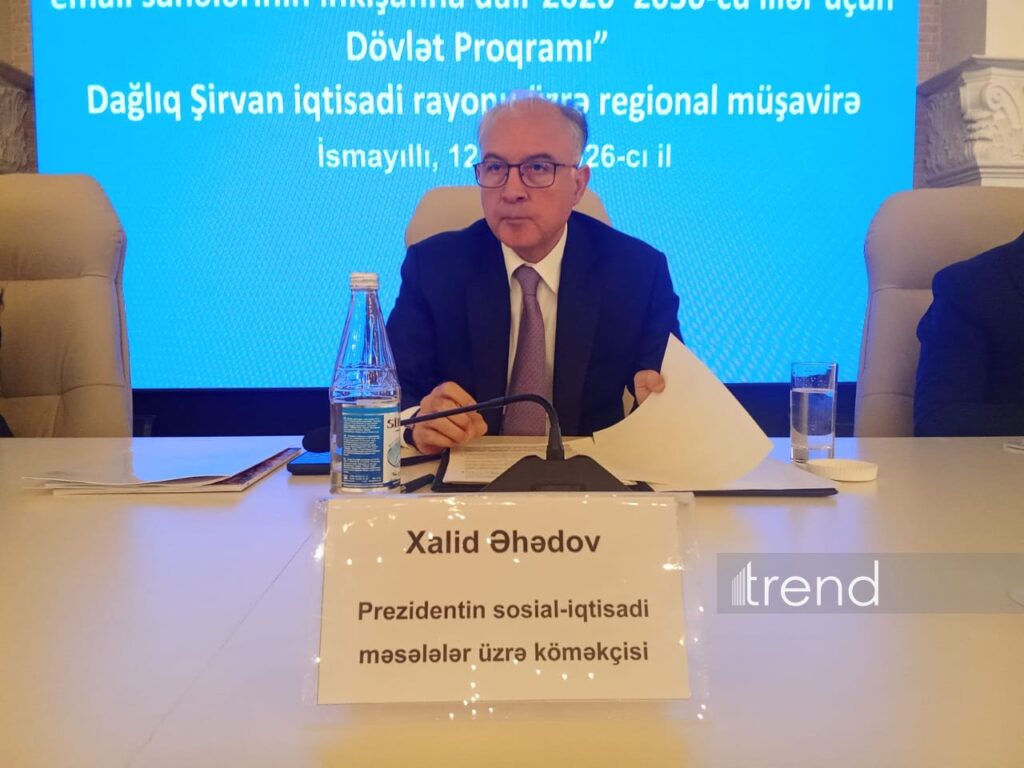
ISMAYILLI, Azerbaijan, June 12. More than 5
billion manat ($2.9 billion) will be invested in the agrarian state
program in Azerbaijan, Khalid Ahadov, assistant to the President of
Azerbaijan on socio-economic issues, said, Trend‘s correspondent reports
from the event.
Ahadov made the remark at a regional consultation on the
Mountainous Shirvan economic region in the district, conducted
within the framework of the State Program for the Development of
Agricultural Production and Processing, Fisheries, and Aquaculture
in Azerbaijan for 2026–2030.
He explained that it’s planned to attract more than 2 billion
manat ($1.18 billion) from the public and about 3 billion manat
($1.7 billion) from the private sector to implement the measures
envisaged in the program.
According to him, taking into account that the adopted state
program should be implemented within four and a half years, we
should start implementing the tasks set before us without wasting
time, guided by the instruction of the President to immediately
begin the implementation of this program.
“We can fully achieve the implementation of the tasks set before
us by the President of the Republic of Azerbaijan, Ilham Aliyev, as
a result of ensuring the coordinated activities of all central and
local executive bodies and mobilizing the investment and management
capabilities of the private sector,” he noted.
Ahadov pointed out that the efficient use of water and land
resources is one of the main priorities.
“The introduction of modern irrigation systems, improvement of
on-farm irrigation networks, cleaning of existing canals, as well
as education of farmers, requires special attention,” Ahadov
said.
The official underscored that increasing productivity in the
agricultural sector, improving irrigation and energy supply,
introducing modern technologies, and timely implementation of
agrotechnical measures can only be possible as a result of the
joint activities of all executive bodies.
“The heads of executive authorities, entrepreneurs, and
representatives of large farms participating in today’s meeting
should pay special attention to the implementation of the following
tasks arising from the State Program. The heads of executive
authorities, together with representatives of relevant
institutions, should determine target indicators and result
indicators for the main directions in the agrarian sector based on
the state program and ensure the preparation of a socio-economic
development program for each region for 2026-2030, take all
necessary measures to support entrepreneurship and local producers
in the areas, establish processing plants, silos and cold storages,
expand the application of modern irrigation systems, and increase
productivity in the production of agricultural products, especially
in the fields of cotton and grain growing, make the promotion of
the state program among farmers and entrepreneurs their daily tasks
by using local opportunities, act as the main organizers of this
work, and ensure the implementation of systematic and complex
measures in accordance with the requirements of the time. The basis
of the promotion should be the President’s speech at the meeting
dedicated to agricultural issues.
Every employee of the city and district executive authorities,
including local representatives of the heads of executive
authorities, should study this speech in depth and base it on it in
their propaganda work, mobilize all their capabilities, and take
all necessary measures to ensure that entrepreneurs and farmers
join the President’s call. The main responsibility for carrying out
organizational work related to the implementation of the State
Program lies with local executive authorities and all organizations
included in this structure.
The President’s special emphasis on the role of the private
sector in the implementation of the state program once again shows
that sustainable development of agriculture is possible not only
with state support, but also with the active participation of
farmers, agroparks, processing enterprises, logistics companies,
and private sector entities providing technology and irrigation
solutions. Thus, in the coming period, the private sector should
act not only as a producer, but as a main participant and driving
force in the agrarian value chain. The farmer produces the product,
the processing enterprise adds additional value to that product,
the logistics and storage infrastructure reduces product losses,
and the exporter exports the product to foreign markets. It should
be taken into account that if any link in this chain is broken, the
result obtained in production cannot be fully converted into
economic value,” Ahadov added.