
In March, as U.S. and Israeli military operations against Iran were underway, Iran struck critical nodes of digital infrastructure, including Amazon Web Services data centers in the United Arab Emirates, highlighting the fragility of the infrastructure upon which the world depends for communications, economic activity, and security. The conflict also disrupted undersea cable development projects in the region, such as the “Pearls” segment of Meta’s 2Africa consortium cable project in the Persian Gulf. As digital infrastructure is more deeply tied to geopolitics, the governance questions surrounding it have become more urgent.
In “The Web Beneath the Waves,” Samanth Subramanian brings to light the significance of undersea cables for internet connectivity, economic activity, geopolitics, and security, while investigating who exercises control over this critical infrastructure. Submarine cables are essential infrastructure for global communications; no replacement comes close in terms of data-carrying capacity, speed, and cost. As shown by sociologist Susan Leigh Star, infrastructure tends to become visible upon breakdown. It is through moments of failure, fragility, and breakdown that Subramanian makes the political and social significance of these systems legible to a public audience. The book lays bare questions of maintenance, responsibility, and governance that are typically obscured by the seeming invisibility of these networks. For legal scholars and policymakers, it is less fully developed in its engagement with the governance and legal questions that its own reporting raises.
Cables and the Fragilities of Global Connectivity
The book starts by making the stakes of a cable break apparent, especially in regions linked to the internet through a single cable. In January 2022, the Hunga Tonga volcano’s powerful atmospheric explosion pushed rock, ash, and sediment into the air, which fell back into the ocean. The rock and sediment severed 55 miles of Tonga’s single international link, connecting Tongatapu to Fiji, and through there to the broader global network. The volcanic eruption disconnected Tonga from the internet and electronic communications with the rest of the world for five weeks. International money transfers were halted, communications were disrupted, and economic activity was interrupted.
This example illustrates how deeply every aspect of daily life depends on a communications infrastructure that typically remains invisible and is taken for granted until it fails. The cable breakage also made coordinating cable repairs extremely difficult, as the communications needed to organize them had themselves gone dark. As Subramanian observes, “[t]he safety of cables in the ocean is a national security issue, a precondition for the economy, and a matter of literal life and death.” Island states are particularly vulnerable to cable disruptions due to the limited connections they tend to have and their distance from repair hubs. The Tonga case illustrates not just the vulnerabilities of an island with limited cable connections, but the fragilities of the global cable network as a whole.
Empire, Cable Ownership, and Geopolitics
From Tonga, Subramanian traces the geographies of cables and the parallels between their imperial pasts and contemporary geographies reflected in today’s fiber optic cables that support the digital economy. The British Empire’s dominance over undersea cables and thus telegraphic communications during the period of wired communications networks’ dominance both reflected and reinforced its imperial power. Its control over Malaya, where the insulating material of gutta percha was derived and extracted, gave it distinct advantages in developing cable infrastructure. The empire’s power was reinforced by swift communications that enabled it to quell rebellions from afar and communicate with local colonial administrators more quickly. These early submarine cable paths created path dependencies, as can be seen in the overlaps between those geographies and the maps of today’s submarine cables. Subramanian also discusses transformations in the materials used for cable communications, such as the transition to fiber optics and glass in the 1980s, which enabled significantly higher speeds and capacity.
While many cable geographies reflect and perpetuate historical inequalities and imperial interests, contemporary networks have generated new patterns of concentrated ownership and dependency. Subramanian draws on his experience attending the International Cable Protection Committee (ICPC) conference in 2023 to explore changes in the cable industry with executives at telecommunications and submarine cable companies from all over the world. In the late 1990s, the first major privately financed undersea cables, such as FLAG (the Fiber-Optic Link Around the Globe), spurred increased funding for cable projects by private investors, moving away from government-controlled telecommunications as the sector was becoming increasingly privatized. The consortium model of cable ownership became increasingly concentrated as new ownership models developed, such as involving local telecom companies as landing partners rather than giving them stakes in the project. As big tech companies such as Meta and Google increasingly move toward single ownership of cables, they gain increased control over multiple layers of the stack, from the data to the physical networks.
From the late 2000s onward, China emerged as a major actor in the undersea cable industry, with HMN Tech (spun off from Huawei) becoming a significant player and undersea cables becoming an important part of China’s Digital Silk Road Initiative. With the United States blacklisting Huawei in 2019 and listing HMN Tech on its sanctions list, it has prevented cables controlled by Chinese entities from landing on its territories. This geopolitical conflict has been reflected in increased fragmentation in the geographies of the internet’s infrastructure.
Cable damage raises issues of who bears responsibility for maintenance and repair. Vulnerabilities can stem from nonhuman marine or geological causes, such as shark bites and volcanic eruptions. They can also be caused by accidental human activity, such as fishing, trawling, or anchoring too close to a cable. Cables are also subject to intentional damage motivated by geopolitical rivalries and strife. The risks of intentional damage have become a subject of increased concern in recent years, with concerns primarily over Russian “shadow fleets,” or civilian fleets operating as instruments of statecraft, and China’s “gray zone” tactics short of formal conflict. The result has been the increased securitization of the seas, in the form of increased surveillance and NATO activities, especially in sensitive regions such as the Baltic Sea, which experienced several cable cuts within a short time in the same areas in November 2024. The simultaneous significance and vulnerability of cables make them susceptible to weaponization. As Subramanian points out, a geopolitical battle is being carried out via denials and delays of permits and licenses and fragmentation of networks, with many territories, economies, and populations caught in the middle of these battles over ownership, the terms of connectivity, and responsibility for maintenance and repairs.
What and Who the Book Leaves Out
While Subramanian’s book succeeds in offering a compelling and evocative narrative account of the significance and fragility of cables, its engagement with the governance implications of the vulnerabilities it documents is less developed. The book raises important questions about these questions of control but leaves them largely unanswered. Should responsibility rest with technology firms, whose ownership of and control over cable infrastructure continues to expand? Should it rest with states, whose geopolitical rivalries increasingly shape the terms of connectivity and may be materially splintering the internet? These are questions the book surfaces but does not resolve.
The territorial dimensions of submarine cable politics represent a related gap. As my forthcoming book, “Cable Empires,” discusses, while traditional conceptions of territoriality have been in crisis for some time as technologies, global information networks, and mobile capital shifted the scales of political control, the past several decades have witnessed the increased territorialization of the seas, and undersea cables are a significant part of that story. Undersea cables can be understood as extensions of sovereignty beyond territorial borders and extraterritorial exercises of public and private power. Undersea cables have thus emerged as a critical site for contested assertions of sovereignty. As early debates in the 1990s on the so-called borderless internet raised challenges to traditional conceptions of jurisdiction and governance, it has now become clear that assertions of jurisdiction and sovereignty over different components of the digital world, including submarine cables, are subject to contested visions of global order.
The physical infrastructure of cables functions as a chokepoint of access to data flows, granting considerable decision-making power to those who control them. States have used critical infrastructure such as submarine cables to extend their jurisdiction by exercising gatekeeping power over other states and over corporations. Digital sovereignty, which encompasses the ability to determine cable routes and locations, technical standards, and protections for data and physical infrastructure, has become a central arena of geopolitical contestation. While Subramanian notes that cable-laying permits in the South China Sea have become entangled in competing territorial claims, with significant consequences for the physical geography of digital connectivity, he does not discuss the broader implications of the increased territorialization of the seas that this reflects.
Cable development, funding, and ownership are shaped by overlapping international and private legal regimes, from the law of the sea to property and contract arrangements grounded in various countries’ domestic laws. The United Nations Convention on the Law of the Sea provides formal protections for submarine cables, but enforcement jurisdiction remains limited, particularly beyond territorial waters. Since most cable damage results from accidental rather than deliberate acts, questions of repair obligations and the allocation of responsibility are difficult to resolve. Cables raise significant challenges for international law, which has struggled to capture the public-private and technological arrangements of power that these systems embody. The book also leaves largely unexamined the private legal regimes that shape cable investments and ownership rights, such as property rights, contractual arrangements, and corporate governance structures. This may be beyond the scope of a journalistic account, but it is a significant part of the governance story.
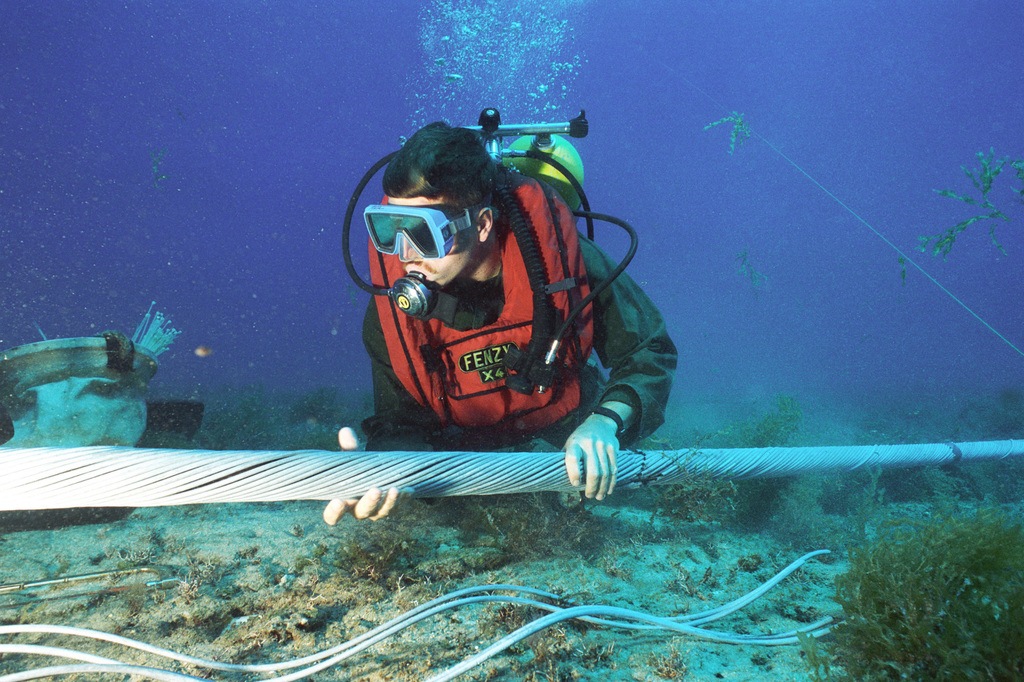
Finally, while Subramanian’s interviews give the reader unique insights into the history and dynamics of the cable industry, they are focused mostly on heads of major telecom companies and delegates at the ICPC, a private, industry-led nonprofit whose members are mostly representatives of private cable companies, telecom authorities, and cable operators from around the world. By focusing on engineers and executives, the book reproduces the invisibility of those whose labor sustains cable systems. Who are the workers doing the work of construction, repair, and maintenance? The workers, supply chains, and material processes that make global digital connectivity possible through cables are largely absent from this account. Engaging more with the material aspects of cable development, laying, and repair would have greatly enriched the book.
Conclusion
Despite these criticisms, “The Web Beneath the Waves” will live in the imaginations of readers and make them more informed by rendering visible the infrastructure of the digital world. Undersea cables form an invisible network that sustains our daily lives. They are vectors of power and profit that are unequally distributed, reflect historical patterns of inequality, are the subject of geopolitical rivalries and fragmentation, and are creating new global patterns of dependency. As undersea cables are increasingly subject to “gray zone” tactics and are targets of conflict, the stakes surrounding them have never been more urgent. They thus raise crucial governance questions that ought to be considered not only in forums such as the ICPC and the International Telecommunication Union but also among the firms that fund, construct, and control cables, and in broader public discussions that bear on the concerns of those who depend on them in their daily lives. Subramanian lays the crucial investigative foundations to make those discussions possible.