
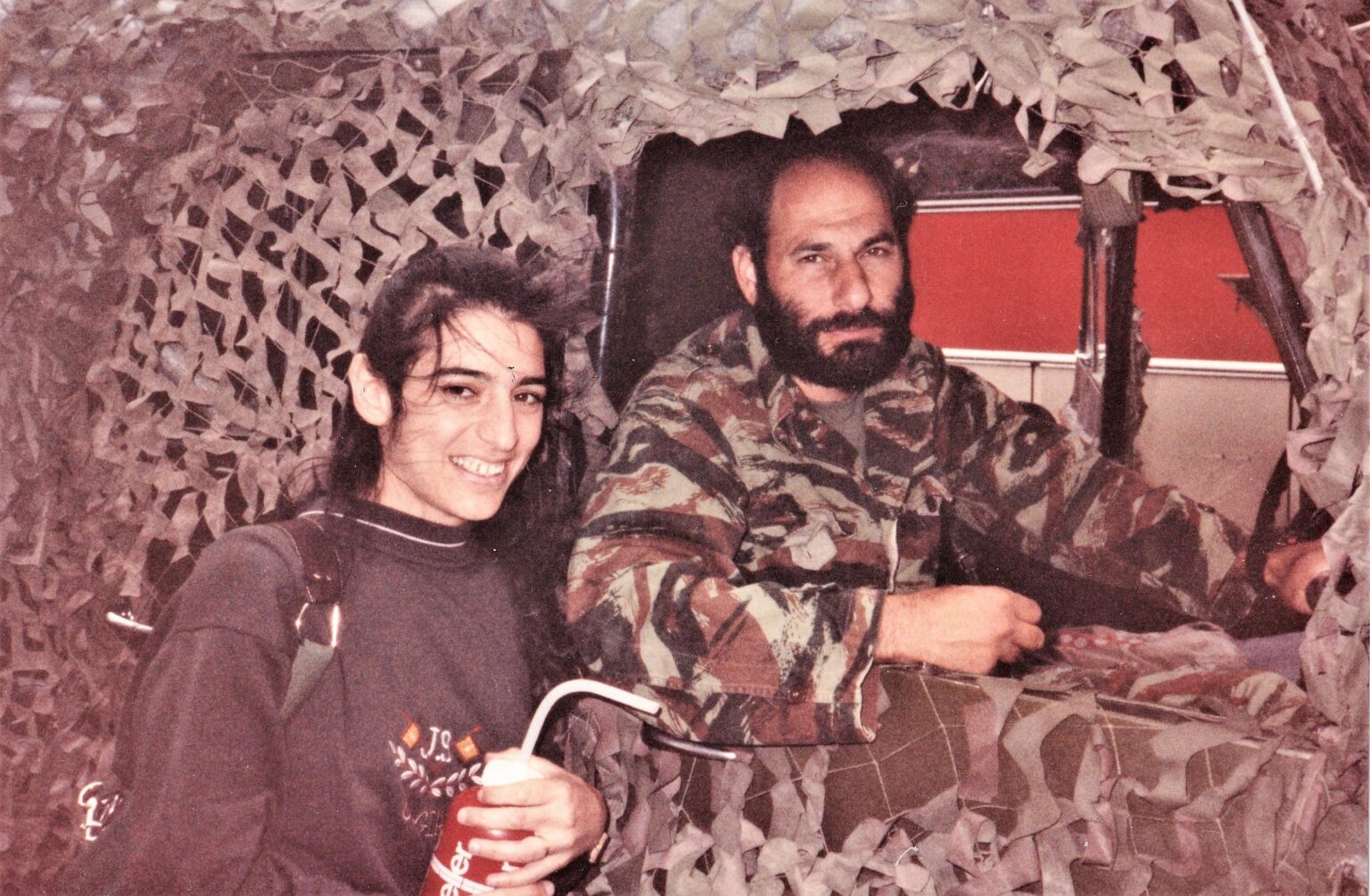
Seta Kabranian-Melkonian
Recently I have often thought about my wonderful, safe but somewhat isolated childhood. In our Armenian village in Lebanon, often called Little Armenia, we were happy with our identity. I now understand that nationalism was rampant there, but we were proud of our life, of our ancestors’ struggle, and of our connectedness. I was a schoolgirl when a debate was organized in the village titled “Are you born Armenian first or human?” Certainly, many people from my generation remember this sentence that has haunted me. To this day, I still wonder how such a debate could have taken place.
We were often told that Lebanon was not our true homeland, that sooner or later we would “Go to Armenia and rebuild our homes.” Being the children of Genocide survivors, we chose to believe these sermons and felt alienated in our rightful country.
Once, years later, Monte and I were talking about Lebanon.
“How much Lebanese am I, after all? I lived an Armenian life and I left for Soviet Armenia at the age of eighteen. How Lebanese does that make me?” I asked.
Monte looked at me perplexed.
“You are as Lebanese as any other Lebanese. Your parents and the rest of the people all became Lebanese together,” he said.
Monte was right, of course. I was the one who had issues with identity and belonging. Something that would persist and I would start using the word multicultural frequently.
***
In April 1993, after great successes of liberating historical lands, many European journalists and documentarians arrived in the Armenian enclave of Artsakh, also known as Nagorno Karabagh. One early morning, Monte and I climbed down the concrete stairs and joined the group outside. We were going to the fourth century Amaras Monastery. I entered the UAZ staff car first and sat on my designated wooden box, between the driver and Monte. I was excited. Men with large cameras squeezed in the back seat and talked out loud. Monte sat next to me. Someone called him back for an issue. Voices increased, someone said that other men were to join us, the car would be cramped. I got out as Monte was returning to the car.
“You go, it’s okay, I’ll stay. Others are going to join you,” I said.
Monte looks at me confused while his driver, Gomidas, called out.
“No, come on, come on, there’s a place for you,” he said.
“Go, go,” I said, and as the car pulled away, I noticed a young woman at a distance staring at us. Her eyes made me feel uncomfortable. I reckon my grandmother would have said, “This woman gave the evil eye.” Instantly, I felt regret for not having gone with Monte. I would carry this regret for the rest of my life.
***
In September 1999, the first Armenia-Diaspora conference took place in Yerevan. I was both surprised and flattered to receive the invitation to participate as a member of the Artsakh Delegation. Since February 1988, when I was still a student, Artsakh had become an important part of our lives. Every historical fact took on new importance, and we reminded each other that Mesrob Mashdots, the creator of the Armenian alphabet, opened the first school in the Amaras monastery in the fifth century, that the oldest dated khachkar was found in the village of Vaghuhas in Artsakh, and so on. It was as if we were trying hard to tell the world that Armenians had lived on this land for millennia. Artsakh, the tenth province of the historical Kingdom of Greater Armenia, had endured long struggles. Armenian philologist and folklorist Aram Ghanalanian wrote in his book Avantabadum that, “To enter Nagorno-Karabagh Turkish bandits always passed through the valley in the Martuni region. Each time they committed great massacres in the canyon. That’s how it got the name Bloody Valley.” Artsakh had survived Mongol-Tatar invasions, Persian rule, the expansionist Ottoman tyranny, and Tzarist Russia. Nevertheless, the people of Artsakh had safeguarded their identity.
In his travel notes Im Hishadagaraneh, the historian Leo, a native of the town of Shushi in Artsakh, described the places he visited. He wrote that once, when the villagers of Chrapert were besieged by enemies and faced famine, they did not let hunger take them captive. They collected lime, sifted it, and let it blow outside the walls of the fortress. Thinking that it was flour and could sustain the inhabitants of the fortress for a long time, the dispirited enemy abandoned the siege and left. Enduring centuries of oppression, the people of Artsakh preserved their national and cultural identity. On the verge of the collapse of the Soviet Union, Artsakh was rising again.
On 19 August 1988, Monte wrote to me:
“…We should be very, very proud and encouraged that today our people (especially our compatriots in Artsakh, that small population of 130,000 in a country with 282 million people) have taken on the role of a vanguard in the S. Union, at least on the issue of nationalities. It’s a great thing. It is also an extremely great thing that our people have mobilized, broken the habits of stagnation and learned how to popularly and en masse take their destiny into their own hands. Our people have begun a new process, a new process that can have very positive and constructive results in all aspects. It is true that the Artsakh issue is currently hitting a wall, but this situation is temporary. If our people continue to mature politically and become active, if they further advance socialist and internationalist principles, and if they continue their decision making in a mass democracy, the Artsakh issue will be resolved in the future, and the life of both our homeland and our people will get a new “dynamism” that will be of great benefit to all of us in every way. It is very clear that the initiative of the people of Artsakh is right and just, and that it is the only logical solution from the perspective of scientific communism. … Personally, I am delighted and I congratulate our compatriots there for their vanguard efforts. They have done an exemplary job and should continue (although perhaps by changing their tactics).”
***
For twenty years, I lived in Soviet Armenia and then the Republic of Armenia, and for a while in the Republic of Artsakh. Having nurtured a feeling of belonging there, I applied for Armenian citizenship in 1999. My application, however, remained unanswered. I was told that my file had been lost. Three years later, I appeared at OVIR again with my new application file. On the wall behind the official sitting at the desk, I notice the framed photo of the infamous “Secret Army” dictator. The arrogant employee looked straight in my eyes.
“What do you need Armenian citizenship for?” he asked.
I was stunned, not knowing what to say. I never received a response to my citizenship application.
My friends from Artsakh joke.
“We will give you citizenship. Come here,” they say. “We will provide housing too”.
There was a time when we all believed that Artsakh was becoming a reality. It seemed that Artsakh would be the first oblast to achieve self-determination. The constitution of the USSR provided the right of self-determination to nations, including independent statehood through a referendum and a transitional period. We thought that this transitional period would create conditions for correcting a historical mistake, and that following this process, the people of Artsakh would be the first among the peoples of the Soviet autonomous oblasts to win the legitimate right of independence on their ancestral land. We believed that this goal was almost in our hands. Almost. And then poof. It flew away.
We will bear this regret for the rest of our lives.
If you found a typo you can notify us by selecting the text area and pressing CTRL+Enter