
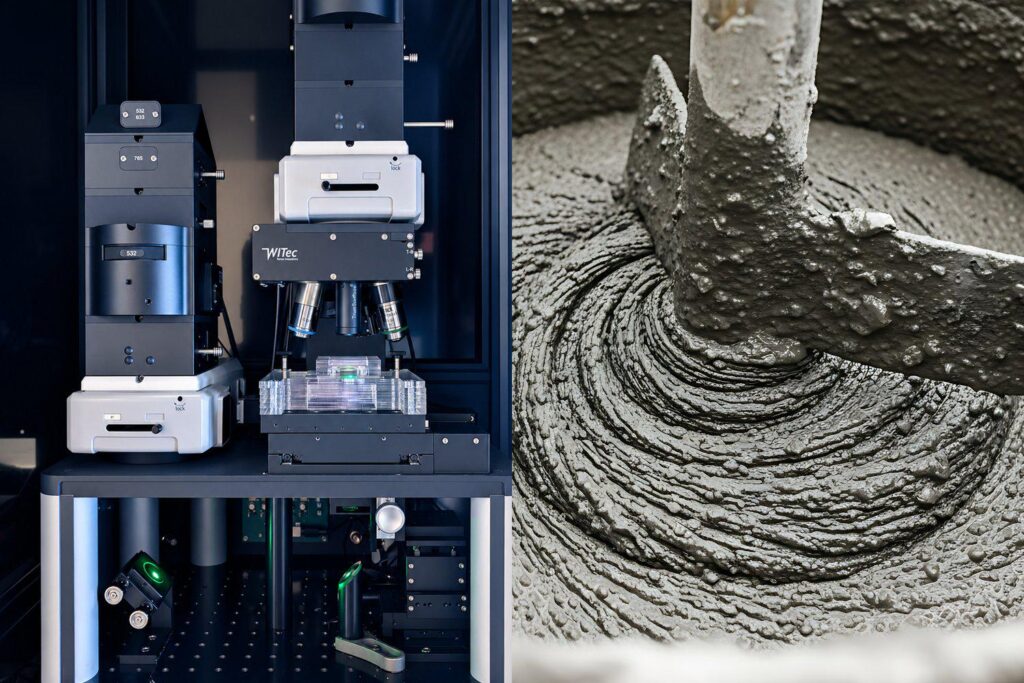
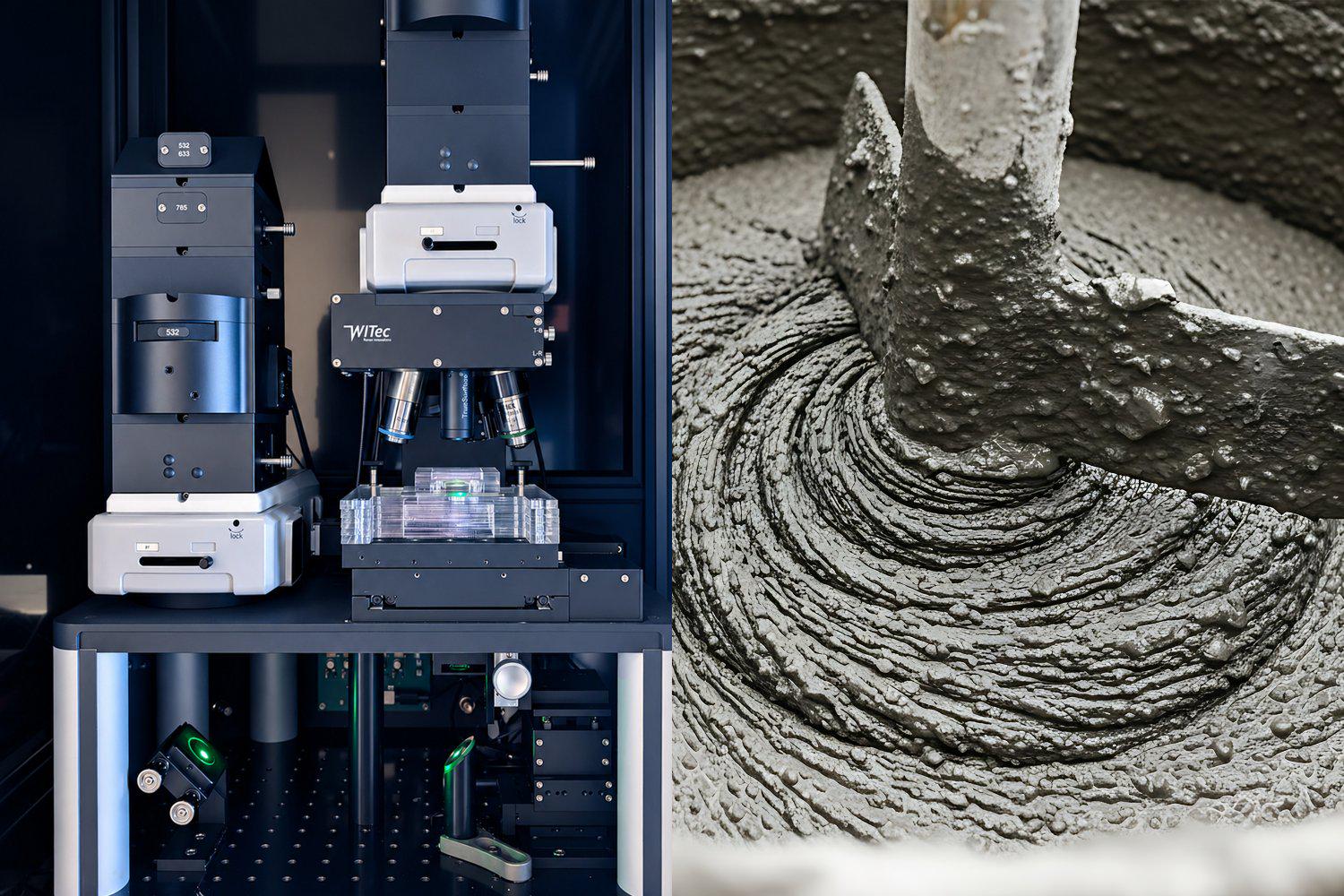
Previous studies had pieced together a story about CO2 injection’s chemical impacts from theory and indirect evidence; the key reactions simply moved too fast, and vanished too completely, for conventional techniques to catch them in the act. Raman confocal microscopy could — and it works on a simple principle: Illuminate a molecule with a laser, and the scattered light will reveal its identity. The light interacts with each material’s unique chemical bonds, shifting in energy to produce a distinct spectral “fingerprint.” Even the most fleeting and amorphous phases leave a readable trace.
What they saw, unfolding during 24 hours of continuous scanning, was a three-act chemical drama.
The moment that CO2 is added to the fresh cement paste, it goes to work. It dissolves into the pore solution and reacts with calcium released by the dissolving clinker, precipitating as various forms of calcium carbonate. Clinker is produced by heating limestone and aluminosilicate materials in a kiln, forming the primary ingredient ground into a fine powder to make cement. This happens within the first hour, temporarily slowing the normal hydration reaction, which requires calcium to proceed.
Once the injected CO2 is fully mineralized — around four to five hours after mixing — normal hydration resumes. Calcium hydroxide begins to precipitate into the pore space, and when it does, it encounters the silica gel network waiting for it.
With the silica gel consumed, the paste settles into conventional hydration, but what it leaves behind is measurably different. Because the new binder was distributed more evenly throughout the cement matrix, the resulting microstructure is stronger and more uniform at an early age. In the study, paste mixed with CO2 at 1 percent by cement weight achieved, on average, 13 percent higher compressive strength at 24 hours, compared to reference mixes.
“We’ve been injecting CO2 into cement products for years without fully understanding what it was doing inside. Now that we can see it and understand the underlying mechanism that leads to improved performance, we can start to control it. And there’s a lot of room to push,” says Masic.
https://news.mit.edu/2026/carbon-dioxide-rewires-how-cement-sets-0611