

 Aerial view of the mass burial ditch (below) with renderings of the individual skeletons (above). Credit: Katharina Fuchs/Agnes Heitmann/Nils Müller-Scheeßel/Till Kühl
At the entrance to a 7,000-year-old village in Slovakia, archaeologists found a scene that looked, at first, like the aftermath of a massacre. Dozens of human skeletons, most without heads, lay tangled at the bottom of a ditch.
But archeologists aren’t convinced we’re witnessing the scene of a massacre or some form of mass violence. Researchers studying the Neolithic settlement of Vráble-Veľké Lehemby argue that many skulls were probably removed with care, perhaps as part of a repeated burial rite in a farming community where decapitation may have carried deep social or spiritual meaning.
Not your average grave
Vráble belonged to the Linear Pottery culture, or LBK, one of the first farming traditions to spread across Central Europe. Its people built longhouses, kept farm animals, grew crops, and made pottery stylized with parallel lines.
The settlement was large for its time. Archaeologists have mapped at least 313 houses arranged in three neighborhoods, occupied roughly between 5250 and 4950 BCE. A double ditch about 1.3 kilometers long, with at least six entrances, set one neighborhood apart from the rest.
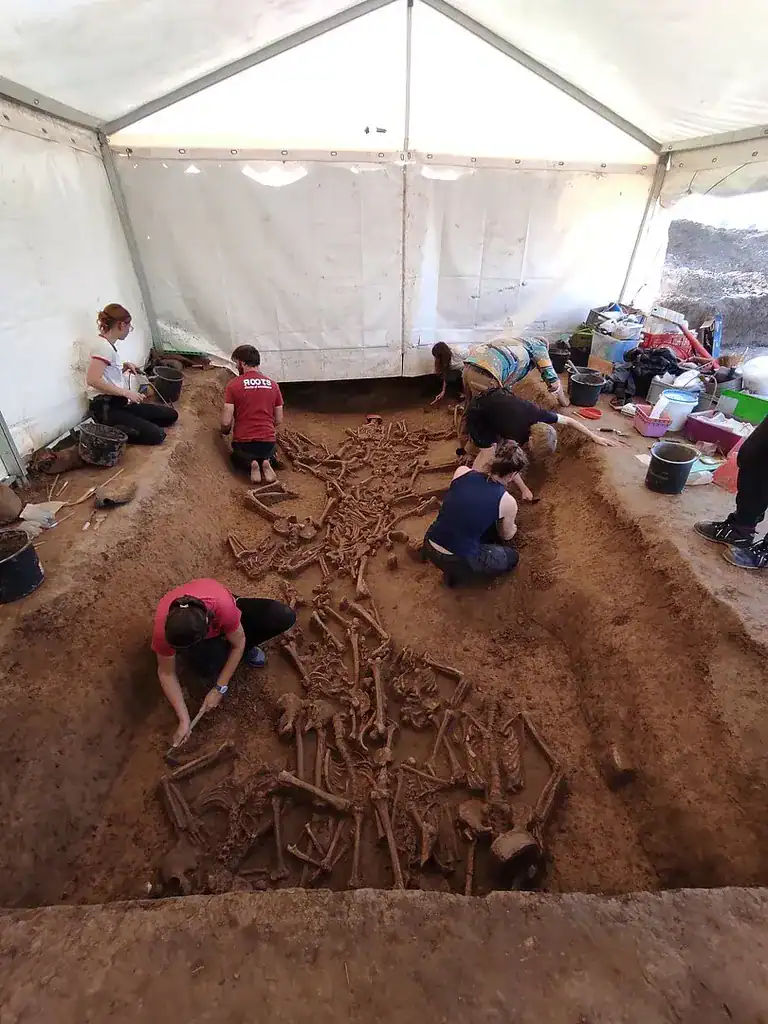 Archaeologists at the excavation site. Credit: Katharina Fuchs
The bodies lay in that enclosure, mostly near an entrance. By 2024, excavations had revealed at least 77 headless skeletons and one complete skeleton—a child—in the main deposit, with more of the ditch still unexcavated. The study notes that the skeletons were prone, supine, or twisted, with limbs folded, splayed, or trapped beneath other bodies.
There were no clear grave goods, although a few objects lay among the bones. These included potsherds, flint and obsidian tools, pebbles, a bone needle, grinding-stone pieces, one stone axe head, and five perforated teeth, four of them human.
Surgical Cuts
So, were these people killed and beheaded?
The researchers are cautious. Although they have not ruled out death by violence, this is not their main hypothesis.
“The features clearly exhibit an intentional manipulation of the bodies,” Dr. Katharina Fuchs, a biological anthropologist at Kiel University, said in a statement. “First analyses suggest, above all, that violent ‘decapitations’ were not conducted here, but rather skillful removals of the skulls.”
 Examples of different treatments and states of preservation of human remains at Vráble-Veľké Lehemby. Credit: Proceedings of the Prehistoric Society
Cut marks on neck vertebrae suggest sharp tools sliced away the heads rather than blunt force chopping them off. Many neck bones still lined up correctly, and hands and feet often remained intact—signs that people placed the bodies in the ditch before decomposition had advanced. Some upper neck bones rested against the ditch wall, which suggests people placed at least some bodies there only after removing the heads.
The lower jaws were also mostly missing.
Forgotten Rituals
Archaeologists have found skull rituals across the Neolithic world. In parts of the Near East, communities removed skulls, plastered faces over them and displayed them. At Çatalhöyük in Turkey, researchers have documented careful skull retrieval and reburial. The Vráble team points out that the Slovakian site fits into this broad burial pattern, with the important distinction that the missing heads haven’t been found elsewhere.
“The deposition of bodies and body parts may have been part of more complex, meaningful and recurring practices,” Nils Müller-Scheeßel, an archaeologist at Kiel University, said in a statement.
The ditch at Vráble held regular burials, pairs of headless skeletons and the large mass deposit. The study argues that this variety points to an “array of meaningful practices” along the enclosure, rather than one episode with one explanation. Only one of the three neighborhoods had the ditch, and its entrances faced away from the other two.
Future DNA, isotope and forensic studies may reveal whether the dead were locals or outsiders, relatives or strangers, victims or honored ancestors.
The study was published in the journal Proceedings of the Prehistoric Society.