
US atmospheric chemist Susan Solomon was named the winner of the Tang Prize in Sustainable Development today for her discoveries in atmospheric science and climate research that have helped shape environmental policies worldwide.
Solomon was awarded for her “groundbreaking advances and leadership in atmospheric and climate sciences that shaped global policy for Sustainable Development,” Liu Chao-Han (劉兆漢), chair of the Tang Prize Selection Committee for Sustainable Development, said at a news conference in Taipei.
Solomon is set to receive NT$50 million (US$1.58 million) for winning the honor, including NT$40 million in prize money and a NT$10 million research grant, the Tang Prize Foundation said.
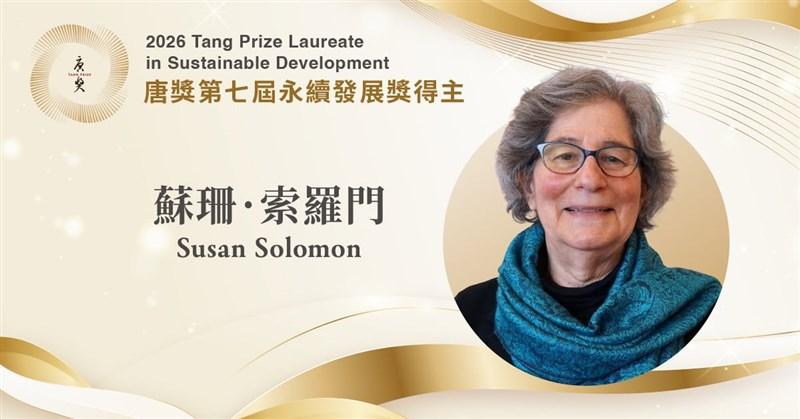
Photo: Screen grab from the Tang Prize’s Facebook page
Launched in 2012 by late Taiwanese entrepreneur Samuel Yin (尹衍樑), the Tang Prize recognizes individuals whose achievements have made exceptional contributions in the fields of sustainable development, biopharmaceutical science, sinology and the rule of law.
Solomon played a key role in pioneering research in the 1980s that identified the role of chlorofluorocarbons (CFCs) in the depletion of the ozone layer over Antarctica.
Her work linked chemical reactions occurring on polar stratospheric clouds to ozone depletion, providing crucial insight into the processes behind the Antarctic ozone hole.
The findings laid the scientific foundation for the Montreal Protocol, the landmark international treaty that phased out ozone-depleting substances, including CFCs.
In 2009, Solomon made another major contribution to climate science by showing that some effects of climate change caused by carbon dioxide emissions could persist for about 1,000 years after emissions cease.
Her research found that while atmospheric carbon dioxide levels gradually decline after emissions stop, the resulting reduction in radiative forcing is largely offset by the slow release of heat from the oceans, causing global temperatures to remain elevated for centuries.
The findings helped policymakers better understand the long-term consequences of greenhouse gas emissions and underscored the urgency of mitigation efforts.
In 2016, Solomon and her team at the Massachusetts Institute of Technology (MIT) presented evidence that the Antarctic ozone hole was showing signs of recovery, demonstrating that international efforts to curb CFC emissions were producing measurable results.
Solomon joined MIT in 2012 and now serves as the Lee and Geraldine Martin Professor of Environmental Studies and Chemistry. She also chairs MIT’s Program in Atmospheres, Oceans and Climate.
From 2002 to 2008, Solomon served as co-chair of Working Group I of the Intergovernmental Panel on Climate Change’s (IPCC) Fourth Assessment Report. The IPCC was awarded the Nobel Peace Prize in 2007, jointly with former US Vice President Al Gore.
Before joining MIT, Solomon worked at the National Oceanic and Atmospheric Administration from 1981 to 2011.