
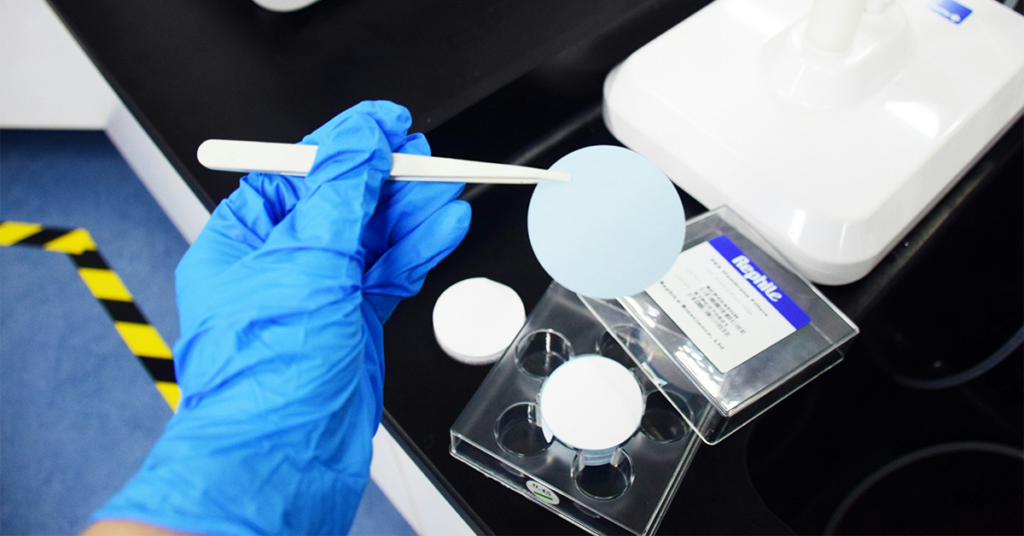
Have you ever heard the claim that the average person eats a credit card’s worth of plastic every single week? Well, turns out that popular statistic, based on the high-end numbers of a 2019 study, is probably wildly wrong because scientists have overlooked a “surprising source” of sample contamination that’s “led to wildly exaggerated results”: standard plastic gloves. But what does this have to do with creation?
According to a popular science article,
Scientists may have been unknowingly inflating microplastics pollution estimates, and the surprising source could be their own lab gloves. A University of Michigan study found that common nitrile and latex gloves release tiny particles called stearates, which closely resemble microplastics and can contaminate samples during testing. In some cases, this led to wildly exaggerated results, forcing researchers to track down the unexpected culprit.
Researchers will now need to revisit old datasets, using a new technique to separate out contamination from the real microplastics, to find the true quantity of microplastics. Now for the creation connection!
The grad student who made a surprising discovery using testable, observable, and repeatable science (what we call observational science) showed how the microplastics research field was getting it completely wrong. Her new research, based on experimentation in the present, calls into question much of the previous research done on this particular topic. So what happens when scientists are wrong about something they can’t test?
The only way to ensure you have the right worldview for interpreting the evidence is to start with a perfect eyewitness account.
When it comes to answering questions about the past, we can’t do direct experiments in the same way because we’re dealing with history—it’s gone—all we have is the present. This historical science is not directly testable, observable, or repeatable (like the origins issue as that concerns the past). Rather, it’s interpretations of the evidence in the present, trying to make sense of what happened in the past. And interpretation requires a worldview (yes, everyone has a worldview!).
The only way to ensure you have the right worldview for interpreting the evidence is to start with a perfect eyewitness account. And the only perfect eyewitness account is found in God’s Word.
If we want to be sure we have the right framework for interpreting the evidence and we aren’t missing anything that would totally change our interpretations of the present—like a global flood, a young earth, or a perfect creation marred by sin—we must start with Scripture!
Oh—and yes, evolutionists have had a massive number of wrong interpretations, and will continue to do so, as their worldview is based on fallible man’s word.
Thanks for stopping by and thanks for praying,
Ken
This item was written with the assistance of AiG’s research team.