
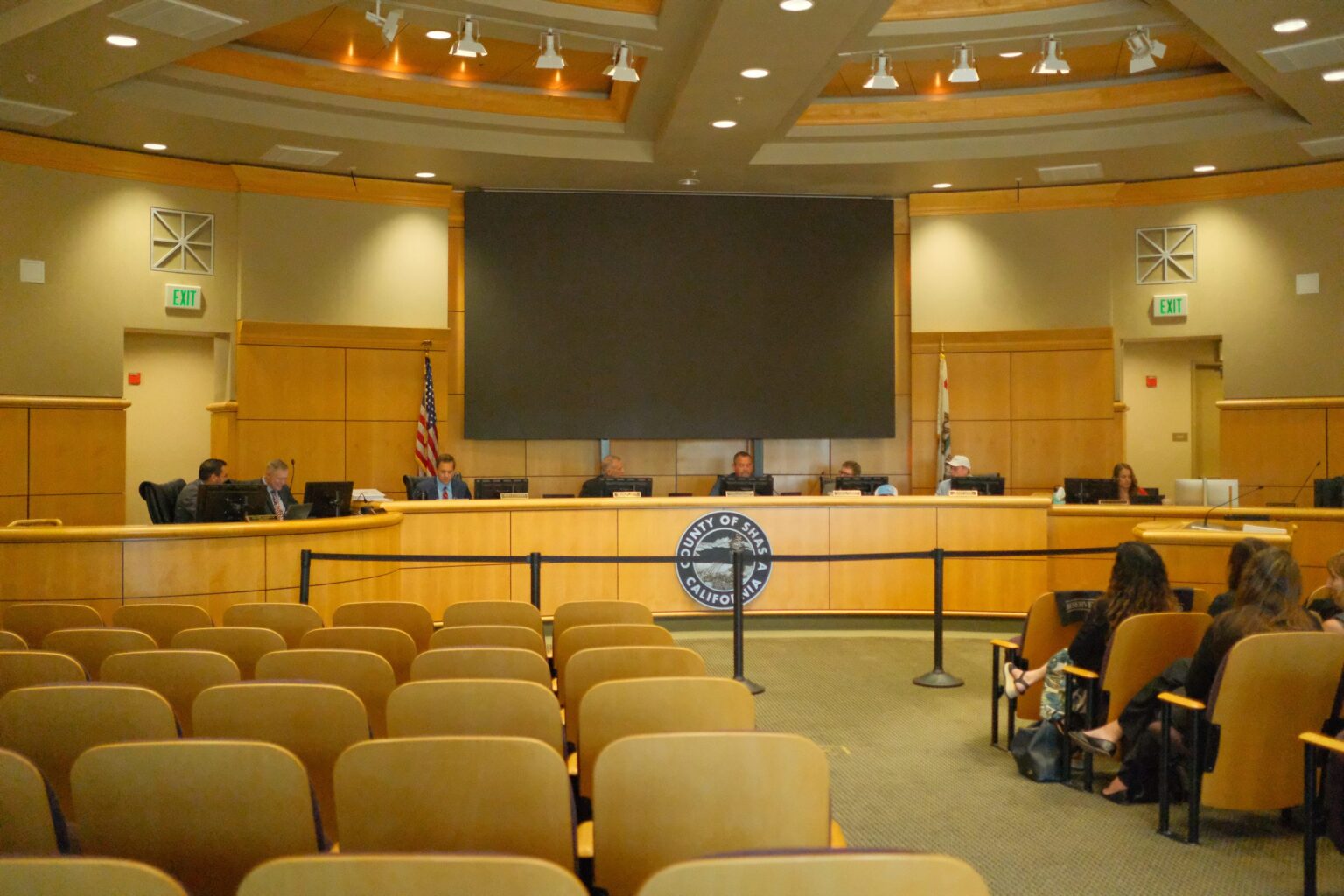
 The Shasta County Board of Supervisors. Photo by Moe Shimizu
District 4 Supervisor Matt Plummer wants to make Shasta County “the most AI-literate community in California.”
Last Monday, he and his fellow supervisors discussed a draft resolution designed to guide the integration of artificial intelligence into county departments.
The resolution called for the Shasta County Board of Supervisors’ support of “the responsible and strategic use of artificial intelligence to enhance public services, support an understaffed workforce, and promote long-term fiscal sustainability.” It also emphasized the need for “maintaining strong ethical safeguards, privacy protocols, and human oversight.”
“This is a first step to say we want to be looking towards ways to use [AI] effectively,” Plummer said in the meeting, “but we also want to make sure that the human is the one making the decision, that people’s data is protected, that we’re being transparent when we are using this.”
The board didn’t pass the resolution last week, citing the need to bring the county’s information officer into the conversation. It’s returning to the board tomorrow for a second look.
Since the beginning of his term in 2025, Plummer has been a vocal advocate for the implementation of AI in Shasta County. Last year, he also began an informal group which he calls the Shasta County AI Task Force. That group, he said during an interview, is separate from his board initiatives.
The task force, Plummer told Shasta Scout, includes around six representatives from across different fields in Shasta, including the Redding Chamber of Commerce, the Shasta Economic Development Corporation, and the Shasta Union High School District. The group discusses ideas he hopes will increase transparency and decrease workload for county workers, such as using AI to streamline the permitting and planning process, and pushing out AI-generated summaries right after board meetings.
Some community members aren’t convinced.
Plummer’s videos about the task force have garnered some pushback online, including a comment on Facebook that declared “we do NOT want AI replacing our human workforce, invading our privacy, or any Data Centers development.” Recently, commenters on a Redding Reddit thread that cited Plummer’s social media speculated about potential development of an AI data center in Redding, leading to outrage from some community members.
Plummer dispelled the data center speculation last week, clarifying for a reporter that “I’ve not heard of any company proposing to build a data center, or any kind of interest in that.”
He does hope to formalize AI use in the county. However, Shasta hasn’t initiated any official directives on AI thus far.
Last December, Plummer pushed out a motion to extend a loan of general funds to the county’s Health and Human Services Agency, including a directive to encourage staff to “pursue conversations with artificial intelligence developers for potential cost reductions.”
The motion did not receive a board majority, primarily due to disagreement between Plummer and the majority of supervisors about what month the loan should be extended til. District 2 Supervisor Allen Long and District 5 Supervisor Chris Kelstrom said during the discussion they didn’t want to “micromanage” the agency by officially encouraging use of AI solutions.
While last week’s AI resolution has yet to be voted on, it may be a turning point.
The board generally showed agreement with the direction of Plummer’s resolution, though the vote was pushed back after District 1 Supervisor Kevin Crye said he felt that discussion with Shasta County’s Chief Information Officer Thomas Schreiber would be necessary for supervisors to make an informed decision, something Chair Kelstrom agreed with. The board voted to discuss the resolution again at an upcoming meeting and it’s since been scheduled for tomorrow.
It turns out artificial intelligence is already being used in county departments on a “case by case basis,” something Long noted during last Tuesday’s meeting.
While Schreiber did not respond to multiple requests for comment, Plummer confirmed that to his understanding, county employees are permitted to use AI programs such as ChatGPT and Claude on their individual work browsers as long as confidential information is not uploaded, and AI is not connected to other applications.
The county’s current lack of guidelines, Plummer noted, is exactly what he hopes to change. He said that he is already working with Schreiber and the County Administrative Office to produce more specific policies by the end of the summer, if supervisors support the resolution he’s already brought forward.
“It would be much more tactical,” Plummer said of the kind of policy he envisions for the county. “Like, which tools can you use if you want to use a new AI tool? What’s the process for having that reviewed, and who has to be involved with that? How can you use them in what scenarios?”
When asked about how he would address safety and ethics concerns, Plummer said that he envisioned the county implementing AI in two potential ways. The first would be to work with a program that would provide a specific use for a specific department. He cited the example of LexisNexis, a research service which is already being used by county attorneys to search for past lawsuits.
The second way he sees AI potentially being implemented, Plummer said, is by the county working with a vendor that would “build an AI-powered solution embedded within the county IT infrastructure.” Such an approach, he said, would ensure that the data the AI used to build its insights would be controlled and contained by the county.
The discussion of AI use comes as the county sees an ongoing shortage of funds and employees in many county departments, with the District Attorney’s Office and Public Defender’s Office as well as HHSA being primary examples.
During last week’s budget meetings, the board passed funding for the DA’s office to “expand the use of AI technology.” As described by District Attorney Stephanie Bridgett, funding will allow for the implementation of Axon’s AI extension. The program, she explained, would analyze the footage and rapidly search it for relevant data as a way to increase efficiency within the department.
The extension wasn’t discussed in detail as the board’s focus remained on budget. Specifics weren’t provided on what kinds of privacy measures would be implemented within the program to safeguard community members whose images appear on body cams.
Asked how confident he feels about gaining a majority of the board’s agreement on an AI resolution at tomorrow’s meeting, Plummer sounded hopeful.
“Even in the budget hearings and meetings over the course of the last few days, I’m hearing other board members mention it and raise it to department heads,” Plummer said. “I think the conversation is moving more favorably.”
Do you have a correction to share? Email us: editor@shastascout.org