
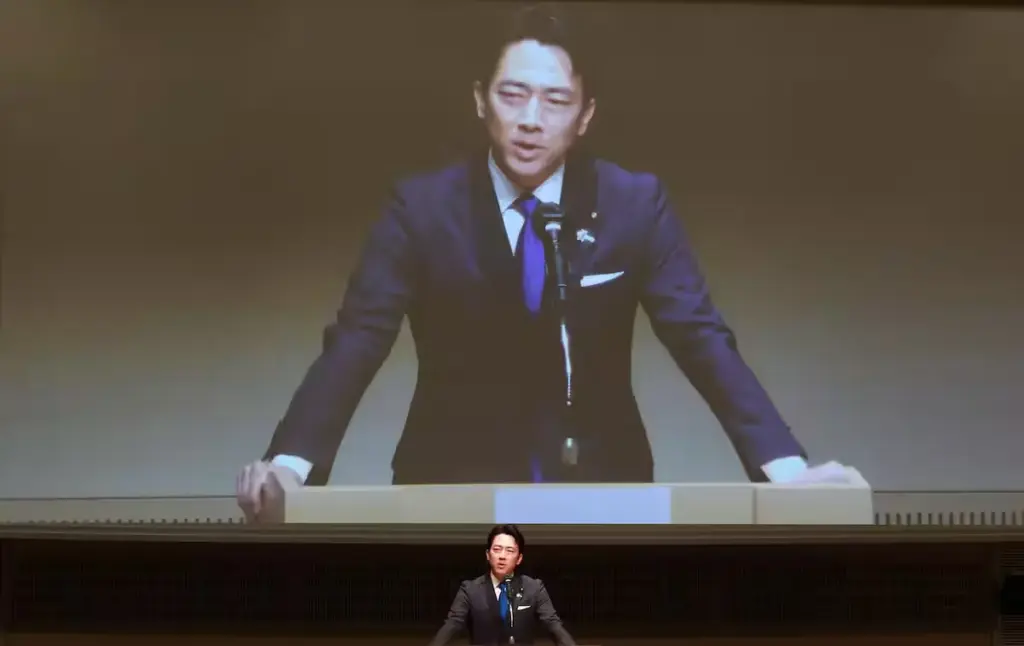
On June 14, Japan’s Defense Minister Shinjiro Koizumi delivered a keynote address at a forum held at the Otemachi Sankei Plaza in Tokyo. He warned that Japan had become “overly optimized for peacetime” across all sectors and said that overcoming this challenge was a major task amid rising geopolitical tensions.
Excerpts from the speech follow.
We have entered an era in which major changes can occur rapidly through top-down decision-making. At the Asia Security Summit (Shangri-La Dialogue) held in Singapore in May, I asked US Defense Secretary Pete Hegseth whether he could provide a message of reassurance, as it cannot be denied that some countries remain concerned about whether the United States will maintain its engagement in the region. It was important for many people to hear and share in the confidence that America’s commitment remains unwavering.
Especially now, there are people across television, newspapers, radio, and the internet who seek to spread skepticism about whether the United States will continue its involvement. It is obvious who benefits as this skepticism continues to spread. What Japan can do now is help prevent gaps from emerging [among like-minded nations].
Building a More Resilient Japan
Unfortunately, the security environment we face today is less than ideal. The challenge is how to make sustained and effective efforts to create a more stable and secure environment. This applies not only to security but also to areas such as the economy, food security, and energy security. We must take a comprehensive look at Japan’s vulnerabilities and systematically transform each of them into a source of resilience. That is what it means to transform our national security strategy.
A desirable security environment is one in which Japan’s sovereignty and independence are maintained, and the lives and peaceful livelihoods of its people are securely protected from threats.
First, unilateral attempts to change the status quo by force must be deterred in this region. Second, peace and stability must be maintained across the Indo-Pacific through greater resilience to crises. Third, the free and open international order based on the rule of law must be strengthened. Fourth, the international community must be able to coexist and prosper without falling deeper into confrontation and division. These are the conditions for a desirable security environment.
Given that the security environment has deteriorated in a way that threatens the Free and Open Indo-Pacific, we are reminded of how precious the postwar peace Japan has enjoyed truly is. Japan, the region, and the world now share a strong interest in protecting it.
Self-Reliance and Preparedness
Just as Fukuzawa Yukichi believed that Japan should be a nation in which every individual possesses a spirit of independence and self-respect, what we value most today is that same spirit. We must protect our country ourselves. That is what we must pursue most seriously.
What Japan must consider is preparing for worst-case scenarios. At the very least, such a perspective is required of the Minister of Defense when formulating policy. The same applies to the entire government.
What I feel across all areas today is that Japan has become overly optimized for peacetime. When countries around the world think about security, they do not base their thinking on peacetime—they prepare for contingencies. That is only natural.
We must confront the major challenge of how to transform systems that are overly optimized for peacetime. Some people may take peace for granted, but behind that sense of “normality” lie the tireless efforts of the Japan Self-Defense Forces.
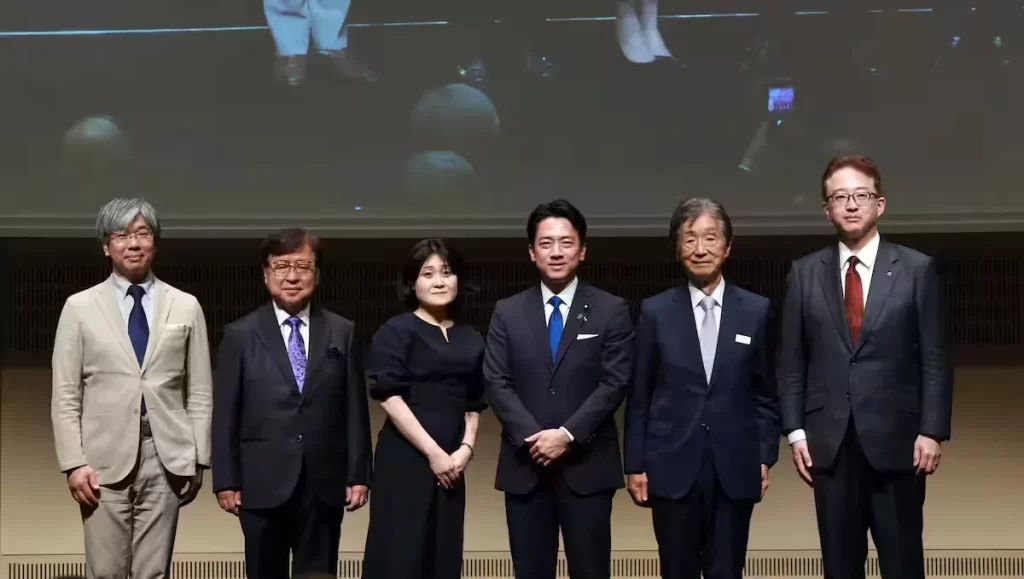 Defense Minister Shinjiro Koizumi (fourth from left) poses with participants at the forum in Chiyoda Ward, Tokyo, on June 14. (©Sankei/Hideyuki Matsui)

National Resolve and Deterrence
Democracy requires accountability to the public. Compared with non-democratic countries, decision-making may be slower. Non-democratic states do not need to explain themselves to their citizens; they hold no press conferences and face no parliamentary questioning.
In the process of transforming our security strategy, this is something I have repeatedly emphasized within the government. Even with the most advanced technologies, including artificial intelligence, we risk becoming overly optimistic in our assumptions unless we take into account the differences in decision-making speed and dynamism that arise from different political systems.
At the same time, we must never lose hope. As a democratic nation, Japan must clearly demonstrate the strength of public support to the outside world. Deterrence comes from not allowing hostile countries to believe that “now might be the time to act.” This does not depend solely on the amount of equipment possessed by the Self-Defense Forces or the government.
The Japanese people are unwavering. Because we share a strong awareness of these challenges and are a nation that understands the value of peace better than any other, we will never allow a new war to occur. This firm and unwavering resolve is shared by the people of Japan. That is Japan’s strength, and it is something we can project internationally precisely because we are a democratic nation.
In revising the Three Security Documents, including the National Security Strategy formulated in December 2022, the aim is to respond to new ways of warfare by developing new ways of defense. Through this effort, Japan intends to continue proactively building a peaceful nation and a peaceful Indo-Pacific region.
RELATED:
(Read the article in Japanese.)
Speech by Defense Minister Shinjiro Koizumi
Continue Reading