

Despite the fact that the Hungarian left has won an election this April largely built on a narrative of Hungary being the poorest country in Europe and economic stagnation, the official data show a very different picture. The average gross earnings were 9.0 percent higher, the average net earnings were 11.2 percent higher, and real earnings were 8.9 percent higher than a year earlier, the Central Statistical Office (KSH) reported.
In April, the average gross earnings for full-time employees were 772,200 forints (EUR 2200), while the average net earnings were 541,200 forints (EUR 1540). The median gross income reached 616,000 forints (EUR 1760), while the median net income reached 436,400 (EUR 1240) forints—up 9.1 percent and 11.1 percent, respectively, from April of last year.
The increase in average net earnings was significantly influenced by the higher family tax credits introduced by the Orbán government on July 1, 2025, and January 1, 2026, as well as the tax credits for mothers raising three children introduced on October 1, 2025, October 1, 2025, for mothers raising three children, as well as the personal income tax exemption for mothers under 40 raising two children, effective January 1, 2026, and the expansion of tax credits for mothers under 30—as highlighted in the KSH report.
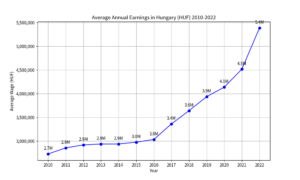
The growth of average income since the start of the Orbán government in 2010 until 2022. In 2025 the annual gross earnings of a full-time employee was cc. 8.5 million forints.
The average gross regular earnings (excluding bonuses, rewards, and one-time monthly allowances) were 711,400 forints, which is 8.4 percent higher than in the same period of the previous year. The average gross regular earnings were 705,000 forints in the private sector, 720,200 forints in the public sector, and 747,000 forints in the nonprofit sector, representing increases of 8.0 percent, 9.8 percent, and 7.9 percent, respectively, over the course of a year.
Not surprisingly, bankers and business people have done much better that the average earner. In the finance and insurance sector, the average gross monthly wage in April was 1,419,100 forints, while in the accommodation and food services sector, it was 491,000 forints. In the mining sector, gross earnings rose by 22.8 percent to 961,500 forints, while in the electricity, gas, steam, and air conditioning sector, gross earnings fell by 1.0 percent compared to April of last year but still reached nearly 1.1 million forints.

Via Mandiner, Featured Image: Pixabay