
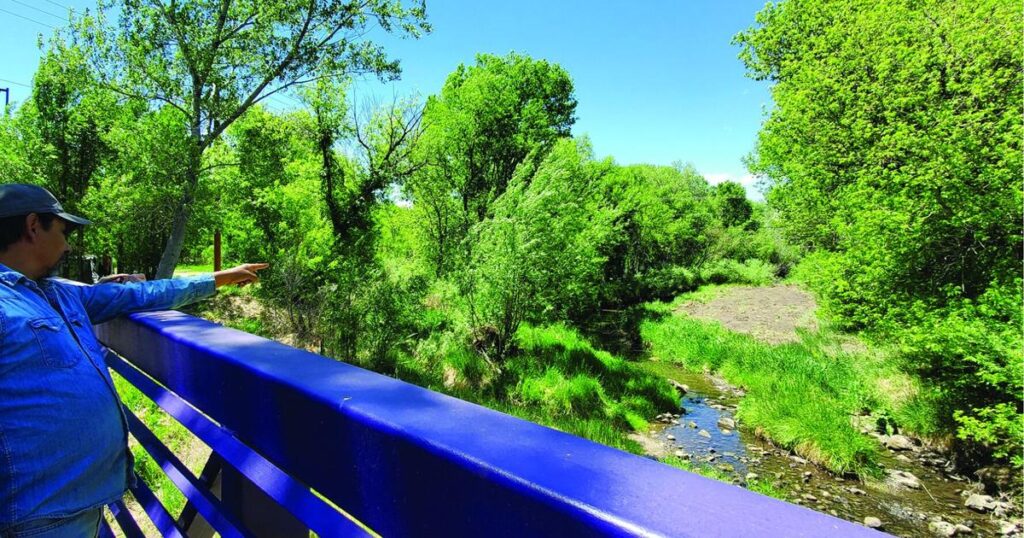

Dr. Edward Martinez, deputy director of the New Mexico Forest and Watershed Restoration Institute, points out areas of the Gallinas River on May 19.
Vanessa Maciel/Optic photo
A city project meant to make the Gallinas River safer has exposed opposing points of view on what is the best way to manage the stream.
City officials hope that the Gallinas River debris removal project – a FEMA-funded endeavor that kicked off in mid-April and is expected to continue for a few more weeks – will decrease the effects of flooding and discourage vagrants settling around the river. The scope of the project consists of debris and sediment removal in the outer banks of the Gallinas River, between Mills Avenue and Grand Avenue.
Project contractors have removed vegetation around the river and, starting on Wednesday, are removing sediment and ash deposits “resulting from previous flooding and wildfire events,” according to a press release.
However, those involved with agencies that work toward protecting the river worry that the debris removal project may hurt its ecosystem. Leadership with the Hermits Peak Watershed Alliance and the New Mexico Forest and Watershed Restoration Institute also dispute the city’s claim that they were contacted before the project began.
In a press release from the city published April 17 in The Optic, the city claims that the HPWA and the NMFWRI “were included in discussions to provide input, concerns and feedback during project planning.”
“That sentence is not accurate,” said Lea Knutson, founder and executive director of the HPWA. “We were not involved in the planning. … We were only informed about it after the plans were developed.”
Knutson said she was informed of the work to be done during a meeting with city officials on April 7, after plans for the debris removal project were already underway.
Knutson said she would have given very different input on how the debris removal project was conducted if given the opportunity to do so. Knutson and Dr. Edward Martinez, deputy director of the NMFWRI, said that removing vegetation around the Gallinas River and compacting the soil in its banks through the use of heavy machinery can damage the river’s ecosystem.
Dr. Michael Remke, Department chair of the forestry department at New Mexico Highlands University, said that when he saw the work that was being done on the Gallinas River he was “horrified.”
“Once I saw the work they had begun implementing I was pretty horrified by the ecological implications,” Remke said. This included heavy equipment tracks in the mud, soil compaction, and wounds on residual trees that were left behind.
“I was concerned about the health and the longevity of the ecosystem,” he said, noting that birds that called the river ecosystem home may have been disrupted when the trees were removed. Also, Remke said, he lives in the floodplain and said he is concerned about the removal of so much vegetation going into the summer, as it might have the effect of leaving the floodplain vulnerable.
“This is the opposite of flood risk reduction,” Remke said. “This is exacerbating flood risk. I was pretty horrified when I saw the results.”
Remke said he often walks, runs or rides his bicycle along the river trail. He said he appreciates that the city “is taking initiative,” but also wishes that the community could give input to the city’s ideas and projects.
“A lot of us love and cherish the Gallinas,” he said. “It would be wonderful to see opportunities for us to come together and create a shared community vision for what we want that space to be and how to navigate the challenges of the post-fire flooding and whatever aspects the city’s hoping to address with this project.”
Arnold Lopez, public works director for the city, said that he has met with the HPWA and the NMFWRI on several occasions, during which Knutson explained the need for certain vegetation around the river, and how the river environment can be kept healthy.
“I was disappointed in myself that I didn’t know some of those things,” Lopez said of his discussions with Knutson.
The city focuses on flood mitigation, public safety
City officials have said that removing debris and vegetation from around the Gallinas River has helped reduce the chance of flooding as well as cleared up homeless camps from around the stream.
“One of the main goals of the city is to promote the safety and wellbeing of its residents,” said Lopez during a telephone interview with The Optic on Monday. He said the cleanup effort has made it possible for people to enjoy the riverwalk. It has also discouraged homeless people from setting up camp in the area as it is a “wide open area” now, Lopez said.
“Before, (the homeless) would move into heavily vegetated areas and set up a camp,” Lopez said on Monday. “Now that it’s wide open, (the homeless) don’t congregate in those wide open areas because now they’re visible. They don’t like their camps to be visible of course.”
During a press conference on May 20 organized by the city to discuss the debris removal project, Mayor David Romero acknowledged the concern about how the project was moving forward.
“Sometimes, I think we forget the reasons why we need to clean this riverwalk,” Romero said. He mentioned the debris that is a result of the Hermits Peak/Calf Canyon Fire. He also said that both Storrie and McCalister lakes are almost at capacity, and potential summer monsoons may increase the chances of flooding.
The Gallinas River debris removal project is a FEMA-funded disaster recovery project, said Deb Sulzer, CEO and founder of the Sulzer Group, during the press conference. The emergency management company that was retained by the city to help develop federal disaster claims.
“That fire devastated the upper Gallinas watershed and left behind enormous volumes of ash, sediment and woody debris that every storm event has been pushing down towards the community,” Sulzer said.
“The community has already seen what that means,” Sulzer said. “In June 2024, ash and soot from the burn scar contaminated the reservoir and put the city’s water supply into crisis.”
Sulzer said that post-fire sediment and debris in the river reduces its capacity to carry water during a storm.
“A channel that is full of sediment cannot hold the same volume of water that the same channel can hold when it’s clear,” she said. Aside from contaminating the city’s water supply, the flooding of the Gallinas River also puts everything near it at risk, Sulzer noted.
“The Gallinas runs through the city, bridges cross it, roads parallel it, homes sit alongside it and parks and recreation areas are built around it,” she said.
While the Sulzer Group helped the city secure federal funding for the project, Cordova Construction has led field operations and Goodwyn Mills Cawood has provided monitoring of the project.
During a telephone interview with The Optic, Lopez said it is difficult to estimate how much the project will cost. While the city had initially estimated that 10,000 cubic yards of sediment and debris would have to be removed, Lopez said “we’re not going to hit that amount.” He said the project may clear up about 6,000 cubic yards of sediment and debris at a cost of $79.50 per cubic yard, plus tipping fees. He said that “when it is all said and done” the project may cost close to $1.5 million, which includes cleanup and restoration tasks he has since discussed with Knutson.
Lopez acknowledged the contention created by the project, stating that he has heard from members of the community who are for and against it.
“There’s comments both ways, but there’s more positive than negative,” Lopez said. “Some people didn’t care for the removals and the cleanup effort, and some people are really appreciative and excited about how the river looks and how safe it is to walk it now.”
Overall, Lopez said, the debris removal project “has been a great effort … a great improvement for the area.”
“We accomplished what we needed to,” he said.
‘Two very different points of view’
Martinez, like Knutson, said he was not consulted by the city prior to the start of the debris removal project. However, he has met with city officials – including Lopez as well as City Manager Robert Anaya – starting in April.
“I kind of tried to educate them on what a healthy system looks like and why vegetation … is important,” Martinez said.
Martinez said that while it may be more desirable to have open space near the river, the removal of vegetation does not provide stability to the river bank. He said vegetation is needed in order to keep shade over water. He said that shade over the water helps keep it cool – which is necessary for the river’s trout to survive.
While warm water is not ideal for trout, it also releases oxygen, Martinez said. The warmer the water gets the less oxygen it can withhold. Trout also need high concentrations of oxygen to survive, Martinez said.
Martinez also noted that a lack of vegetation around the river may increase runoff going into the river.
“You want to minimize the ability for runoff to erode your banks,” Martinez said. “How do you do that? By keeping vegetation.”
“I fully realize that I approach this from the point of view of a healthy system, from the point of view of a healthy stream or what is needed to have a healthy stream,” Martinez said. “I know that the city approaches this from the point of view of what is safe for the community and what reduces flooding risk.”
“It’s two very different points of view,” Martinez continued. “Somewhere I think there’s a middle ground. … I think we’re really looking for what might be that middle ground. In terms of what’s healthy for a system and what is safe for the community.”
Knutson said that the HPWA has worked with the city to improve the Gallinas River in the past – and even had an MOU with the city towards this end.
The project, called “Rewinding the Gallinas,” began in 2017 and fizzled out during the Hermits Peak/Calf Canyon Fire of 2022. Knutson said it led to the creation of at least rainwater gardens – all located at West Las Vegas High School – as well as stormwater retention basins.
At that time, the HPWA created a “big open wetland” near Independence Avenue, which involved clearing out cattails and routing the Gallinas River so that it would provide water to the area. Knutson said that ducks, black-crowned night heron and even beaver called the pond home before the Hermits Peak/Calf Canyon Fire filled it with sediment and ash.
Now that discussions are taking place between the HPWA and the city, Knutson said she hopes to reestablish the work that was previously done on the Gallinas River and clear out the pond again.
Lopez said he also hopes to reestablish the MOU.
“The city is interested,” he said.
Martinez said he does not believe that actions the city may have done to hurt the river’s ecosystem were intentional.
“I think it was just a learning experience for all of us,” Martinez said of the situation created by the debris removal project.
“I think we’re on the same page about trying to do what’s good for the community and good for the river.”